How Much Is the Average Car Accident Settlement in the USA?
A car accident can turn your life upside down in seconds. Medical bills start piling up, insurance companies begin asking questions, and you may be unable to work. Many people facing these challenges ask the same question:
How much is my car accident settlement worth?
The truth is that averages only tell part of the story. Some accident claims settle for around $10,000, while severe injury cases can exceed $1,000,000. Insurance companies evaluate several factors before offering compensation:
- Medical expenses
- Liability (who was at fault)
- Severity of injuries
- Insurance coverage limits
- Long-term disability or lost wages
Understanding these elements is important because insurance adjusters routinely offer less than claims are worth. This guide explains:
- How car accident settlements are calculated
- Average payout ranges by injury type and accident type
- The factors that raise or lower your settlement
- How to estimate your own claim and maximize your payout
By the end of this article, you will have a clear understanding of what your claim could be worth and how to avoid leaving money on the table.
The Anatomy of a Car Accident Settlement
Every car accident settlement consists of multiple components. Understanding the difference between them is critical, because each is valued differently.
Economic Damages
Economic damages represent measurable financial losses. These losses can be easily documented using receipts, bills, and pay records. Common examples include:
- Emergency room bills
- Surgeries and follow-up care
- Physical therapy and rehabilitation
- Lost wages and reduced earning capacity
- Vehicle repair or replacement costs
For example, if an injury prevents someone from returning to their job for three months, their lost income is added to the claim as economic damages. Insurance companies carefully review these financial records when calculating offers – which is why documentation is everything.
Non-Economic Damages
Non-economic damages compensate accident victims for pain and suffering that cannot be measured with receipts. These damages include:
- Pain and suffering
- Emotional distress and anxiety
- Loss of enjoyment of life
- Permanent scarring or disfigurement
Insurance companies often calculate these damages using the multiplier method: economic damages multiplied by a factor of 1.5 to 5. More severe injuries generally result in a higher multiplier.
Damage Comparison Table
| Damage Type | Description | Examples |
|---|---|---|
| Economic | Financial losses | Medical bills, lost wages, vehicle repairs |
| Non-Economic | Emotional and physical suffering | Pain, trauma, loss of enjoyment of life |
Average Car Accident Settlement Amounts by Injury Type
Car accident settlements vary widely depending on the seriousness of injuries. Below is a general overview of typical settlement ranges in the USA:
| Injury Type | Average Settlement |
|---|---|
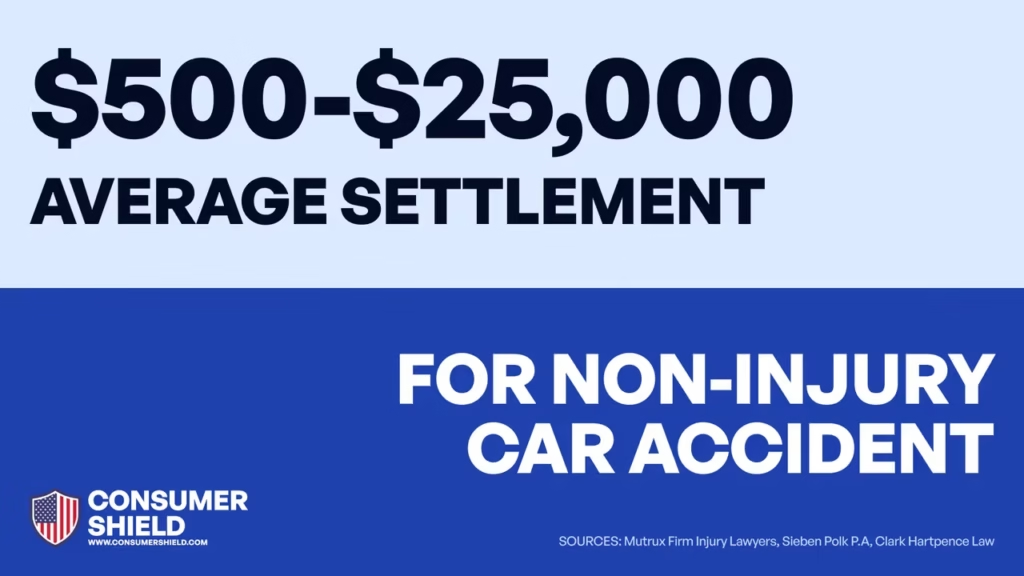
| Minor injuries | $10,000 – $25,000 |
| Moderate injuries | $25,000 – $100,000 |
| Severe injuries | $100,000 – $500,000 |
| Catastrophic injuries | $500,000 – $2,000,000+ |
These figures represent national averages compiled from reported settlements and verdicts and should not be interpreted as guarantees. Individual outcomes depend on fault, evidence, insurance limits, and state law.
Minor Injuries
Minor accident injuries often include:
- Whiplash
- Muscle strains and sprains
- Bruising and minor cuts
These injuries may require several weeks of treatment, such as physical therapy or chiropractic care. Typical settlements range between $10,000 and $25,000. Because injuries are minor, multipliers stay low (1.5-2x) and negotiations usually wrap up within a few months.
Moderate Injuries
Moderate injuries often involve:
- Broken bones
- Ligament tears
- Concussions
Victims may require hospital stays, follow-up care, and rehabilitation. Settlement values for these cases commonly fall between $25,000 and $100,000. Clear medical documentation is what separates a $30,000 outcome from an $80,000 one at this level.
Severe or Catastrophic Injuries
Serious accidents may result in:
- Traumatic brain injuries
- Spinal cord damage
- Multiple fractures requiring surgery
- Permanent disability
These injuries may require long-term care, medical equipment, and ongoing therapy. Some catastrophic injury settlements exceed $1,000,000. According to data published by the Insurance Information Institute, severe auto liability claims are among the costliest claims insurers pay each year.
Average Settlements by Accident Type
- Rear-end collision: $10,000-$40,000 for whiplash and soft tissue injuries; clear liability usually means faster payment
- T-bone (side-impact) crash: $40,000-$150,000 for fractures, concussions, and internal injuries
- Head-on collision: $150,000-$1M+ for surgeries, brain injuries, or permanent disability
- Hit-and-run: depends on your uninsured motorist coverage; payouts typically $15,000-$100,000
- Drunk driving crash: often higher due to clear fault and possible punitive damages
- Commercial truck accident: typically larger because of bigger policy limits and more severe injuries
Key Factors That Influence Your Settlement Amount
Several legal and financial factors influence how much compensation an accident victim receives.
Liability (Fault)
Determining fault is one of the most important steps in any accident claim. Many states follow a legal rule known as comparative negligence. Under this rule, compensation is reduced based on the percentage of fault assigned to each party.
Example: If you are 20% responsible for the accident and your total damages are $100,000, you can still recover $80,000. However, a few states bar recovery entirely if you were more than 50% at fault.
Insurance Policy Limits
Even if a case is worth $100,000, the at-fault driver’s insurance may only cover $50,000. This is known as the policy limit – the maximum the insurer will pay. Many drivers carry only minimum coverage, which can significantly reduce your recovery. Your own uninsured/underinsured motorist (UM/UIM) coverage can fill the gap.
Medical Documentation
Proper medical documentation is essential for a strong case. Insurance companies may deny or reduce claims if victims:
- Delay medical treatment
- Skip follow-up appointments
- Have unexplained gaps in care
Consistent medical records demonstrate the seriousness of an injury and directly support higher multipliers.
Location of the Case
Settlement amounts can also vary depending on where the accident occurred. Major metropolitan areas often see higher settlements compared to rural regions. Factors influencing this include:
- Medical costs
- Jury verdict trends
- Local insurance practices
- State damage caps and fault rules
How to Estimate Your Own Settlement
Use this simplified version of the formula attorneys and adjusters apply:
Estimated Settlement = (Medical Bills + Lost Wages + Property Damage) x Pain Multiplier x (1 – Your Fault %)
Worked example:
- Medical bills: $15,000
- Lost wages: $8,000
- Vehicle damage: $7,000
- Economic total: $30,000
- Pain multiplier (moderate injury): 3x = $90,000
- Fault: 0%
Estimated settlement: $120,000
Then check this against the at-fault driver’s policy limit – your practical recovery is the lower of the two numbers. For a more detailed breakdown, use the Car Accident Settlement Calculator.
What Lowers Your Settlement (Avoid These)
- Gaps in treatment: adjusters argue gaps mean you were not really hurt
- Recorded statements: casual comments get twisted to minimize your injuries
- Social media posts: photos of physical activity contradict injury claims
- Settling before maximum medical improvement: future costs get left out
- Missing the statute of limitations: most states allow only 2-3 years to file
Lump Sum vs Structured Settlements
When your claim settles, you may be offered a choice between a lump sum and a structured settlement. A lump sum pays everything at once – giving you immediate control but also immediate tax and budgeting responsibility. A structured settlement pays out in installments over months or years, often funded by an annuity. Structured payouts can provide long-term security for catastrophic injury cases, guarantee income during recovery, and sometimes offer tax advantages. The downside: less flexibility if your needs change. Minors and permanently disabled claimants frequently receive structured settlements ordered by the court. For most moderate claims, a lump sum is simpler and more common. Discuss both options with your attorney before signing – the payment structure you choose affects your financial future as much as the amount itself.
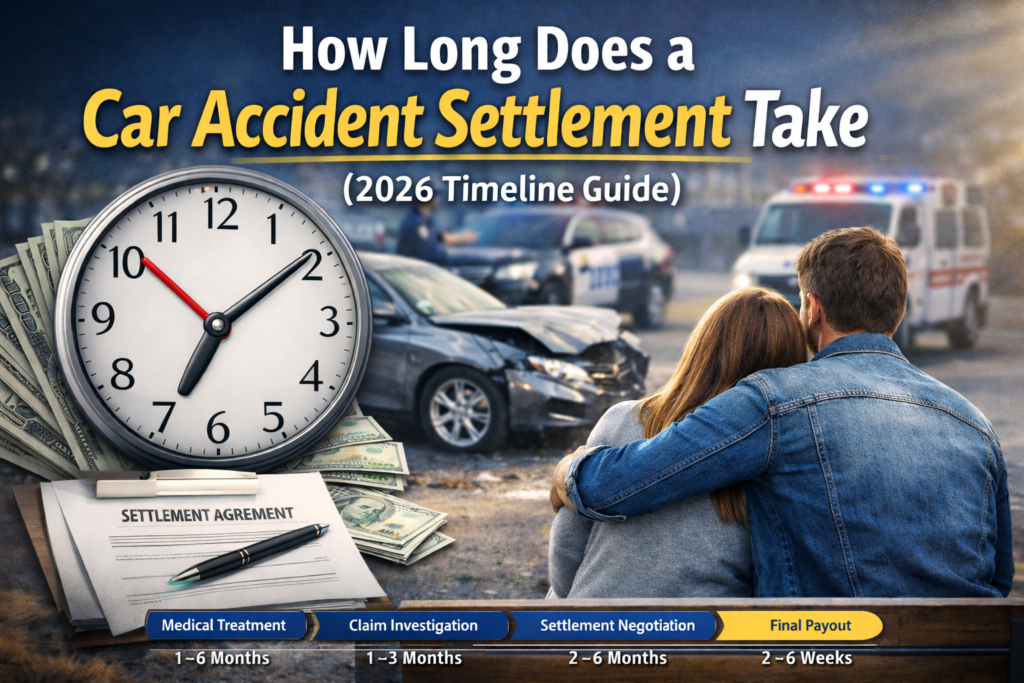
Car Accident Settlement Timeline
Most personal injury claims follow a predictable process:
Step 1: Filing the Insurance Claim
The accident victim reports the incident and files a claim with the at-fault driver’s insurer (and their own, if applicable).
Step 2: Investigation
Insurance adjusters investigate the accident by reviewing:
- Police reports
- Witness statements
- Medical records
- Vehicle damage photos
Step 3: Demand Letter
Once treatment stabilizes, the victim sends a demand letter outlining damages and requesting a specific settlement amount – ideally anchored by a calculated estimate.
Step 4: Negotiation
Insurance companies usually respond with a lower offer, and negotiation begins. Most cases settle in this phase.
Step 5: Lawsuit or Trial
If negotiations fail, the case may proceed to court. However, most personal injury cases settle before trial – the credible threat of litigation is itself powerful leverage.
How to Maximize Your Payout
- Calculate first: know your estimated range before any negotiation
- Document everything: bills, photos, reports, and a daily pain journal
- Never accept the first offer: it is typically 30-50% below fair value
- Be patient: wait until you reach maximum medical improvement
- Get representation for serious injuries: attorneys consistently secure multiples of unrepresented payouts
Related Settlement Tools
Use these alongside the averages above:
- Car Accident Settlement Calculator – estimate your specific claim value
- Personal Injury Settlement Calculator – full injury claim valuation breakdown
- Insurance Settlement Calculator – value any insurance claim
- Lawsuit Settlement Calculator – see how courts value litigated cases
Authoritative Resources
- NHTSA (National Highway Traffic Safety Administration) – official US data on crash injuries, fatalities, and vehicle safety
- Insurance Information Institute (III) – independent research on auto insurance claims and industry trends
Frequently Asked Questions
1. How long does a car accident settlement take?
Most settlements take 3-12 months, depending on injury severity and negotiation complexity. Severe cases involving litigation can take 1-2+ years.
2. Do I need a lawyer for a minor accident?
Minor claims can sometimes be handled independently, but legal representation usually results in significantly higher compensation when injuries are involved. Most personal injury attorneys work on contingency, so there is no upfront cost.
3. Are settlements taxable in the USA?
Generally, compensation for physical injuries is not taxable at the federal level. However, lost wages, punitive damages, and interest on the settlement can be taxable.
4. What happens if the other driver is uninsured?
You may file a claim under your own uninsured/underinsured motorist (UM/UIM) coverage. Check your policy – this coverage is your safety net.
5. Can I reopen a settlement if my injury worsens?
Usually no. Once a settlement agreement is signed, the claim is permanently closed. That is why you should never settle before reaching maximum medical improvement.
6. How is pain and suffering calculated?
Insurance companies often use the multiplier method: economic damages multiplied by 1.5 to 5, based on injury severity, recovery time, and permanency.
7. What is a lowball offer?
A lowball offer is an initial settlement offer significantly below the claim’s fair value. It is a standard opening tactic – insurers expect you to counter, not accept.
8. Does a police report guarantee compensation?
No. Police reports provide evidence but do not determine settlement amounts. Medical documentation and liability proof carry the most weight.
9. Should I settle or go to trial?
Most cases settle outside court, but severe injury claims sometimes achieve higher awards at trial. Trials carry risk and cost – use them as leverage, not a first resort.
10. What is the statute of limitations?
Most states allow 2-3 years from the accident date to file a personal injury lawsuit. Missing the deadline eliminates your right to sue entirely.
Conclusion
Car accident settlements depend on numerous factors, including injury severity, documentation, fault, and insurance limits. While minor claims may settle quickly, severe injury cases often take longer and result in significantly higher compensation.
Understanding how settlement values are calculated can help accident victims avoid lowball offers and negotiate from strength. If you want to estimate your compensation, use the calculators linked above – and remember that averages are a starting point, not a ceiling.
Legal Disclaimer
This article is for informational purposes only and does not constitute legal advice. Settlement amounts vary based on jurisdiction, facts, and evidence. Always consult a licensed attorney in your state before making decisions about your claim.