
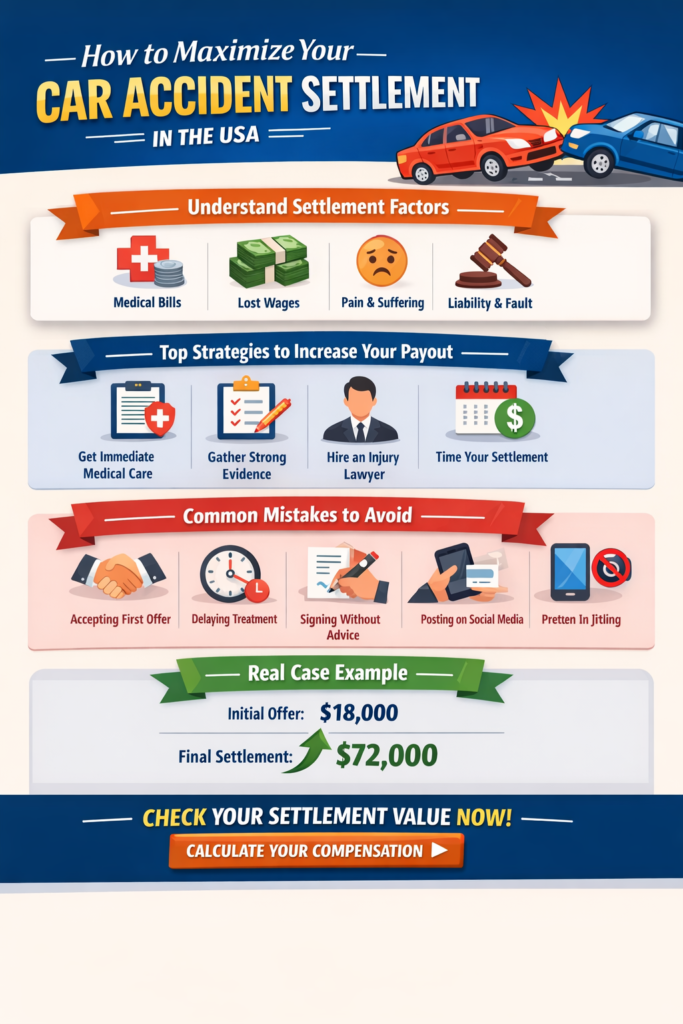
Introduction: Why Most Accident Victims Lose Thousands of Dollars
Every year in the United States, thousands of car accident victims receive settlements. Some walk away with fair compensation, while others unknowingly accept far less than they deserve.
The difference is not luck. It is knowledge.
Insurance companies are highly trained to minimize payouts. Their goal is simple: close your case quickly and pay you as little as possible. If you do not understand how settlements work, you are at a disadvantage from the beginning.
On the other hand, individuals who understand the process, document their case properly, and use the right strategies often receive significantly higher settlements. This 2026 guide walks you through the exact strategies used to maximize a car accident settlement in the USA — from calculating what your claim is really worth to negotiating like a professional.
If you want a quick estimate before reading further, try our car accident settlement calculator to see the average payout range for cases like yours in the USA.
What Determines a Car Accident Settlement in the USA
Several key factors determine how much compensation you can receive. Understanding each one is the first step toward maximizing your payout.
1. Medical Expenses (Economic Damages)
Medical costs form the foundation of your claim. These include:
- Emergency room visits
- Hospitalization
- Surgery costs
- Physical therapy
- Prescription medications
- Future medical expenses
The higher your documented medical expenses, the stronger your claim becomes. Keep every bill, receipt, and treatment record from day one.
2. Lost Income and Earning Capacity
If your injuries prevented you from working, you can claim:
- Lost wages
- Missed work opportunities
- Reduced earning capacity
- Future income loss
A letter from your employer and recent pay stubs are powerful evidence for this part of your claim.
3. Pain and Suffering (Non-Economic Damages)
This is often the largest portion of a settlement. It includes:
- Physical pain
- Emotional distress
- Anxiety and trauma
- Loss of enjoyment of life
In many cases, pain and suffering accounts for 50% or more of total compensation. Keeping a daily pain journal can dramatically strengthen this part of your claim.
4. Liability and Fault Percentage
State laws determine how fault affects your payout:
- 100% not at fault → full compensation
- Partially at fault → reduced payout based on your share of fault
How Settlement Amounts Are Calculated
A commonly used method in car accident cases is the multiplier method:
Settlement = (Medical Bills + Lost Wages) × Multiplier
The multiplier (usually between 1.5 and 5) reflects the severity of your injuries and the strength of your evidence.
Example Calculation
| Factor | Amount |
|---|---|
| Medical Bills | $20,000 |
| Lost Wages | $10,000 |
| Multiplier | 3x |
| Estimated Settlement | $90,000 |
In this example, ($20,000 + $10,000) × 3 = $90,000. You can run your own numbers with our free car accident settlement calculator to estimate your payout in minutes.
Advanced Strategies to Increase Your Settlement Amount
Most people follow only the basic steps. But the highest payouts go to claimants who use advanced strategies. Here are the five most effective ones.
1. Understand the Multiplier Method Deeply
Insurance companies calculate pain and suffering using a multiplier applied to your economic damages. The severity of your injuries decides which multiplier you get:
| Injury Severity | Typical Multiplier |
|---|---|
| Minor injury | 1.5x – 2x |
| Moderate injury | 2x – 3.5x |
| Severe injury | 4x – 5x |
How to Increase Your Multiplier
- Strong, consistent medical documentation
- Longer recovery time with specialist records
- Proof of permanent damage or disability
- Clear evidence of emotional distress (therapy records, daily journal)
The stronger your case, the higher the multiplier — and the difference between a 2x and a 4x multiplier can be tens of thousands of dollars. Severe injury cases can reach the kind of figures seen in our $1M+ car accident settlement examples.
2. Use the Demand Letter Strategy
A demand letter is a powerful tool that personal injury lawyers use to anchor negotiations. It is a formal document sent to the insurance company that lays out your entire case.
What It Includes
- Detailed description of the accident
- Itemized breakdown of medical expenses
- Explanation of emotional suffering and life impact
- Total compensation demand with justification
Why It Works
Insurance companies take structured, professional claims far more seriously than informal ones. A random, undocumented claim gets a low offer; a professional demand letter sets the stage for higher negotiation.
3. Timing Your Settlement Matters
Settling at the wrong time is one of the costliest mistakes accident victims make.
Wrong Timing
- Immediately after the accident
- Before treatment is complete
Right Timing
- After you reach maximum medical improvement
- When all future damages are clear and documented
Timing decides the final payout. Never settle while you are still treating or unsure about long-term effects.
4. Leverage Comparative Fault Laws
Every state has different rules for how shared fault affects your compensation. Knowing your state’s system is essential.
Types of Fault Systems
- Pure comparative negligence: you can recover damages even if you are mostly at fault, reduced by your fault percentage (used in states like California and New York).
- Modified comparative negligence: you can recover only if you are less than 50% or 51% at fault, depending on the state.
- Contributory negligence: even slight fault can bar recovery entirely (used in a few states such as Alabama, Maryland, and Virginia).
Example: If you are 20% at fault on a $100,000 claim under comparative negligence, your payout becomes $80,000. Understanding this math prevents adjusters from exaggerating your share of fault.
5. Negotiate Like a Pro
Negotiation is where the real money is made. Follow this flow:
- The insurance company makes an initial low offer.
- You reject it politely and in writing.
- You counter with a higher, well-documented demand.
- Several rounds of negotiation follow.
- You settle at a fair number — or prepare to file a lawsuit.
The biggest rule: never reveal your minimum expectation, always counteroffer, use evidence as leverage, and stay patient. Most importantly, never accept the first offer.
Comparison: Early vs Strategic Settlement
| Factor | Early Settlement | Strategic Settlement |
|---|---|---|
| Speed | Fast | Moderate |
| Amount | Low | High |
| Risk | High — future costs uncovered | Controlled |
| Outcome | Underpaid | Maximum payout |
Psychology Behind Insurance Company Tactics
Insurance companies do not just use numbers — they use psychology to get you to settle for less.
1. Pressure Technique
“This offer is valid for a limited time.” The goal is to force a fast decision before you understand your claim’s true value.
2. Lowball Anchoring
Adjusters start with a very low offer so that any slightly higher number feels like a win. Recognize the anchor and ignore it — counter with your documented demand instead.
3. Confusion Strategy
Complex legal language and paperwork are used to confuse claimants and discourage negotiation. Stay calm, ask for everything in writing, and never sign anything you do not fully understand.
Hidden Factors That Increase Settlement Value
1. Consistency in Medical Treatment
Gaps in treatment signal to insurers that your injuries are not serious. Attend every appointment and follow your doctor’s plan exactly.
2. Specialist Reports
Reports from specialists such as orthopedic surgeons, neurologists, and therapists carry more weight than general practitioner notes alone.
3. Expert Witnesses
In severe cases, expert testimony and accident reconstruction can dramatically increase payouts by proving liability and long-term damage.
High-Value Damages Most People Ignore
1. Future Medical Costs
- Long-term therapy
- Future surgeries
- Ongoing medication
2. Emotional and Psychological Damage
- PTSD
- Anxiety
- Depression
3. Loss of Enjoyment of Life
Document how the injury changed your daily activities — hobbies you gave up, events you missed, things you can no longer do. Include all of these in your demand, and your settlement increases.
When to Hire a Lawyer (Critical Decision Point)
Hire Immediately If:
- Serious injury
- High medical bills
- Disputed fault
- Insurance denying your claim
You May Handle It Yourself If:
- Minor injury
- Low damages
- Clear liability
Remember: studies consistently show that claimants with legal representation receive significantly higher payouts. Most personal injury lawyers work on contingency, meaning you pay nothing unless you win.
Red Flags That Reduce Your Settlement
- Giving recorded statements to the adjuster
- Signing documents without reviewing them
- Ignoring medical advice
- Accepting the first offer
- Posting about the accident on social media
Real Settlement Comparison Case
A 32-year-old accident victim from Texas was involved in what appeared to be a minor collision. The insurance company quickly offered a settlement of $18,000.
At first glance, the offer seemed reasonable. Many people in similar situations accept such offers without questioning them.
However, instead of accepting immediately, the victim evaluated the actual value of the claim, documented all damages thoroughly, and consulted a legal professional.
The final settlement reached $72,000 — four times the original offer.
The outcome was not based on luck. It was based on understanding the true value of the claim and using the right approach. Most people accept what is offered. Those who calculate, document, and negotiate receive significantly higher compensation.
Settlement Timeline in the USA
- Medical treatment: 1–6 months
- Claim filing: 2–4 weeks
- Negotiation: 1–3 months
- Final settlement: 3–12 months total in most cases
States with Higher Settlement Averages
- California
- New York
- Texas
- Florida
These states often have higher payouts due to larger jury awards and stronger consumer legal frameworks. For a sense of how payouts scale with injury severity, see our $100K+ personal injury settlement examples with real USA cases.
You may also read:
- Car Accident Settlement Calculator: Find Your Estimated Payout in the USA
- $1M+ Car Accident Settlement Examples USA (2026): Real Million Dollar Accident Payouts
- $100K+ Personal Injury Settlement Examples USA (2026): Real Cases, Injury Payouts & Compensation Guide
- Average Medical Malpractice Settlement by State (USA 2026): Payout Amounts & Lawsuit Compensation Guide
External References
- National Highway Traffic Safety Administration (NHTSA) — official crash data and road safety statistics
- Insurance Information Institute (III) — insurance industry research and settlement data
What You Should Do Immediately After an Accident
- Seek medical attention
- Report the accident to the police
- Collect evidence (photos, witness contacts)
- Avoid admitting fault
- Consult a legal professional before speaking with insurers
Frequently Asked Questions
1. How much is the average car accident settlement in the USA?
The average settlement varies widely, but most cases fall between $10,000 and $100,000 depending on injury severity, liability, and documentation. Severe injury cases can reach far higher — see our million-dollar settlement examples for the upper range.
2. What factors increase my settlement amount the most?
Documented medical expenses, strong evidence, well-proven pain and suffering, and professional legal representation have the biggest impact on settlement value.
3. Should I accept the first settlement offer?
No. Initial offers are almost always lower than the actual value of your claim. Reject the first offer politely, present your documented demand, and negotiate.
4. How long does a car accident settlement take?
Most cases take between 3 and 12 months, depending on injury complexity and negotiation rounds. Complex cases with serious injuries can take longer.
5. Do I need a lawyer for my claim?
While not mandatory, hiring a personal injury lawyer on contingency typically results in significantly higher compensation — often two to three times more than handling it alone.
6. How is pain and suffering calculated?
It is usually calculated with the multiplier method: your economic damages (medical bills + lost wages) are multiplied by a factor of 1.5 to 5 based on injury severity.
7. Can I claim future medical expenses?
Yes. Future surgeries, ongoing therapy, medication, and long-term care can and should be included in your claim before you settle.
8. What happens if I am partially at fault?
Under the comparative negligence rules used in most states, your compensation is reduced by your percentage of fault. For example, 20% fault on a $100,000 claim means an $80,000 payout.
9. Can my settlement be taxed?
Most personal injury settlements for physical injuries are not taxable under federal law, but portions like lost wages or punitive damages may be. Consult a tax professional for your situation.
10. What is the biggest mistake accident victims make?
Accepting a quick settlement without understanding the full value of their claim — including future medical costs and pain and suffering — before all damages are known.
Final Checklist Before You Settle
- Have all medical treatments been completed?
- Are future expenses included?
- Is the offer aligned with actual damages?
- Have you compared similar cases and run a settlement estimate?
If the answer to any of these is no, it is too early to settle.
Conclusion
Maximizing your car accident settlement is about strategy, not luck. Document everything, understand the multiplier method, time your settlement correctly, and negotiate from a position of evidence. Insurance companies count on uninformed claimants — do not be one of them.
Take control of your claim: estimate your payout, build your evidence file, and never accept the first offer. The difference between an average settlement and a maximum settlement is the work you put in before you sign.
Legal Disclaimer
Disclaimer: This article is intended for informational purposes only and does not constitute legal advice. Settlement amounts vary by case, state laws, and individual circumstances. For advice about your specific situation, consult a licensed personal injury attorney in your state.
