
Structured Settlement Explained: Imagine this — you win a lawsuit. You’re told you’ll receive $250,000… $500,000… even $1 million. Sounds life-changing, right? But here’s the twist most people don’t expect: instead of getting all the money at once, you’re offered monthly payments for years — or even decades.
This is called a structured settlement — and it can either make you financially secure for life, or quietly limit your access to cash when you need it most. This guide explains everything you need to know.
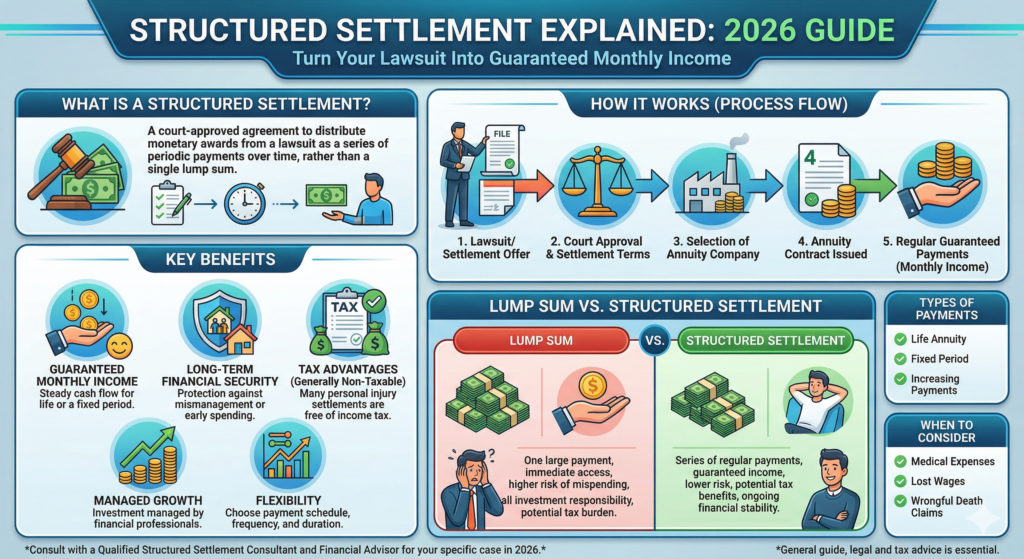
What Is a Structured Settlement?
A structured settlement is a financial arrangement where your lawsuit compensation is paid over time instead of as a single lump sum. Instead of getting all the money upfront, you receive monthly payments, annual payments, or a customized payment schedule.
Simple Example
Let’s say you win a $300,000 case:
- Option 1 (Lump Sum): You get $300,000 immediately
- Option 2 (Structured Settlement): You receive $2,000/month for 10-15 years, plus occasional lump payouts
Structured Settlement vs Lump Sum: Quick Comparison
| Feature | Structured Settlement | Lump Sum |
|---|---|---|
| Payment Style | Monthly / Scheduled | One-time |
| Financial Stability | High | Depends on spending habits |
| Flexibility | Low | High |
| Risk of Overspending | Low | High |
| Investment Control | Limited | Full |
| Tax Treatment | Often tax-free for injury cases | Often tax-free for injury cases |
Why Lawyers and Insurance Companies Recommend Structured Settlements
Here’s something most articles won’t tell you: insurance companies prefer structured settlements because they don’t have to pay the full amount upfront, they earn interest on the remaining funds, and it reduces their financial risk.
Lawyers often recommend them because they protect clients from overspending a large windfall and ensure long-term financial security, especially for clients with ongoing medical needs.
When Structured Settlements Are a Smart Choice
Structured settlements are powerful if used correctly. They work best for:
- Accident victims with long-term medical needs
- People who struggle with managing large sums of money
- Families needing steady, reliable income
- Disability or lifelong care cases
- Minors receiving settlement funds (court-ordered structures)
Real-Life Scenario
A victim receives $1,000/month for 20 years plus a $10,000 annual bonus payout. Result: stable income, no financial stress, and long-term security — instead of a lump sum that might be spent within a few years.
The Biggest Downsides to Know
Before you choose this option, understand the trade-offs:
1. No Immediate Large Cash
You can’t access the full amount instantly, which can be a problem if you have urgent large expenses.
2. Limited Flexibility
You’re locked into a payment schedule. Life changes — but the schedule usually doesn’t.
3. Hard to Change Later
Once agreed, modifying a structured settlement is difficult and often requires court approval.
4. Inflation Risk
Fixed future payments may lose purchasing power over time. $2,000/month today will buy less in 15 years.
How Structured Settlements Are Calculated
A structured settlement isn’t random. It’s calculated using financial and legal factors:
1. Medical Expenses
Current treatment costs, future medical care, surgeries, and rehabilitation. More severe injuries generally mean higher compensation.
2. Lost Income and Future Earnings
If your injury affects your ability to work, this is calculated. Example: $4,000/month income x 5 years unable to work = $240,000+ in lost earnings.
3. Pain and Suffering
This is often one of the biggest components, covering physical pain, emotional distress, and reduced quality of life. It’s often calculated as 2x-5x medical expenses.
4. Liability (Fault Percentage)
If you are partially at fault, your settlement may be reduced. Example: 30% at fault could mean a 30% reduction.
5. Insurance Policy Limits
Every claim has a hidden cap. If insurance coverage is $100,000 but damages are $300,000, you may only receive $100,000 from that policy.
Settlement Calculation Example
- Medical expenses: $50,000
- Lost income: $100,000
- Pain and suffering: $150,000
- Total settlement: $300,000
Structured version: $50,000 upfront + $2,000/month for 10 years + annual bonus payouts.
Can You Sell a Structured Settlement?
Yes — selling is 100% legal. If you’re receiving monthly payments, you can sell some or all of them to a company in exchange for instant cash. But there’s a catch: you never get full value. Companies buy at a discount.
Example: You’re supposed to receive $100,000 over time, but you may only get $60,000-$75,000 upfront.
Typical Discount Rates
| Total Future Payments | You Typically Receive | Effective Discount |
|---|---|---|
| $50,000 | $30,000-$40,000 | 20-40% |
| $100,000 | $60,000-$75,000 | 25-40% |
| $200,000 | $120,000-$150,000 | 25-40% |
| $500,000 | $300,000-$375,000 | 25-40% |
The more urgent your need for cash, the lower the offer tends to be. Always compare multiple quotes.
Well-Known Settlement Buyers
Companies in this space include J.G. Wentworth, Peachtree Financial Solutions, Fairfield Funding, and Stone Street Capital. Always compare 3-4 offers before selling — competition gets you a better price.
How to Avoid Scams
Red flags: ‘guaranteed highest payout’ promises, no written contract, pressure to sign quickly, hidden fees.
Safe approach: Compare 3-4 companies, read the full agreement, check reviews, and get legal advice before signing.
When Selling Makes Sense (and When It Doesn’t)
Good reasons: medical emergency, debt payoff, business investment, buying a home.
Bad reasons: impulsive spending, lifestyle upgrades, or selling with no financial plan.
Smartest move: sell only part of your payments and keep the rest. You get cash now plus ongoing security.
Smart Strategies to Maximize Your Settlement
1. Combine Lump Sum + Structured Payments
Many experts suggest taking 50-70% as a lump sum and keeping 30-50% structured. You get immediate cash plus monthly income — the best of both worlds.
2. Negotiate Everything
Don’t just accept the payment amount. Negotiate the duration, bonus payouts, cost-of-living adjustments, and start date. Everything is negotiable.
3. Never Accept the First Offer
The first offer is usually 20-40% below actual value. Insurers want to close cases quickly and cheaply.
4. Time Your Decision
Never decide when you’re emotionally stressed or financially desperate — that’s when people accept the worst deals.
5. Get Professional Help
An experienced lawyer can often increase your payout significantly, handle negotiations, and protect your rights. A financial advisor can help you choose between lump sum and structured options.
Frequently Asked Questions
1. Can I sell my structured settlement anytime?
Yes, but in most states you’ll need court approval for the transfer, which typically takes 2-6 weeks. The court must find the sale is in your best interest.
2. Do I have to sell all of my payments?
No. You can sell partial payments — for example, sell 3 years of payments and keep the rest. Partial sales are often the smartest option.
3. How long does the selling process take?
Usually 2-6 weeks, depending on how quickly you get court approval in your state.
4. Is selling a structured settlement legal?
Yes, it is completely legal in the United States, though transfers generally require court approval under state structured settlement protection acts.
5. Will I get the full value if I sell?
No. Buying companies apply a discount rate, so you’ll typically receive 60-80% of the future payments’ total value as a lump sum.
6. What is a discount rate?
The discount rate is the percentage a buying company deducts from your future payments’ total value to calculate your lump-sum offer. It reflects their profit and the time value of money.
7. Do I need court approval to sell?
In most cases, yes. State laws generally require a judge to approve the transfer to protect sellers.
8. Are structured settlement payments taxable?
Payments from personal injury settlements are generally tax-free under federal law. However, rules differ for other case types, so consult a tax professional.
9. Can I sell my settlement more than once?
Yes. You can do multiple partial sales over time, as long as you still have future payments remaining.
10. What documents do I need to sell?
Typically your settlement agreement, annuity contract, identification, and proof of the payment stream.
11. Who regulates settlement buying companies?
State courts oversee transfers, and state insurance departments may regulate aspects of the business. There is no single federal regulator.
12. Should I consult a lawyer before selling?
Yes — always recommended. An independent attorney can review the offer, explain the true cost of the discount, and represent you at the approval hearing.
13. What’s better: lump sum or structured settlement?
It depends on your needs. Lump sums offer flexibility and control; structured settlements offer stability and protection from overspending. Many people choose a hybrid of both.
14. Can creditors take my structured settlement payments?
Protections vary by state, but structured settlement payments from injury cases often have strong creditor protections. Ask a local attorney about your state’s rules.
15. How do I get the best price when selling?
Get quotes from at least 3-4 companies, sell only what you need, avoid acting under pressure, and have a lawyer review the final agreement.
Related Guides
- Average Car Accident Settlement Amounts in the USA (2026 Guide)
- How Long Does a Car Accident Settlement Take? (2026 Timeline)
- Personal Injury Lawyer Near Me: 2026 Top-City Guide
- Car Accident Lawyers Near Me: 15 Ways to Find the Best Help
Trusted External Resources
Legal Disclaimer
This article is for informational purposes only and does not constitute legal, financial, or tax advice. Structured settlements involve binding legal agreements — always consult a qualified attorney and financial professional before accepting, modifying, or selling a structured settlement.