Why Mesothelioma Lawsuits Matter
Mesothelioma is a rare but aggressive cancer caused almost entirely by asbestos exposure. For much of the 20th century, companies used asbestos in construction, shipbuilding, manufacturing, and countless products — often while knowing the health risks.
Today, mesothelioma lawsuits give victims and families a way to hold those companies accountable and recover compensation for:
- Medical expenses, including surgery, chemotherapy, and immunotherapy
- Lost income and reduced earning capacity
- Pain, suffering, and emotional distress
- Wrongful death damages for surviving families
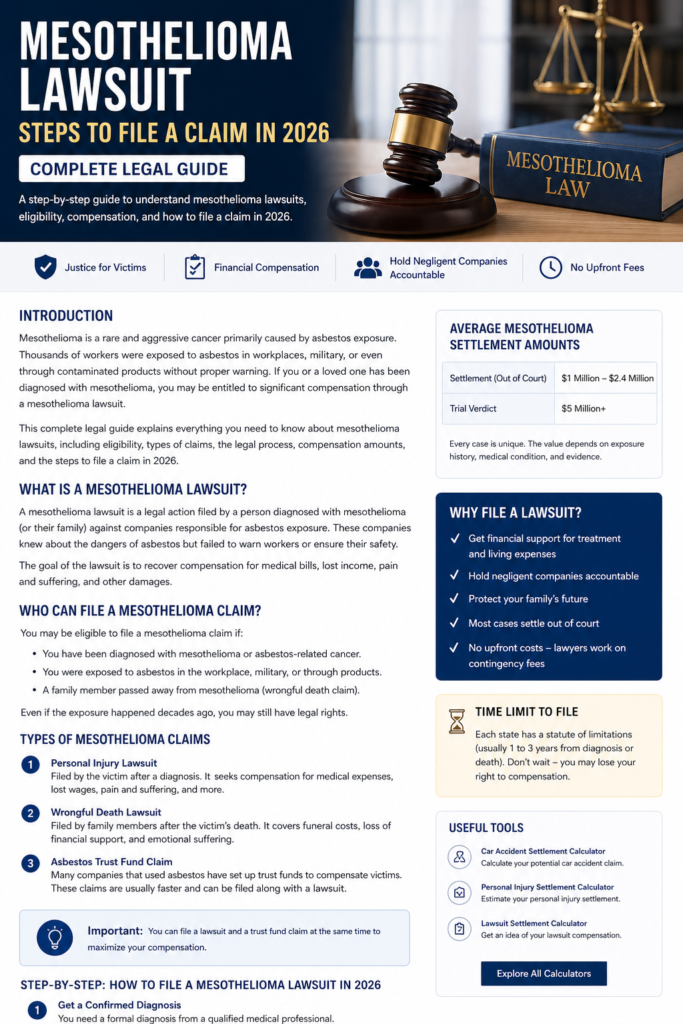
Because these cases often involve clear evidence of corporate negligence, settlements and verdicts are among the highest in personal injury law — averaging $1 million to $2.4 million per case.
What Is a Mesothelioma Lawsuit?
A mesothelioma lawsuit is a legal claim filed by a patient — or their family — against the companies responsible for asbestos exposure.
These lawsuits typically allege:
- Failure to warn workers and consumers about asbestos risks
- Unsafe working conditions and inadequate protective equipment
- Negligence in handling hazardous materials
- Concealment of known health dangers
If you are new to the topic, start with our What Is Mesothelioma? Lawsuits, Liability, and Legal Information (2026 Guide), which explains the disease, liability rules, and compensation options in depth.
Who Can File a Mesothelioma Claim?
You may be eligible to file if:
- You have been diagnosed with mesothelioma (or another asbestos-related disease)
- You were exposed to asbestos at work, in the military, or through a product
- You can identify — even approximately — the companies or job sites involved
- You are within your state’s statute of limitations
Eligible Claimants Include:
- Construction and industrial workers
- Shipyard workers and military veterans (especially Navy)
- Factory and power plant workers
- Auto mechanics, electricians, and plumbers
- Family members exposed indirectly (secondary or “take-home” exposure)
- Spouses and dependents filing wrongful death claims
Types of Mesothelioma Lawsuits
There are three main legal paths to compensation. Many victims pursue more than one.
1. Personal Injury Lawsuit
Filed by the patient after diagnosis. This is the most common type and typically yields the highest compensation. It covers:
- Medical costs — past and future
- Lost wages and diminished earning capacity
- Pain and suffering
2. Wrongful Death Lawsuit
Filed by surviving family members after a loved one dies from mesothelioma. It covers:
- Funeral and burial expenses
- Loss of financial support and household income
- Loss of companionship
- Emotional damages
3. Asbestos Trust Fund Claims
Dozens of bankrupt asbestos companies were ordered to establish trust funds — collectively holding around $30 billion — to pay victims. Trust fund claims use a streamlined, paperwork-based process and are often faster than court cases. You can file trust fund claims in addition to a lawsuit.
Step-by-Step: How to File a Mesothelioma Lawsuit
Filing follows a clear sequence. Here is what to expect at each stage:
Step 1: Get a Confirmed Diagnosis
A formal diagnosis from a qualified physician — supported by pathology and imaging — is required before any claim can proceed. Keep copies of every medical report; they are the foundation of your case.
Step 2: Hire an Experienced Mesothelioma Attorney
Choose a lawyer who specializes in asbestos litigation, not a general personal injury attorney. A specialist will:
- Identify all responsible companies, including ones you may not remember
- Gather employment, military, and medical evidence
- Handle every legal procedure and deadline
- File in the state court most favorable to your claim
Reputable mesothelioma lawyers work on contingency — you pay nothing unless you win.
Step 3: Identify Your Exposure History
Your legal team will investigate your work history in detail:
- Job sites and employers, going back decades
- Specific asbestos-containing products you handled or worked near
- Duration and intensity of exposure
- Coworker witnesses who can confirm product use
Even if a company went bankrupt or no longer exists, its trust fund may still owe you compensation.
Step 4: File the Lawsuit
Your attorney files the case in the appropriate court, naming every potentially liable company as a defendant. Filing in the right jurisdiction matters — experienced firms know which courts move asbestos cases fastest and award the highest damages.
Step 5: Discovery Phase
Both sides exchange evidence:
- Medical records and expert testimony
- Employment and military service records
- Internal company documents showing knowledge of asbestos dangers
- Depositions of witnesses and company representatives
Step 6: Settlement Negotiation
Most mesothelioma cases settle before trial. Companies often prefer settlement to avoid large, public jury verdicts. Your attorney negotiates with each defendant — skilled negotiation here can add hundreds of thousands of dollars to your recovery.
Step 7: Trial (If Needed)
If no fair agreement is reached, the case goes to trial. Trials take longer and involve more risk, but jury verdicts in mesothelioma cases average $5 million or more — often far above settlement offers.
Step 8: Compensation Payout
Once the case settles or a verdict is reached, compensation is distributed to you or your family — often within weeks of a settlement agreement.
Internal Tools to Estimate Compensation
You can get a rough estimate of potential payouts using our free calculators:
- Car Accident Settlement Calculator
- Personal Injury Settlement Calculator
- Lawsuit Settlement Calculator
These tools give a starting estimate only — a mesothelioma attorney can value your specific case far more accurately.
How Much Compensation Can You Get?
Settlement amounts vary, but national averages are well established:
| Case Type | Average Compensation |
|---|---|
| Settlement | $1 million – $2.4 million |
| Trial verdict | $5 million or more |
| Trust fund claim | $100,000 – $500,000 per trust |
For a deeper breakdown of payouts, verdicts, and trust fund payment percentages, see our Mesothelioma Compensation Claims Guide USA 2026: Average Payouts, Lawsuits & Trust Fund Claims.
Factors That Affect Settlement Amount
1. Medical Expenses
Treatment for mesothelioma is expensive and ongoing. Cases with higher documented medical costs — surgery, chemotherapy, immunotherapy, clinical trials — generally command higher compensation.
2. Lost Income
This includes wages already lost and future earnings the patient will never recover. Younger patients with decades of lost earning capacity often see larger awards.
3. Pain and Suffering
The physical pain and emotional toll of mesothelioma — on both the patient and their family — is a major component of non-economic damages.
4. Company Negligence
The stronger the evidence that companies knew about asbestos dangers and hid them, the higher the compensation. Internal memos and prior warnings can dramatically increase awards — including punitive damages.
5. Number of Defendants
Most victims were exposed to products from multiple companies. Each liable defendant can contribute to the total recovery.
6. State Laws
Damage caps, filing rules, and jury tendencies vary by state — another reason the choice of jurisdiction matters.
How Long Does a Mesothelioma Lawsuit Take?
- Settlement cases: 6–18 months from filing to payout
- Trial cases: 1–3 years
- Trust fund claims: 3–6 months
Many courts fast-track mesothelioma cases because of the severity of the illness — some seriously ill plaintiffs receive expedited trial dates within months of filing.
Statute of Limitations (Important)
You must file within a limited time after diagnosis or a loved one’s death:
- Usually 1 to 3 years, depending on the state
- The clock typically starts at diagnosis, not exposure
- Wrongful death claims have their own deadline, usually measured from the date of death
Missing this deadline means permanently losing your right to compensation — no matter how strong your case. Contact an attorney as soon as possible after diagnosis.
External Legal Resources
For authoritative medical and regulatory background:
- According to the American Cancer Society, mesothelioma is strongly linked to asbestos exposure, and early diagnosis improves treatment outcomes.
- According to the U.S. Environmental Protection Agency, asbestos exposure remains a serious public health risk, and there is no safe level of exposure.
Mesothelioma Lawsuit vs Class Action
| Feature | Mesothelioma Lawsuit | Class Action |
|---|---|---|
| Type | Individual case | Group case |
| Payout | High ($1M+) | Lower (split among many) |
| Control | High — your attorney, your strategy | Limited |
| Speed | Faster for individuals | Often slower |
Most mesothelioma claims are filed as individual lawsuits because they produce significantly higher compensation than class actions.
Common Mistakes to Avoid
- Waiting too long to file — statutes of limitations are strict
- Choosing an inexperienced lawyer — asbestos litigation is a specialty
- Not documenting exposure history — write down every job site and product you remember
- Accepting the first settlement offer — early offers are often low
- Missing medical appointments or legal deadlines — gaps hurt your case
Real-Life Example
Consider a former shipyard worker exposed to asbestos insulation in the 1970s. Diagnosed with pleural mesothelioma decades later, he hired a specialized attorney who:
- Identified multiple liable manufacturers from old purchase records
- Filed an individual lawsuit plus three trust fund claims
- Negotiated settlements with most defendants
His total recovery exceeded $2 million — covering his medical bills, replacing lost income, and securing his family’s financial future. While every case differs, this pattern is common: thorough investigation plus experienced counsel produces strong results.
Who Should File a Lawsuit?
You should seriously consider filing if:
- You or a loved one has been diagnosed with mesothelioma
- You were exposed to asbestos at work, in the military, or at home
- You want financial support for treatment and your family’s future
- You want the responsible companies held accountable
Even if you are unsure about the details of your exposure, a free case evaluation with a mesothelioma attorney can determine whether you have a viable claim.
Frequently Asked Questions
1. What is mesothelioma?
Mesothelioma is a rare, aggressive cancer caused almost exclusively by asbestos exposure. It develops in the lining of the lungs, abdomen, or heart — typically 20 to 50 years after exposure.
2. Can I file a lawsuit after a mesothelioma diagnosis?
Yes. A confirmed diagnosis gives you the right to file a personal injury lawsuit against the companies responsible for your asbestos exposure, as long as you are within your state’s filing deadline.
3. Is hiring a lawyer necessary?
It is highly recommended. Asbestos litigation is complex — involving multiple defendants, decades-old evidence, and specialized trust fund procedures. An experienced mesothelioma attorney typically increases compensation substantially.
4. How much compensation can I get?
Average mesothelioma settlements range from $1 million to $2.4 million; trial verdicts average $5 million or more. Trust fund claims can add hundreds of thousands of dollars on top.
5. How long does the process take?
Most cases settle within 6 to 18 months. Trials take 1 to 3 years. Trust fund claims are fastest at 3 to 6 months, and seriously ill patients can often get expedited proceedings.
6. Can family members file after a loved one’s death?
Yes. Spouses, children, and dependents can file a wrongful death claim seeking funeral costs, lost financial support, loss of companionship, and emotional damages.
7. What is an asbestos trust fund?
Bankrupt asbestos companies were court-ordered to create trust funds — now holding about $30 billion in total — to compensate victims through a streamlined claims process outside of court.
8. Do all mesothelioma cases go to trial?
No. The vast majority settle out of court. Trials are the exception — usually pursued only when defendants refuse to offer fair compensation.
9. Is mesothelioma compensation taxable?
Generally, compensation for physical illness and medical expenses is not taxable under federal law. Amounts for lost wages or punitive damages may be taxable — consult a tax professional.
10. Can I file in any state?
It depends on where the exposure occurred, where you live, and where the defendant companies operate. An experienced attorney will choose the jurisdiction most favorable to your case.
Conclusion
A mesothelioma lawsuit is one of the most powerful tools available to asbestos victims. It helps victims and families:
- Cover overwhelming medical expenses
- Replace lost income and secure financial stability
- Hold negligent companies publicly accountable
If you or someone you love has been affected, taking legal action quickly is critical — strict filing deadlines apply. You didn’t choose exposure, but you can choose to fight for your rights and your family’s future.
Disclaimer
This article is for informational purposes only and does not constitute legal advice. Laws, deadlines, and compensation outcomes vary by state and individual circumstances. Consult a qualified mesothelioma attorney about your specific situation. No attorney-client relationship is created by reading this article.