A Silent but Deadly Disease
Mesothelioma is not just a medical condition — it is often the result of corporate negligence.
For decades, millions of American workers were exposed to asbestos without proper warnings or protective equipment. Many had no idea they were in danger until symptoms appeared 20, 30, or even 50 years later. By the time mesothelioma is diagnosed, it is often already advanced — and treatment options are limited.
That is why understanding three things can make a life-changing difference:
- What mesothelioma is and how it develops
- Who is legally responsible for asbestos exposure
- How mesothelioma lawsuits and trust fund claims work
This 2026 guide explains the disease, the law, and the compensation options available to patients and families across the United States.
What Is Mesothelioma?
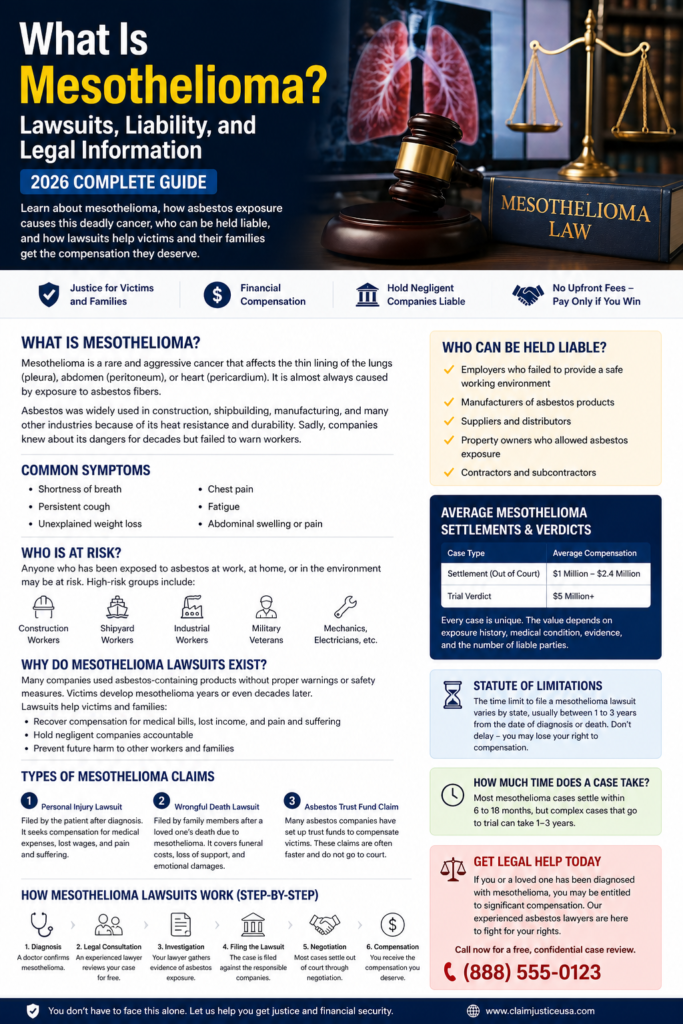
Mesothelioma is a rare and aggressive cancer that develops in the mesothelium — the thin layer of tissue lining the lungs, abdomen, heart, and other internal organs. Around 3,000 new cases are diagnosed in the United States each year.
Unlike many cancers, mesothelioma has a single dominant cause: asbestos exposure. Nearly every case can be traced back to inhaled or ingested asbestos fibers.
Main Cause: Asbestos Exposure
Asbestos is a naturally occurring mineral once prized for its heat resistance and durability. It was widely used throughout the 20th century in:
- Construction materials (insulation, roofing, floor tiles, cement)
- Shipbuilding and naval vessels
- Automotive brakes and clutches
- Industrial manufacturing plants and refineries
- Power plants and chemical facilities
When asbestos-containing materials are disturbed, microscopic fibers become airborne. Once inhaled or swallowed, these fibers lodge in the body and cause cellular damage over decades — eventually triggering mesothelioma.
Types of Mesothelioma
Mesothelioma is classified by where in the body it develops:
1. Pleural Mesothelioma (Most Common)
Accounting for roughly 75% of all cases, pleural mesothelioma affects the lining of the lungs (pleura). Common symptoms include chest pain, shortness of breath, and a persistent cough.
2. Peritoneal Mesothelioma
This type affects the lining of the abdomen (peritoneum) and causes abdominal swelling, digestive problems, and unexplained weight loss. It is the second most common form.
3. Pericardial Mesothelioma (Rare)
Affecting the lining around the heart (pericardium), this rare form can cause chest pain, heart palpitations, and breathing difficulty.
4. Testicular Mesothelioma (Very Rare)
The rarest form, affecting the lining of the testes. Because it is so uncommon, it is frequently misdiagnosed at first.
Symptoms of Mesothelioma
Mesothelioma symptoms often mimic less serious conditions, which is one reason diagnosis comes late. Common warning signs include:
- Shortness of breath
- Chest or abdominal pain
- Persistent dry cough
- Fatigue and weakness
- Unexplained weight loss
- Abdominal swelling or lumps
- Night sweats and fever
Symptoms typically appear 20 to 50 years after asbestos exposure. If you worked in a high-risk industry decades ago and now experience these symptoms, tell your doctor about your exposure history — it can speed up diagnosis significantly.
Mesothelioma Treatment Options (2026 Update)
Although mesothelioma remains aggressive, treatment options have improved significantly in recent years. Most patients receive a combination of therapies:
Common Treatments
- Surgery — removes tumors; most effective in early-stage cases
- Chemotherapy — kills cancer cells throughout the body
- Radiation therapy — targets tumors in specific areas
- Immunotherapy — boosts the body’s immune system to fight cancer cells
- Clinical trials — provide access to cutting-edge experimental treatments
According to the American Cancer Society, early diagnosis and a multimodal treatment approach can improve survival rates and quality of life.
How Asbestos Exposure Happens
Most exposure happened on the job — but not all of it. Understanding where exposure occurs helps establish legal liability. The U.S. Environmental Protection Agency classifies asbestos as a serious health hazard, and there is no safe level of exposure.
Industries with the Highest Asbestos Exposure Risk
- Construction and demolition workers
- Shipyard workers and Navy veterans
- Industrial laborers and factory workers
- Auto mechanics (brakes and clutches)
- Electricians and plumbers
- Firefighters
- Power plant and refinery workers
- Military veterans (especially Navy service members)
Secondary Asbestos Exposure (A Hidden Risk)
Not everyone exposed to asbestos worked directly with it. Secondary exposure happens when workers unknowingly carry asbestos dust home on their clothing, skin, or hair — exposing spouses and children who inhale the fibers. Courts in many states recognize these “take-home exposure” claims, and families have won significant compensation.
Why Mesothelioma Leads to Lawsuits
Here is the harsh reality behind most cases:
- Many companies knew asbestos was dangerous as early as the 1930s
- They failed to warn workers or provide protective equipment
- Some companies actively concealed the risks from employees and regulators
This documented corporate knowledge creates clear legal liability — which is why mesothelioma lawsuits consistently produce some of the highest payouts in personal injury law.
Who Is Liable in Mesothelioma Cases?
Multiple parties can share responsibility for asbestos exposure:
1. Employers
- Failed to provide safety measures and protective equipment
- Ignored known health risks
2. Manufacturers
- Produced asbestos-containing products
- Did not label products with adequate warnings
3. Contractors and Suppliers
- Installed or distributed hazardous materials
- Failed to follow safety regulations at job sites
4. Property and Premises Owners
- Allowed unsafe exposure in buildings and facilities
- Failed to remediate known asbestos hazards
An experienced mesothelioma attorney investigates your full work history to identify every company that may owe you compensation.
What Is a Mesothelioma Lawsuit?
A mesothelioma lawsuit is a legal claim filed by a patient or their family against the companies responsible for asbestos exposure.
Purpose of the Lawsuit
- Recover medical expenses and future treatment costs
- Recover lost income and reduced earning capacity
- Obtain compensation for pain, suffering, and emotional distress
- Hold negligent companies publicly accountable
Types of Legal Claims
1. Personal Injury Claim
Filed by the patient after diagnosis. Covers medical bills, lost income, and pain and suffering. This is the most common type of mesothelioma claim.
2. Wrongful Death Claim
Filed by surviving family members when a loved one dies from mesothelioma. Covers funeral expenses, loss of financial support, loss of companionship, and emotional damages.
3. Asbestos Trust Fund Claim
Many asbestos companies declared bankruptcy and were ordered to create asbestos trust funds — now holding an estimated $30 billion collectively. Trust fund claims follow a faster, simpler process than lawsuits, and many victims file both a lawsuit and trust fund claims for maximum compensation.
For a detailed walkthrough of the filing process, see our Mesothelioma Lawsuit: Steps to File a Claim in 2026 (Complete Legal Guide).
How Mesothelioma Lawsuits Work
Most mesothelioma cases follow a predictable path from diagnosis to compensation:
Step 1: Diagnosis
A confirmed medical diagnosis of mesothelioma is required. Pathology reports, imaging scans, and biopsy results form the foundation of the case. Without a definitive diagnosis, no claim can proceed.
Step 2: Legal Consultation
A specialized asbestos attorney evaluates your case — usually free of charge — and identifies the companies responsible for your exposure. Choose a lawyer with a proven mesothelioma track record, not a general personal injury attorney.
Step 3: Evidence Collection
Your legal team gathers work history records, military service records, medical files, witness statements, and product identification evidence. Coworker testimony about which asbestos products were used at a job site can be especially powerful.
Step 4: Filing the Case
Your lawyer files the lawsuit in the jurisdiction most favorable to your claim, often naming multiple defendants. Experienced firms know which state courts tend to move asbestos cases fastest.
Step 5: Settlement or Trial
The vast majority of mesothelioma cases settle out of court — defendants usually prefer to avoid a public trial. A small percentage go to trial, where verdicts are often higher but less certain.
Step 6: Compensation
Payouts are distributed to the victim or family, often within weeks of a settlement agreement. If trust fund claims were filed alongside the lawsuit, those payments may arrive even sooner.
Mesothelioma Lawsuit vs. Asbestos Trust Fund
Many victims pursue both routes at the same time. Here is how they compare:
| Feature | Lawsuit | Trust Fund Claim |
|---|---|---|
| Speed | Slower (9–18 months) | Faster (3–6 months) |
| Average payout | Higher ($1M–$2.4M) | Moderate (varies by trust) |
| Process | More complex, adversarial | Simpler, paperwork-based |
| Best for | Maximum total compensation | Quick partial compensation |
How Much Compensation Can You Receive?
Mesothelioma compensation varies by case strength, but averages are well documented:
| Case Type | Average Amount |
|---|---|
| Settlement | $1 million – $2.4 million |
| Trial verdict | $5 million or more |
| Trust fund claim | $100,000 – $500,000 per trust |
For detailed payout data, real case examples, and trust fund payment percentages, read our Mesothelioma Compensation Claims Guide USA 2026: Average Payouts, Lawsuits & Trust Fund Claims.
Factors That Affect Compensation
No two mesothelioma cases are identical. The final amount depends on:
- Severity of illness — advanced stages typically yield higher awards
- Duration and intensity of exposure — longer exposure strengthens the case
- Number of companies involved — more defendants can mean a larger total recovery
- Strength of evidence — clear documentation of exposure and negligence
- State laws — damage caps and filing rules vary by state
- Age and lost earning capacity of the victim
- Medical costs — past and projected future treatment expenses
Average Mesothelioma Settlement Timeline
| Stage | Typical Time |
|---|---|
| Case filing | 1–2 months |
| Evidence collection | 3–6 months |
| Settlement negotiations | 6–12 months |
| Final payout | 9–18 months total |
Some cases are fast-tracked due to the patient’s condition — many courts grant expedited trial dates for seriously ill plaintiffs.
Mesothelioma vs. Other Personal Injury Lawsuits
| Feature | Mesothelioma Case | General Injury Case |
|---|---|---|
| Cause | Asbestos exposure | Varies (accidents, negligence) |
| Average compensation | High ($1M+) | Moderate |
| Legal complexity | High (multiple defendants) | Medium |
| Evidence timeline | Decades of work history | Single incident |
How Lawyers Get Paid (Contingency Fees)
Most mesothelioma lawyers work on a contingency fee basis, which means:
- No upfront fees or out-of-pocket costs
- The lawyer is paid only if you win compensation
- Typical fee: 25%–40% of the settlement or verdict
- Free initial case evaluation
This arrangement gives every victim access to top-tier legal representation, regardless of financial situation.
How to Choose the Right Mesothelioma Lawyer
Choosing the right attorney can significantly affect your compensation. Look for:
- Proven experience specifically in asbestos and mesothelioma cases
- A documented history of large settlements and verdicts
- Nationwide case-handling capability
- Resources to investigate decades-old exposure
Avoid general personal injury lawyers for these cases — choose a specialist. To get a rough estimate of what your claim could be worth, try our Lawsuit Settlement Calculator or Personal Injury Settlement Calculator.
Emotional and Financial Impact on Families
Mesothelioma affects entire families, not just patients:
- Loss of household income when the patient can no longer work
- Emotional stress and anxiety for spouses and children
- Mounting medical bills and travel costs for treatment
- Long-term caregiving costs
Legal compensation helps families secure financial stability, access better treatment, and hold negligent companies accountable.
Common Mistakes to Avoid
- Waiting too long — statutes of limitations are strict and unforgiving
- Hiring an inexperienced lawyer — generalists miss asbestos-specific strategies
- Failing to document exposure — detailed work history is critical evidence
- Accepting the first settlement offer — initial offers are often far below case value
- Ignoring legal notices and deadlines — missing one can derail the case
Signs You May Have a Strong Legal Case
- You have a confirmed mesothelioma diagnosis
- You worked in a high-risk industry or served in the military
- Your exposure history can be traced to specific products or job sites
- Multiple companies may share liability
- You have medical and employment documentation
Strong documentation generally leads to higher settlement potential.
Statute of Limitations: Act Quickly
Every state sets a strict deadline for filing:
- Typically 1–3 years from diagnosis (personal injury) or death (wrongful death)
- The clock usually starts at diagnosis, not at the time of exposure
- Missing the deadline can permanently bar your claim
Because these deadlines are strict and vary by state, contacting an attorney promptly after diagnosis is critical.
Frequently Asked Questions
1. What is mesothelioma?
Mesothelioma is a rare, aggressive cancer caused almost exclusively by asbestos exposure. It develops in the lining of the lungs, abdomen, or heart — often 20 to 50 years after exposure.
2. Is mesothelioma curable?
There is currently no cure, but surgery, chemotherapy, radiation, and immunotherapy can extend life and improve quality of life — especially when the cancer is caught at an early stage.
3. Can I file a lawsuit for mesothelioma?
Yes. If you were exposed to asbestos and developed mesothelioma, you can file a personal injury lawsuit against the responsible companies. Surviving family members can file wrongful death claims.
4. How much compensation can I receive?
Average mesothelioma settlements range from $1 million to $2.4 million, while trial verdicts average $5 million or more. Asbestos trust fund claims can add hundreds of thousands more.
5. How much does it cost to hire a mesothelioma lawyer?
Nothing upfront. Reputable mesothelioma attorneys work on contingency, collecting 25%–40% of your compensation only if you win your case.
6. Do most mesothelioma cases settle out of court?
Yes — the overwhelming majority settle before trial, which means faster compensation and far less stress for patients and families.
7. Can family members file a claim?
Yes. Spouses, children, and other dependents can file wrongful death claims. Family members harmed by secondary (take-home) asbestos exposure may also file their own personal injury claims.
8. What is an asbestos trust fund?
Bankrupt asbestos companies were ordered to establish trust funds — collectively holding around $30 billion — to compensate victims through a streamlined, paperwork-based claims process.
9. How long does a mesothelioma lawsuit take?
Most cases resolve within 9 to 18 months. Trust fund claims are faster (3–6 months), and seriously ill patients can often request expedited court proceedings.
10. Is mesothelioma compensation taxable?
Generally, compensation for physical illness and medical expenses is not taxable under federal law, though portions allocated to lost wages or punitive damages may be. Consult a tax professional about your specific situation.
Conclusion
Mesothelioma is more than a disease — it is often the result of preventable corporate negligence. Legal action helps victims secure financial support, access better treatment, and hold negligent companies accountable.
If you or a loved one has been affected, understanding your legal rights is the first step toward justice — and acting before the statute of limitations expires is essential.
Disclaimer
This content is for informational purposes only and does not constitute legal advice. Mesothelioma laws, deadlines, and compensation outcomes vary by state and individual circumstances. Always consult a qualified mesothelioma attorney about your specific situation. No attorney-client relationship is created by reading this article.