Asbestos Lawsuit Attorney (2026 Guide): The Case That Starts Years Too Late
Most asbestos stories don’t begin today. They begin 20, 30, even 40 years ago — in a shipyard, on a construction site, inside a factory, or aboard a Navy vessel. Back then, everything seemed normal. There were no warning signs, no safety briefings about the dust in the air, no labels on the insulation being cut, fitted, and swept up at the end of every shift.
Decades later, the symptoms appear. Shortness of breath that doesn’t go away. Chest pain that gets worse. A persistent cough. Then comes the diagnosis no one expects: mesothelioma, asbestos-related lung cancer, or asbestosis. And that’s when people realize this didn’t just happen — it was caused by exposure they never chose and were never warned about.
That’s where an asbestos lawsuit attorney comes in. These specialized lawyers help victims and families trace exposure back through decades, identify the companies responsible, and fight for the compensation that can cover medical bills, lost income, and the financial security a family deserves.
What Is an Asbestos Lawsuit Attorney?
An asbestos lawsuit attorney is a lawyer who focuses specifically on cases involving asbestos exposure and the diseases it causes. Unlike general personal injury lawyers, these attorneys have deep experience with the unique challenges of asbestos litigation: decades-old evidence, bankrupt defendants, trust fund claims, and complex medical causation.
These lawyers focus on:
- Identifying who caused the asbestos exposure, often across multiple employers and decades
- Building cases around decades-old work records, product identification, and witness testimony
- Filing claims against solvent companies, asbestos trust funds, and government benefit programs
- Maximizing total compensation by pursuing every available avenue of recovery
Why You Cannot Use a General Lawyer for an Asbestos Case
This is one of the biggest mistakes people make: hiring a general lawyer for an asbestos case. Asbestos litigation is nothing like a car accident claim or a slip-and-fall case. Here’s why that fails:
- Exposure history is complex. Tracing where and when exposure happened 30 years ago requires specialized databases of asbestos products, job sites, and shipping records.
- Multiple companies are involved. A single worker may have been exposed to products from dozens of manufacturers. Each one is a potential defendant.
- Evidence is decades old. Companies have gone bankrupt, records have been destroyed, and witnesses have passed away. Specialists know how to build cases anyway.
- Laws vary by state. Statutes of limitations, filing rules, and trust fund procedures differ dramatically. The wrong filing strategy can cost a family everything.
Only specialized attorneys understand how to build these cases from fragments of history into winning claims. A general lawyer, however well-meaning, simply doesn’t have the product databases, medical expert networks, or trust fund experience to maximize your recovery.
The Truth About Asbestos Exposure
For decades, companies used asbestos because it was cheap, heat-resistant, and durable. It was in insulation, brake pads, floor tiles, roofing, cement, gaskets, and hundreds of other products. Workers handled it daily without protection.
But the hidden truth is damning: many companies knew asbestos was dangerous and used it anyway. Internal documents revealed in litigation show that some manufacturers were aware of the health risks as early as the 1930s and 1940s, yet they:
- Continued using asbestos in products for decades
- Failed to warn workers about the dangers
- Ignored or suppressed safety research
- Lobbied against regulations that would have protected workers
That’s the foundation of asbestos lawsuits today. These aren’t frivolous claims — they’re about holding companies accountable for knowingly putting profits ahead of human lives.
Who Can File an Asbestos Lawsuit?
You may be eligible to file if you were exposed to asbestos and developed an asbestos-related disease, or if a loved one passed away due to asbestos exposure. The key is connecting the illness to the exposure — which is exactly what a specialized attorney helps you do.
High-Risk Professions
Certain occupations carry the highest risk of asbestos exposure:
- Construction workers (insulation, drywall, roofing, demolition)
- Shipyard workers and Navy veterans
- Factory and manufacturing employees
- Electricians, plumbers, and pipefitters
- Auto mechanics (brake and clutch work)
- Power plant and refinery workers
- Firefighters and first responders
- Teachers and school maintenance staff (older buildings)
Secondary Exposure (Take-Home Asbestos)
Even family members who never worked with asbestos can be affected. When workers came home covered in asbestos dust on their clothing, hair, and tools, their spouses and children inhaled those fibers too. This is called secondary or take-home exposure, and courts increasingly recognize these claims. If your parent or spouse worked with asbestos and you developed an asbestos-related illness, you may have a valid claim.
Related Reading on Claim Justice USA
To understand how asbestos cases translate into real compensation, explore these related guides:
- Diagnosed 40 Years Later: A Mesothelioma Settlement Story — how one worker’s decades-old exposure became a winning case
- Mesothelioma Lawsuit Settlement Guide 2026 — average settlement amounts and what drives them
- Mesothelioma Attorney Near Me: 2026 Guide — how to find the right lawyer for your case
- Mesothelioma Settlement Examples 2026 — real verdicts and payout amounts
Types of Asbestos Lawsuits
There isn’t just one kind of asbestos claim. A good attorney will evaluate which types apply to your situation — and often file several simultaneously.
1. Personal Injury Claim
Filed by the patient who developed an asbestos-related illness. This is the most common type and can cover medical expenses (past and future), lost wages and reduced earning capacity, pain and suffering, travel costs for treatment, and loss of quality of life.
2. Wrongful Death Claim
Filed by surviving family members when a loved one passed away from an asbestos-related disease. This can cover funeral and burial costs, lost financial support, loss of companionship, and the family’s emotional suffering.
3. Asbestos Trust Fund Claim
Many asbestos companies declared bankruptcy but were required to create trust funds to compensate victims. There are over 60 active trusts holding tens of billions of dollars. These claims are typically faster than lawsuits but may pay less per claim. A skilled attorney files against every trust you qualify for.
4. VA Benefits Claims for Veterans
Military veterans — especially Navy veterans — have some of the highest asbestos exposure rates. The VA recognizes mesothelioma and other asbestos diseases as service-connected, which can unlock monthly disability compensation, free or low-cost medical treatment, and survivor benefits. An asbestos attorney experienced with VA claims can pursue these alongside your lawsuit.
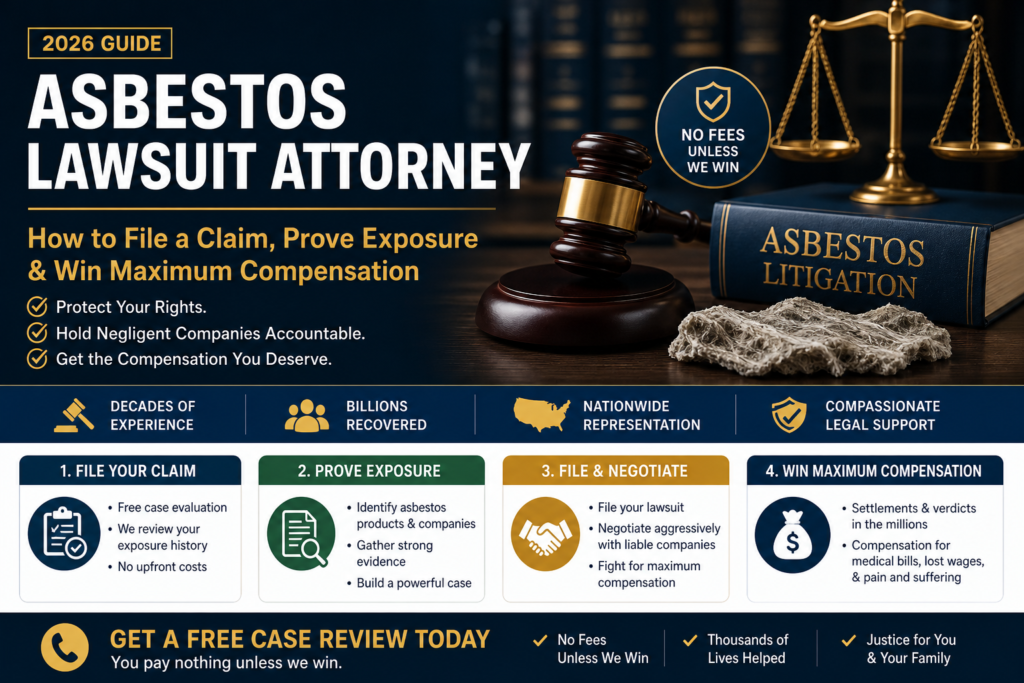
Step-by-Step: How an Asbestos Lawsuit Works
Understanding the process removes fear and helps you prepare. Here’s what happens after you contact an attorney:
Step 1: Medical Diagnosis
You must have a confirmed asbestos-related illness. This typically requires pathology reports, imaging scans, and a physician’s diagnosis linking the disease to asbestos exposure. If you’re still in the testing phase, an attorney can advise you on timing.
Step 2: Lawyer Consultation
The attorney evaluates your case for free. They’ll ask about your work history, military service, known asbestos exposure, and medical diagnosis. Be honest and thorough — every detail matters.
Step 3: Exposure Investigation
This is the most critical stage. Lawyers and investigators identify the job sites where you were exposed, the specific asbestos products you handled or worked around, and the companies that manufactured or installed them. They use product databases, shipping manifests, coworker testimony, and union records.
Step 4: Filing the Case
The legal claim is filed in the court (or courts) most favorable to your case. Experienced national firms know which jurisdictions move fastest and award the highest compensation for asbestos cases.
Step 5: Evidence Collection (Discovery)
Both sides exchange information. Your legal team gathers work records, medical reports, expert testimony from pulmonologists and occupational medicine specialists, and depositions from coworkers who can confirm the exposure conditions.
Step 6: Settlement Negotiation
Most asbestos cases settle before trial. Your attorney negotiates with each defendant’s lawyers, often securing settlements from multiple companies. A good attorney knows when an offer is fair and when to push for more.
Step 7: Trial (If Needed)
Some cases go to court. While trials take longer and involve more risk, they can result in significantly higher compensation — especially when a jury sees evidence that companies knew about the dangers and hid them.
Step 8: Compensation Distribution
Once settlements or verdicts are finalized, funds are distributed. Your attorney deducts the agreed contingency fee and case costs, and you receive the remainder. Trust fund claims may pay out on separate timelines.
How Much Compensation Can You Get?
Compensation varies based on the severity of illness, the strength of exposure evidence, the number of defendants, and the state where you file. Here are typical ranges:
Average Settlement and Verdict Amounts
| Claim Type | Typical Range |
|---|---|
| Mesothelioma settlement | $1M – $2.5M |
| Mesothelioma trial verdict | $5M – $20M+ |
| Lung cancer (asbestos-related) | $500K – $1.5M |
| Asbestosis | $100K – $500K |
| Trust fund claim (per trust) | $10K – $500K |
Asbestos Trust Fund Payments
Individual trust fund claims typically pay between $10,000 and $500,000 per trust, depending on the trust’s payment schedule and your disease severity. The key insight: most victims qualify for multiple trusts. Filing against 5, 10, or even 20+ trusts can add up to a substantial total — sometimes exceeding what a single lawsuit would recover.
The Hidden Advantage: Filing Multiple Claims
Here’s what most people don’t realize: you can file against multiple companies and multiple trusts for the same illness. Each company that exposed you is separately liable.
Example: A shipyard worker exposed to insulation from Company A, gaskets from Company B, and cement from Company C might recover $400K from Company A, $700K from Company B, and $900K from Company C — for a total of $2M+. Add trust fund claims on top, and the total climbs higher.
This is why choosing an attorney with national reach and trust fund expertise matters so much. A local general lawyer might file one claim against one company. A specialist files everywhere you qualify.
Timeline: How Long Does an Asbestos Lawsuit Take?
While every case is different, here’s a realistic timeline:
- Case evaluation and filing: 1–2 months
- Exposure investigation and discovery: 3–6 months
- Settlement negotiations: 3–6 months
- Trial (if needed): additional 6–12 months
Total for most settled cases: 6–18 months. Courts often expedite mesothelioma cases because of the serious nature of the illness. Trust fund claims can be faster (a few months) but sometimes pay in installments.
How Asbestos Lawyers Get Paid
Most asbestos attorneys work on a contingency fee basis. This means:
- No upfront fees. You pay nothing to hire the lawyer or file your case.
- You pay only if you win. If there’s no recovery, you owe no legal fees.
- Typical fee: 25%–40% of the total recovery, depending on the firm and whether the case settles or goes to trial.
Case costs (filing fees, expert witnesses, medical record retrieval) are typically advanced by the firm and deducted from the recovery. Always get the fee agreement in writing before signing.
How to Choose the Best Asbestos Attorney
Your choice of lawyer is the single biggest factor in how much compensation you receive. Here’s what to look for — and what to avoid.
What to Look For
- Dedicated asbestos practice. The firm should handle asbestos and mesothelioma cases as a core focus, not an occasional sideline.
- Proven settlement history. Ask about their track record — total recovered, average settlements, notable verdicts.
- National reach. Asbestos exposure often spans multiple states. National firms can file wherever the law is most favorable.
- Free consultation and contingency fees. Reputable asbestos firms never charge upfront.
- Clear communication. You should understand every step. Avoid firms that won’t explain their strategy.
Red Flags to Avoid
- General personal injury lawyers with no asbestos-specific experience
- Firms that can’t name the trusts or defendants they’d pursue
- Pressure to sign immediately without answering your questions
- Requests for upfront payment or “retainer fees”
- Poor communication or unreturned calls during the consultation phase
External Legal References
For authoritative medical and regulatory background on asbestos:
- American Cancer Society: Asbestos and Cancer Risk — mesothelioma is directly linked to asbestos exposure, with detailed risk information.
- U.S. Environmental Protection Agency: Asbestos — federal regulations, health effects, and where asbestos is still found today.
Common Mistakes That Reduce Your Compensation
Avoid these errors that can cost families hundreds of thousands of dollars:
- Filing too late. Every state has a statute of limitations. Once it expires, your claim is gone forever — no matter how strong it was.
- Weak documentation. Start gathering work records, medical files, and witness contacts immediately. Memories fade and records disappear.
- Hiring an inexperienced lawyer. A generalist may miss trust fund claims, file in the wrong jurisdiction, or accept a lowball settlement.
- Accepting the first offer. Initial settlement offers are almost always low. An experienced attorney knows the true value of your case.
- Not disclosing all exposure. Every job, every product, every secondhand exposure matters. Incomplete histories mean missed defendants.
Real-Life Case Example
Consider a shipyard worker with 25 years of asbestos exposure. His attorney’s investigation identified 6 different companies whose products he handled — insulation, pipe covering, gaskets, and cement. The legal team filed personal injury claims against the solvent companies and trust fund claims against the bankrupt ones.
The result: individual settlements ranging from $200,000 to $800,000 per defendant, plus trust fund payments. Final total payout: $2.7 million. Without a specialist who knew how to find all six companies and navigate the trust system, this family might have recovered a fraction of that amount.
How to Maximize Your Compensation
Act Quickly
Statutes of limitations are strict. Contact an attorney as soon as possible after diagnosis — even if you’re still undergoing treatment.
Keep Detailed Records
Save every medical bill, pathology report, and imaging result. Write down your complete work history: employers, job sites, dates, and the materials you handled. Ask former coworkers if they’ll serve as witnesses.
Choose a Specialist Lawyer
This is the biggest factor. A dedicated asbestos attorney with national reach, trust fund expertise, and a proven track record will almost always recover more than a generalist.
File Every Claim You Qualify For
Don’t stop at one lawsuit. Pursue every solvent defendant, every trust fund, and VA benefits if you’re a veteran. More claims mean more compensation.
Don’t Accept the First Offer
Defendants start low. Your attorney should benchmark every offer against verdicts and settlements in similar cases — and be willing to go to trial if the offers don’t reflect your case’s value.
The Emotional Reality Behind Every Case
An asbestos lawsuit isn’t just about legal claims and dollar amounts. It’s about family security when the breadwinner can’t work. It’s about medical survival when treatment costs hundreds of thousands of dollars. It’s about financial stability for a spouse who may outlive the patient by decades.
Compensation can’t undo the illness. But it can restore a measure of control — paying for the best available treatment, keeping the family home, funding children’s education, and ensuring a spouse isn’t left in debt. That’s what these cases are really about.
Who Should Take Legal Action Now
You should speak with an asbestos lawsuit attorney if you have mesothelioma or another asbestos-related disease, you were exposed to asbestos at work or in the military, a family member was exposed and you developed illness through secondary exposure, or a loved one passed away due to asbestos-related disease.
Even if the exposure happened 40 years ago, even if the company is bankrupt, even if you’re not sure where the exposure occurred — an experienced attorney can investigate. The consultation is free, and you pay nothing unless you win.
Frequently Asked Questions
1. What is an asbestos lawsuit attorney?
An asbestos lawsuit attorney is a lawyer who specializes in cases involving asbestos exposure and related diseases like mesothelioma, lung cancer, and asbestosis. They have specialized knowledge of product identification, trust fund claims, and the decades-long evidence trails these cases require.
2. How much compensation can I get from an asbestos lawsuit?
Mesothelioma settlements typically range from $1 million to $2.5 million, while trial verdicts can reach $5 million to $20 million or more. Asbestosis and asbestos-related lung cancer cases generally recover less. Trust fund claims pay $10,000 to $500,000 per trust, and most victims qualify for multiple trusts.
3. Do I really need a lawyer to file an asbestos claim?
Yes. Asbestos cases involve decades-old evidence, multiple defendants, bankrupt companies, trust fund procedures, and state-specific filing rules. Specialized attorneys have product databases, medical expert networks, and litigation experience that individuals simply cannot replicate on their own.
4. Is filing an asbestos lawsuit expensive?
No. Reputable asbestos attorneys work on contingency — you pay nothing upfront and owe no legal fees unless you win. Case costs are advanced by the firm and deducted from your recovery.
5. How long does an asbestos case take?
Most settled cases resolve in 6 to 18 months. Courts often expedite mesothelioma cases due to the serious nature of the illness. Trust fund claims can be faster. Cases that go to trial take longer but may result in higher awards.
6. Can I file a claim if my exposure was decades ago?
Yes. Most asbestos claims involve exposure from 20 to 50 years ago. The statute of limitations typically starts running from the date of diagnosis, not the date of exposure — which is why these cases are still viable decades later.
7. Can family members file a case?
Yes. Spouses, children, and other dependents can file wrongful death claims if a loved one passed away from an asbestos-related disease. Family members with secondary (take-home) exposure who developed illness can also file personal injury claims.
8. What is an asbestos trust fund?
When asbestos companies declared bankruptcy, courts required them to create trust funds to compensate victims. Over 60 active trusts hold tens of billions of dollars. Victims can file claims directly against these trusts, often faster than traditional lawsuits.
9. Is asbestos compensation taxable?
Generally, compensation for physical illness or injury is not taxable under federal law. However, portions allocated to lost wages or punitive damages may be taxable. Consult a tax professional about your specific situation.
10. Can I sue multiple companies?
Yes — and you should. Most asbestos victims were exposed to products from many manufacturers. Each company is separately liable. Filing against multiple defendants and trusts is the key to maximizing total compensation.
11. What if the company I worked for is closed or bankrupt?
Bankruptcy doesn’t end your options. Bankrupt asbestos companies were required to fund trust funds specifically for victims. Your attorney can also pursue other solvent companies whose products you were exposed to, even if your direct employer is gone.
12. Do asbestos cases go to trial?
Rarely. The vast majority settle before trial. However, having an attorney who’s prepared and willing to go to trial gives you leverage in negotiations and can lead to higher settlement offers.
13. What affects my payout amount the most?
The strength of your exposure evidence, the severity of your illness, the number of defendants identified, the state where you file, and the skill of your attorney. Choosing a specialist with national reach and trust fund expertise is the factor you control most directly.
14. Is compensation guaranteed?
No. No attorney can guarantee a specific outcome. But asbestos cases have one of the highest success rates in personal injury law when handled by experienced specialists, because the scientific link between asbestos and diseases like mesothelioma is so well established.
15. Can I file both a lawsuit and trust fund claims?
Yes. These are separate avenues of recovery. A good attorney pursues lawsuits against solvent companies and trust fund claims against bankrupt ones simultaneously, maximizing your total compensation.
16. Should I accept the first settlement offer?
Almost never. Initial offers are typically low. An experienced attorney benchmarks every offer against comparable verdicts and settlements and negotiates — or goes to trial — to achieve fair value.
Conclusion
An asbestos lawsuit attorney is your path to justice if asbestos exposure caused your illness or took your loved one. They identify the responsible companies, build cases from decades-old evidence, navigate trust funds and courts, and fight for the maximum compensation your family deserves.
They help you identify every responsible company, build a strong case from difficult evidence, maximize compensation across lawsuits and trusts, and secure your family’s financial future.
Final Thought
You didn’t choose the exposure. You didn’t choose the illness. But you can choose to fight back — and to hold accountable the companies that knew the dangers and stayed silent. The consultation is free. The clock is ticking. Take the first step.
Disclaimer
This article is for informational purposes only and does not constitute legal advice. Asbestos laws, statutes of limitations, and trust fund procedures vary by state and change over time. No attorney-client relationship is created by reading this content. For advice about your specific situation, consult a qualified asbestos attorney licensed in your jurisdiction. Past settlement and verdict amounts do not guarantee similar outcomes in your case.