
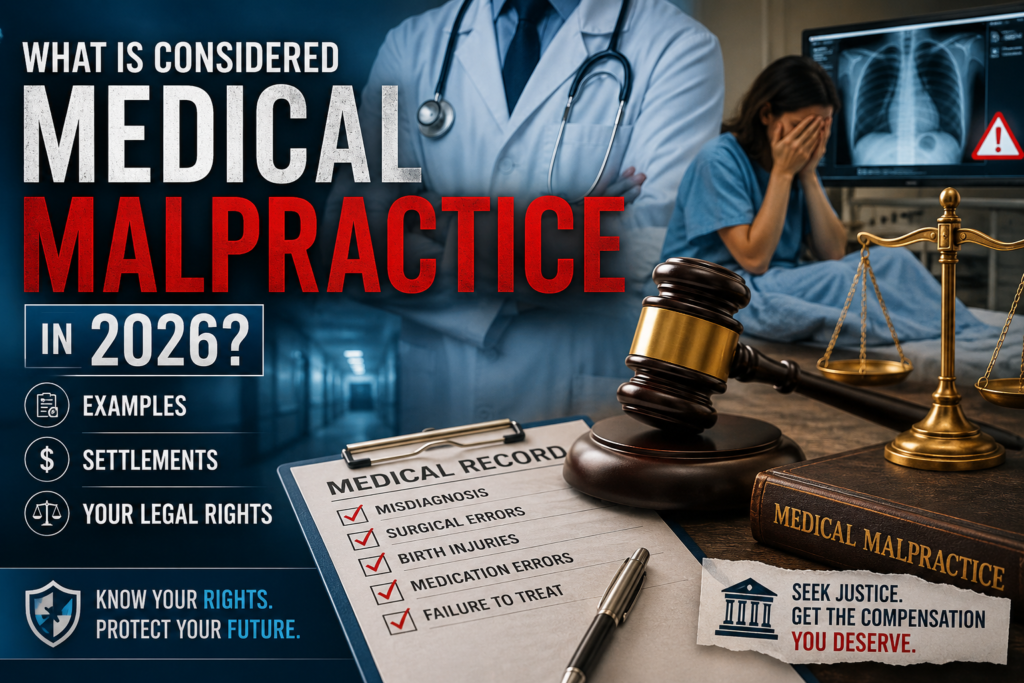
Introduction: What Is Considered Medical Malpractice in 2026?
If you or a loved one has suffered harm due to medical treatment, you may be wondering: what is considered medical malpractice?
Not every bad medical outcome is malpractice. Doctors are not legally required to achieve perfect results. However, when a healthcare provider’s negligence causes serious harm — harm that could have been prevented — that may be medical malpractice.
In 2026, medical malpractice settlements in the United States average between $250,000 and over $1 million depending on the severity of the harm. Understanding what legally qualifies as malpractice is the first step to protecting your rights and securing the compensation you deserve.
In this guide, we explain exactly what is considered medical malpractice, the four legal elements you must prove, real case examples with settlement amounts, and how to know if you have a valid claim. For a companion walkthrough of how these cases are handled by attorneys, see our Medical Malpractice Lawyer 2026 guide.
Legal Definition: What Is Medical Malpractice?
Medical malpractice occurs when a healthcare provider — a doctor, nurse, hospital, or other medical professional — fails to provide the standard of care that a reasonably competent provider would have given in the same situation, and that failure directly causes harm to the patient. Nolo’s medical malpractice legal guide provides additional background on how these claims work under U.S. law.
The 4 Legal Elements of Medical Malpractice
To prove medical malpractice in court, you must establish all four of these elements:
1. Duty of Care. The healthcare provider owed you a duty of care. This means a doctor-patient relationship existed. If a doctor treated you or agreed to treat you, this element is satisfied.
2. Breach of Standard of Care. The provider violated the accepted medical standard of care. This means they acted in a way that a reasonably competent doctor in the same specialty would not have acted under similar circumstances.
3. Causation. The breach of care directly caused your injury. It is not enough to show that the doctor made a mistake — you must prove that the mistake directly caused harm.
4. Damages. You suffered actual damages as a result. This includes medical expenses, lost wages, pain and suffering, disability, or wrongful death.
If any of these four elements is missing, you do not have a valid medical malpractice claim.
What Types of Medical Errors Are Considered Malpractice?
Medical malpractice can occur in many different medical settings and specialties. Here are the most common types:
1. Misdiagnosis or Delayed Diagnosis
When a doctor fails to correctly diagnose a serious condition — or delays diagnosis — and that delay causes the condition to worsen, it may be malpractice.
Common misdiagnosis cases:
- Cancer misdiagnosed as a benign condition
- Heart attack misdiagnosed as indigestion
- Stroke symptoms ignored or misinterpreted
- Bacterial infections misdiagnosed as viral
2026 Average Settlement: $300,000 to $800,000 depending on how the delayed diagnosis affected the patient’s prognosis.
2. Surgical Errors
Surgical mistakes are among the most serious forms of medical malpractice. These errors include:
- Operating on the wrong body part or wrong patient
- Leaving surgical instruments inside the patient
- Damaging organs, nerves, or blood vessels during surgery
- Performing the wrong procedure
- Anesthesia errors causing brain damage or death
2026 Average Settlement: $500,000 to $2,000,000+ for severe surgical errors.
3. Medication Errors
Medication errors occur when:
- The wrong medication is prescribed
- The wrong dosage is given
- Dangerous drug interactions are overlooked
- Medication is administered via the wrong route (IV instead of oral, etc.)
Medication errors are especially dangerous in hospital settings where multiple providers are involved in patient care.
2026 Average Settlement: $250,000 to $900,000 depending on the harm caused.
4. Birth Injuries and Obstetric Malpractice
Birth injuries caused by negligence during pregnancy, labor, or delivery can have lifelong consequences. Examples include:
- Failure to monitor fetal distress
- Improper use of forceps or vacuum extractors
- Delayed cesarean section
- Failure to diagnose maternal infections
- Oxygen deprivation causing cerebral palsy
2026 Average Settlement: $1,000,000 to $10,000,000+ for cases involving permanent disability or brain injury.
5. Failure to Treat
Even after a correct diagnosis, a doctor must provide appropriate treatment. Failure to treat occurs when:
- A doctor discharges a patient too early
- Follow-up care is not scheduled or recommended
- Test results are not communicated to the patient
- A serious condition is diagnosed but treatment is delayed or refused
2026 Average Settlement: $400,000 to $1,500,000 depending on the outcome.
6. Hospital-Acquired Infections
Hospitals have a duty to maintain sanitary conditions and follow infection control protocols. When negligence leads to a hospital-acquired infection (HAI) such as MRSA, sepsis, or surgical site infections, the hospital may be liable.
2026 Average Settlement: $300,000 to $1,200,000 depending on severity and permanent effects.
Real Medical Malpractice Case Examples (2026)
To better understand what is considered medical malpractice, here are real case examples with settlement amounts:
Case 1 — Delayed Cancer Diagnosis
The Facts: A 52-year-old woman visited her doctor complaining of persistent abdominal pain and unexplained weight loss. The doctor attributed her symptoms to stress and did not order imaging or further testing.
Fourteen months later, the woman was diagnosed with Stage 4 ovarian cancer. Medical experts testified that had the cancer been diagnosed at her initial visit, it would have been Stage 1 with a 90%+ survival rate.
Settlement Amount: $1,850,000
Why it was malpractice: A reasonably competent doctor would have ordered imaging given her symptoms. The delayed diagnosis directly caused the cancer to progress to an untreatable stage.
Case 2 — Wrong-Site Surgery
The Facts: A patient was scheduled for surgery to repair a torn meniscus in his right knee. The surgical team operated on the left knee by mistake. The error was not discovered until the patient woke from anesthesia.
The patient required a second surgery to repair the correct knee and suffered permanent damage to the incorrectly operated knee.
Settlement Amount: $950,000
Why it was malpractice: Operating on the wrong body part is a clear breach of the standard of care. Hospitals have multiple safety protocols to prevent wrong-site surgery.
Case 3 — Birth Injury Due to Delayed C-Section
The Facts: During labor, fetal monitoring showed clear signs of fetal distress. The obstetrician delayed performing an emergency cesarean section. By the time the baby was delivered, the infant had suffered oxygen deprivation resulting in cerebral palsy.
Settlement Amount: $8,200,000
Why it was malpractice: The standard of care required an immediate C-section when fetal distress was detected. The delay directly caused the child’s permanent brain injury.
Case 4 — Medication Overdose
The Facts: A hospital pharmacist miscalculated a pediatric dosage for a chemotherapy drug, administering 10 times the correct dose to a 6-year-old cancer patient. The overdose caused permanent kidney damage requiring lifetime dialysis.
Settlement Amount: $3,500,000
Why it was malpractice: Pharmacists must verify dosages, especially for high-risk medications in pediatric patients. The error was preventable and caused permanent harm.
Case 5 — Misdiagnosed Heart Attack
The Facts: A 58-year-old man presented to the emergency room with chest pain, shortness of breath, and arm pain. The ER doctor diagnosed acid reflux and discharged him with antacids.
The patient suffered a massive heart attack 6 hours later, resulting in permanent heart damage and disability.
Settlement Amount: $2,100,000
Why it was malpractice: The patient presented with classic heart attack symptoms. The standard of care required an EKG, cardiac enzyme tests, and cardiac monitoring. The misdiagnosis directly caused the heart attack to go untreated.
What Is NOT Considered Medical Malpractice
It is important to understand that not every bad outcome is malpractice. The following situations generally do not qualify:
1. Unsuccessful Treatment. If a doctor provides competent care following the standard of care but the treatment does not work, that is not malpractice. Medicine does not guarantee results.
2. Informed Refusal of Treatment. If you were properly informed of the risks and chose to refuse recommended treatment, and harm resulted, that is not malpractice.
3. Known Risks That Were Disclosed. Every medical procedure has risks. If you were informed of the risks and consented to treatment, and a known complication occurred, that is generally not malpractice.
4. Minor Errors With No Harm. If a doctor made a mistake but it did not cause any injury or harm, there is no malpractice claim. Remember, all four legal elements must be present.
Medical Negligence vs. Medical Malpractice: Is There a Difference?
People often use the terms “medical negligence” and “medical malpractice” interchangeably, but there is a technical distinction worth understanding. Negligence is the underlying legal concept: it means a healthcare provider failed to exercise the level of care that a reasonably competent provider would have used in the same situation.
Medical malpractice is the specific legal claim that arises when that negligence causes harm to a patient. In other words, negligence is the careless act or omission; malpractice is the lawsuit that follows when negligence produces injury and damages. An attorney evaluates your situation by first identifying the negligent act, then determining whether it caused compensable harm — only then does it become a viable malpractice case.
How to Know If You Have a Valid Medical Malpractice Claim
If you believe you may have been a victim of medical malpractice, ask yourself these questions:
1. Did a doctor-patient relationship exist? Were you treated by the healthcare provider in a professional medical capacity?
2. Would another competent doctor have acted differently? Would a reasonably competent doctor in the same specialty have provided different care under the same circumstances?
3. Did the error directly cause harm? Can you prove that the provider’s actions (or inaction) directly caused your injury?
4. Did you suffer actual damages? Did you incur medical expenses, lost income, pain and suffering, or permanent disability as a result?
If you answered yes to all four questions, you may have a valid medical malpractice claim.
What to Do If You Suspect Medical Malpractice
If you believe you are a victim of medical malpractice, take these steps immediately:
Step 1 — Get a Second Medical Opinion
See another doctor to confirm your condition and document what treatment you should have received. This independent medical opinion is critical evidence.
Step 2 — Obtain All Medical Records
Request copies of all medical records, test results, imaging, prescriptions, and treatment notes. You are legally entitled to your medical records.
Step 3 — Document Everything
Keep detailed records of:
- All symptoms and when they occurred
- Medical appointments and what was said
- Financial losses (medical bills, lost wages)
- How the injury has affected your daily life
Step 4 — Consult a Medical Malpractice Attorney
Medical malpractice cases are complex and require expert testimony. Most medical malpractice attorneys offer free consultations and work on a contingency fee basis — you pay nothing unless they win your case.
Do not wait. Every state has a statute of limitations for medical malpractice claims — typically 2 to 3 years from the date of injury or discovery of the injury. Our Medical Malpractice Lawyer 2026 guide explains these deadlines and the investigation process in detail.
How Much Is a Medical Malpractice Case Worth in 2026?
Medical malpractice settlement amounts depend on several factors:
1. Severity of Injury. Permanent disability, brain damage, and death result in the highest settlements.
2. Economic Damages. This includes all medical bills (past and future), lost wages, lost earning capacity, and cost of ongoing care.
3. Pain and Suffering. Non-economic damages for physical pain, emotional distress, loss of enjoyment of life, and disfigurement.
4. Punitive Damages. In cases of gross negligence or intentional misconduct, punitive damages may be awarded to punish the defendant.
Average settlement ranges in 2026:
| Injury Type | Average Settlement Range |
|---|---|
| Minor injury with full recovery | $100,000 – $300,000 |
| Moderate injury requiring surgery | $300,000 – $800,000 |
| Severe injury with permanent disability | $800,000 – $3,000,000 |
| Catastrophic injury (brain damage, paralysis) | $3,000,000 – $10,000,000+ |
| Wrongful death | $1,000,000 – $5,000,000+ |
Related Reading on Claim Justice USA
- Medical Malpractice Lawyer (2026 Guide): Lawsuits, Settlements & Your Legal Rights
- Medical Malpractice Settlement Calculator (USA, 2026)
- Should I Accept the First Settlement Offer? 2026 Guide
Frequently Asked Questions (FAQs)
1. How long do I have to file a medical malpractice lawsuit?
The statute of limitations varies by state but is typically 2 to 3 years from the date of the injury or from the date you discovered the injury. Some states have different rules for cases involving minors.
2. Do I need an expert witness to prove medical malpractice?
Yes. In almost all medical malpractice cases, you must have a medical expert testify that the defendant breached the standard of care. This is required by law in most states.
3. Can I sue a hospital for medical malpractice?
Yes. Hospitals can be liable for the negligence of their employees (nurses, pharmacists, technicians) or for systemic failures in policies and procedures.
4. What if the doctor says it was just a complication?
Not all complications are malpractice. However, if the doctor failed to inform you of the risk, failed to take appropriate precautions, or the complication resulted from negligence, it may still be malpractice.
5. Can I sue for emotional distress alone?
In most states, you cannot sue for medical malpractice based solely on emotional distress. You must have suffered actual physical harm or injury caused by the provider’s negligence.
6. How much does a medical malpractice lawyer cost?
Most medical malpractice attorneys work on a contingency fee basis, typically 30% to 40% of the recovery. You usually pay nothing upfront, and the lawyer only gets paid if compensation is recovered.
7. What is the average medical malpractice settlement in 2026?
Settlement amounts vary widely. Minor injury claims may settle between $100,000 and $300,000, while catastrophic injury or wrongful death cases can reach $10,000,000 or more.
8. Can medical malpractice happen during telehealth appointments?
Yes. Telemedicine errors are becoming more common in 2026. Misdiagnosis, delayed treatment, and failure to recognize emergency symptoms during virtual visits may sometimes lead to malpractice claims.
9. How long does a medical malpractice lawsuit take?
Some cases settle within months, while others can take several years depending on injury severity, evidence, expert testimony, and whether the case goes to trial.
10. What should I do first if I suspect medical malpractice?
Get a second medical opinion, request complete copies of your medical records, document symptoms and communications, and consult an experienced medical malpractice attorney before signing anything.
Conclusion
Understanding what is considered medical malpractice is critical to protecting your legal rights. Medical malpractice occurs when a healthcare provider breaches the standard of care and that breach directly causes harm to the patient.
Key takeaways from this guide:
- Medical malpractice requires proving all four legal elements: duty, breach, causation, and damages
- Common types of malpractice include misdiagnosis, surgical errors, medication errors, and birth injuries
- Not every bad outcome is malpractice — competent treatment that does not work is not negligence
- Medical malpractice settlements in 2026 range from $100,000 to over $10,000,000 depending on severity
- You must act quickly — statutes of limitations limit how long you have to file a claim
If you believe you have been harmed by medical negligence, consult with an experienced medical malpractice attorney immediately.
Disclaimer
This article is for informational purposes only and does not constitute legal or medical advice. Medical malpractice laws and settlement outcomes vary by state and case. Consult a licensed attorney and medical professional for advice specific to your situation.