
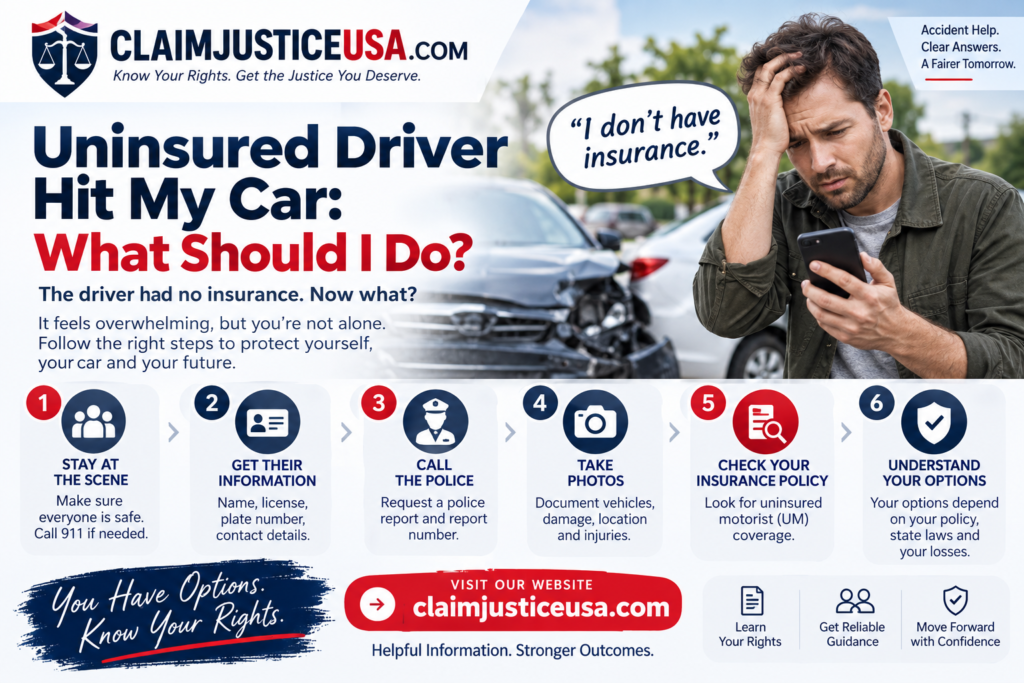
Uninsured Driver Hit My Car
The Driver Had No Insurance. Now What?
You exchange information after the crash.
You take pictures.
You call the police.
Then you ask the other driver for their insurance information.
That’s when you hear:
“I don’t have insurance.”
For many people, this is the moment the accident suddenly feels much worse.
You might immediately think:
“Who is going to pay for my car?”
“What about my medical bills?”
“Am I just stuck with everything?”
Not necessarily.
If an at-fault driver doesn’t have insurance, your options can depend on your own policy, your state’s laws, the circumstances of the accident, and the losses you suffered.
One important source of protection can be uninsured motorist (UM) coverage.
The National Association of Insurance Commissioners (NAIC) explains that uninsured motorist coverage can provide protection when you’re injured by an uninsured driver, and some policies may also include uninsured-motorist property-damage coverage.
So let’s walk through what you should actually do.
1. Stay at the Scene
Even if the other driver says they don’t have insurance, don’t simply drive away.
First, make sure everyone is safe.
If someone is injured, call 911.
If your vehicle can safely be moved out of traffic, do so.
Then contact law enforcement as appropriate.
The NAIC recommends prioritizing safety after a collision and collecting information about the other driver, witnesses, officers, location, weather, road conditions, and the accident itself.
2. Get the Other Driver’s Information
Even if the driver doesn’t have insurance, collect as much information as possible.
Try to obtain:
- Full name
- Address
- Driver’s license information
- License plate number
- Vehicle make and model
- Vehicle identification information, if available
- Phone number
- Any insurance information they provide
Don’t get into an argument with the driver.
You don’t need to convince them to admit fault at the scene.
Your job is to document what happened.
3. Call the Police
When you’re dealing with an uninsured driver, a police report can be especially important.
Tell the officer that the other driver says they don’t have insurance.
The officer may document the information available at the scene.
You should also ask how you can obtain the accident report and whether there is a report number.
A police report doesn’t automatically determine who wins a later insurance dispute, but it can become an important piece of documentation.
4. Take Plenty of Photos
Your phone can become one of the most useful pieces of evidence you have.
Photograph:
- Your vehicle
- The other vehicle
- License plates
- Damage from different angles
- The accident scene
- Traffic signs
- Road conditions
- Skid marks, if visible
- Nearby intersections
- Debris
- Visible injuries
If there are witnesses, get their contact information if possible.
The NAIC recommends documenting the accident scene and collecting witness information after a crash.
5. Check Your Own Insurance Policy
This is where things get interesting.
If the other driver has no insurance, your own insurance policy may contain uninsured motorist coverage.
UM coverage is designed to protect you in certain accidents involving an at-fault uninsured driver.
The exact coverage, limits, conditions, deductibles, and claim procedures vary by state and policy.
Look at your policy for terms such as:
Uninsured Motorist
UM
UMBI
Uninsured Motorist Bodily Injury
Uninsured Motorist Property Damage
Don’t assume that having “full coverage” automatically means you have every type of protection.
Read the actual policy.
6. Understand Uninsured vs. Underinsured
These two terms sound similar, but they’re different.
Uninsured Driver
The at-fault driver has no applicable liability insurance.
Your UM coverage may potentially apply if you have it and the claim meets the policy and legal requirements.
Underinsured Driver
The driver has insurance, but their liability limits may not be enough to cover your losses.
That’s where underinsured motorist (UIM) coverage may become relevant.
The NAIC explains that UIM coverage is intended for situations where the at-fault driver’s insurance isn’t sufficient to cover the damages.
7. Report the Accident to Your Insurance Company
Don’t wait unnecessarily to notify your insurer.
Call the claims number listed on your insurance card or use the insurer’s available claims process.
Tell them:
- When the accident happened
- Where it happened
- That another driver was involved
- That the driver reportedly had no insurance
- Whether anyone was injured
- Whether your vehicle was damaged
- Whether police responded
The NAIC advises consumers to contact their insurer as soon as possible when filing an auto claim.
8. Don’t Forget About Medical Injuries
Sometimes the biggest mistake after a crash is focusing only on the car.
Your vehicle can be repaired.
Your health is more important.
If you were injured, seek appropriate medical attention.
Keep records of:
- Doctor visits
- Emergency-room treatment
- Prescriptions
- Medical bills
- Physical therapy
- Follow-up appointments
- Work you missed
- Out-of-pocket expenses
Some states and policies may also have other types of first-party medical coverage, such as medical payments or PIP, depending on where you live and what coverage you purchased.
9. Keep a File for Your Claim
Here’s something simple that can save you a lot of frustration.
Create one folder on your computer or phone.
Call it:
Car Accident – Uninsured Driver Claim
Put everything inside it.
Accident Documents
- Police report
- Photos
- Videos
- Witness information
Insurance Documents
- Your insurance policy
- Claim number
- Insurance correspondence
- Adjuster information
Medical Documents
- Bills
- Medical records
- Prescriptions
- Treatment notes
Vehicle Documents
- Repair estimates
- Towing receipt
- Rental-car receipts
- Vehicle photographs
Communication
Keep notes of calls with:
- Your insurance company
- Adjuster
- Repair shop
- Medical providers
- Other involved parties
Good organization makes it much easier to understand what is happening with your claim.
10. What If You Only Have Liability Insurance?
This is where your situation can become more complicated.
Liability insurance generally protects you when you are legally responsible for injuries or property damage to someone else.
It doesn’t automatically mean your own vehicle damage is covered.
For damage to your own vehicle, collision coverage may be relevant depending on your policy. The NAIC explains that collision coverage generally applies to damage to your vehicle from a collision, while liability coverage addresses damage or injuries you cause to others.
So if an uninsured driver hits you, check what coverage you actually purchased.
11. What If You Have Uninsured Motorist Coverage?
If your policy includes UM coverage, your own insurer may become involved in the claim.
But this doesn’t mean the insurer automatically pays whatever amount you request.
The insurer can still investigate:
- How the accident happened
- Who was at fault
- Whether the other driver was actually uninsured
- Your injuries
- Vehicle damage
- Available coverage
- Policy limits
- Applicable exclusions and conditions
That’s why evidence matters.
12. Don’t Accept a Settlement Too Quickly
Imagine the insurance company says:
“We can close this claim for $8,000.”
It may be tempting to accept immediately.
But before agreeing to a settlement, understand what the payment is supposed to cover and what rights you may be giving up.
This is particularly important if you’ve suffered injuries that haven’t fully resolved.
A settlement can have legal consequences.
If you’re unsure about the terms, consider getting advice from a qualified attorney before signing anything that releases claims.
A Realistic Example
Let’s say Sarah is driving home from work.
Another driver runs a red light and hits her.
Sarah’s car is badly damaged.
The police arrive.
The other driver admits they don’t have insurance.
Sarah initially thinks:
“I’m going to have to pay for everything myself.”
But when Sarah checks her own policy, she discovers that she has uninsured motorist coverage.
She reports the accident to her insurer and provides:
- Police report
- Accident photographs
- Vehicle damage photographs
- Repair estimate
- Medical records
- Witness information
Her insurer investigates the claim.
Whether Sarah ultimately receives payment, how much she receives, and which losses are covered will depend on her policy, state law, the evidence, and the specific facts of the accident.
The important point is that checking your own policy gave Sarah another potential path forward.
What If the Uninsured Driver Was Clearly at Fault?
You might think:
“If they caused the accident, they have to pay me.”
Legally, an at-fault driver may be personally responsible for damages in appropriate circumstances.
But there’s an important practical problem:
Can they actually pay?
Someone may have legal responsibility for your damages without having enough money or assets to satisfy a judgment.
That’s one reason insurance coverage can be so important.
If you have UM/UIM coverage, it may provide an additional avenue for compensation depending on your policy and state law.
Can You Sue an Uninsured Driver?
Potentially, yes.
But whether filing a lawsuit makes practical sense is another question.
Before suing, consider:
- How strong is the evidence?
- Who was actually at fault?
- How serious are the injuries?
- What are your total damages?
- Does the driver have assets?
- Is there applicable insurance coverage?
- What are the legal deadlines?
- What would litigation cost?
Winning a judgment doesn’t necessarily guarantee that you’ll be able to collect the full amount.
That’s why understanding available insurance coverage should usually be part of the early analysis.
What If the Driver Leaves the Scene?
That’s a different situation.
If the other driver leaves without providing information, you may be dealing with a hit-and-run accident.
In that situation, contact law enforcement promptly and document everything you can.
Depending on your policy and state law, uninsured motorist coverage may potentially apply to certain hit-and-run situations. The NAIC specifically identifies hit-and-run drivers as one circumstance in which UM coverage may provide protection, subject to applicable requirements.
What Can Make an Uninsured Driver Claim More Complicated?
Several things can create additional questions.
For example:
Multiple Vehicles
More than one driver may share responsibility.
Serious Injuries
Large medical expenses can make coverage limits particularly important.
Disputed Fault
The other driver may tell a different story.
Hit-and-Run
You may not know who the driver was.
Policy Questions
Your insurer may need to determine whether your UM/UIM coverage applies.
Multiple Insurance Policies
There may be questions about which policies provide coverage and in what order.
These cases can become fact-specific very quickly.
Uninsured Driver Accident Checklist
If an uninsured driver hits you, remember:
☐ Get to safety
☐ Call 911 if someone is injured
☐ Contact police as appropriate
☐ Get the other driver’s information
☐ Photograph the vehicles and accident scene
☐ Get witness information
☐ Seek medical attention if needed
☐ Notify your insurance company
☐ Review your UM/UIM coverage
☐ Keep every bill and receipt
☐ Keep copies of all claim communications
☐ Don’t rush into a settlement
☐ Check applicable deadlines
Final Thoughts
Getting hit by an uninsured driver can make an already stressful accident even more confusing.
But “the other driver has no insurance” doesn’t automatically mean you have no options.
Start by documenting the accident.
Then review your own policy for uninsured and underinsured motorist coverage.
Notify your insurer.
Keep your medical and financial records organized.
And if the accident involves serious injuries, a disputed claim, significant damages, or complicated insurance issues, consider speaking with a qualified attorney who understands the law in your state.
The NAIC notes that UM/UIM coverage and related requirements can vary by state, so the details of your own policy and local law matter.
Don’t panic. Don’t guess. Check your coverage, preserve your evidence, and understand your options.
Helpful External Resources
National Association of Insurance Commissioners — Uninsured Motorists
The NAIC provides information about uninsured motorists and UM/UIM coverage.
NAIC — Auto Insurance
Useful background on liability, collision, comprehensive, and uninsured/underinsured motorist coverage.
NAIC — What Does Auto Insurance Cover?
Updated June 11, 2026, this guide explains common types of auto insurance coverage, including UM/UIM.
NAIC — What Does Auto Insurance Cover?
Disclaimer
This article is for general informational and educational purposes only and does not constitute legal advice. Insurance coverage, uninsured/underinsured motorist claims, liability rules, deadlines, and lawsuit procedures vary by state and individual circumstances. Reading this article does not create an attorney-client relationship. If you have been involved in an accident with an uninsured or underinsured driver, consider consulting a qualified attorney licensed in your state for advice about your specific situation.
