
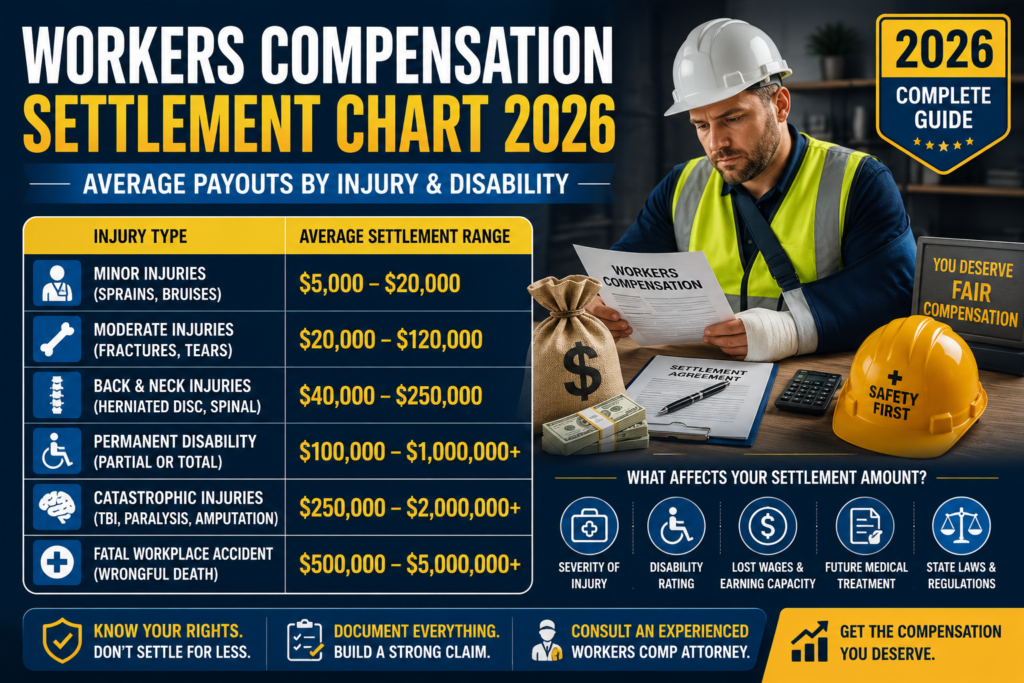
Workers Compensation Settlement Chart
One of my relatives thought workers’ compensation would be simple.
He slipped while unloading heavy boxes at work, injured his lower back, and assumed:
“The company insurance will handle everything.”
At first, it looked straightforward.
The employer reported the injury.
Medical treatment started.
And weekly workers’ comp checks began arriving.
But within months, problems started appearing.
The insurance company questioned:
- whether the injury was work-related,
- whether surgery was necessary,
- and whether he was “fully recovered” enough to return to work.
That’s when the real confusion started.
How much is a workers compensation settlement actually worth?
Why do some injured workers receive:
- $10,000,
while others receive: - $500,000 or more?
And how do insurance companies calculate payouts in 2026?
The reality is:
workers compensation settlement amounts vary massively depending on:
- injury severity,
- permanent disability,
- lost earning capacity,
- state laws,
- future medical treatment,
- and how strong your evidence is.
Some injured workers unknowingly accept low settlements because:
- bills are piling up,
- weekly checks stopped,
- or they simply don’t understand the long-term value of the claim.
This guide breaks down:
- average workers compensation settlement amounts in 2026,
- settlement charts by injury type,
- state differences,
- real payout examples,
- and practical ways to maximize your claim before accepting any offer.
What Is a Workers Compensation Settlement?
Workers compensation is an insurance system designed to provide benefits to employees injured on the job.
Instead of suing the employer directly in most cases, injured workers usually receive:
- medical treatment coverage,
- wage replacement,
- disability benefits,
- rehabilitation support,
- and settlement compensation.
A workers compensation settlement is usually a lump-sum payment resolving part or all of the claim.
Some settlements close:
- wage benefits only.
Others close:
- both wage and future medical benefits permanently.
That difference matters enormously.
Average Workers Compensation Settlement Amounts in 2026
Here’s a general breakdown of average workers compensation settlement ranges in the United States in 2026.
| Injury Type | Average Settlement Range |
|---|---|
| Minor soft tissue injuries | $5,000 – $20,000 |
| Shoulder injuries | $20,000 – $80,000 |
| Knee injuries | $25,000 – $120,000 |
| Back injuries / herniated discs | $40,000 – $250,000 |
| Neck injuries | $30,000 – $150,000 |
| Broken bones / fractures | $15,000 – $100,000 |
| Surgery-related claims | $75,000 – $300,000 |
| Permanent disability | $100,000 – $1,000,000+ |
| Traumatic brain injury (TBI) | $250,000 – $2,000,000+ |
| Fatal workplace accident | $500,000 – $5,000,000+ |
These ranges are based on:
- injury severity,
- disability level,
- state benefit caps,
- and future medical costs.
No settlement is guaranteed.
Some claims settle lower.
Some settle dramatically higher.
Workers Compensation Settlement Chart by Body Part
Certain injuries consistently produce larger settlements because they affect:
- mobility,
- long-term work ability,
- and future medical care.
Back Injury Settlement Chart
| Back Injury Type | Estimated Settlement |
|---|---|
| Mild lumbar strain | $10,000 – $30,000 |
| Herniated disc | $40,000 – $150,000 |
| Multiple disc injuries | $100,000 – $300,000 |
| Spinal fusion surgery | $150,000 – $500,000+ |
| Permanent spinal disability | $500,000 – $2,000,000+ |
Back injuries are among the most disputed workers comp claims because insurers often argue:
- degeneration,
- aging,
- or pre-existing conditions.
Knee Injury Settlement Chart
| Knee Injury Type | Estimated Settlement |
|---|---|
| Minor sprain | $5,000 – $15,000 |
| Torn meniscus | $20,000 – $60,000 |
| ACL tear | $40,000 – $120,000 |
| Knee replacement | $100,000 – $300,000+ |
Workers in:
- warehouses,
- construction,
- delivery jobs,
- and manufacturing
commonly suffer knee injuries from repetitive stress and falls.
Shoulder Injury Settlement Chart
| Shoulder Injury Type | Estimated Settlement |
|---|---|
| Rotator cuff strain | $10,000 – $30,000 |
| Torn rotator cuff | $30,000 – $100,000 |
| Shoulder surgery | $75,000 – $250,000+ |
Shoulder injuries often affect:
- lifting ability,
- overhead movement,
- and long-term physical work capacity.
What Determines a Workers Compensation Settlement Amount?
This is where things become complicated.
Insurance companies don’t randomly choose numbers.
Several factors heavily affect settlement value.
1. Severity of the Injury
This is usually the biggest factor.
Minor injuries that heal quickly settle lower.
Permanent injuries settle dramatically higher.
Especially when the worker cannot return to the same career.
2. Permanent Disability Rating
Many states use disability percentages.
Doctors evaluate:
- mobility limitations,
- pain,
- loss of function,
- and work restrictions.
Example:
A worker receiving:
25% permanent disability
usually receives more compensation than someone with:
5% disability.
3. Future Medical Treatment
Future medical costs can massively increase settlement value.
Especially involving:
- surgeries,
- injections,
- physical therapy,
- medications,
- or long-term rehabilitation.
One major mistake workers make:
settling before understanding future treatment needs.
4. Lost Earning Capacity
If injuries reduce future income potential, settlements rise significantly.
Example:
A construction worker earning:
$90,000/year
who can no longer perform heavy labor may face:
- decades of reduced income.
That lost earning potential becomes part of the claim value.
5. State Workers Compensation Laws
Every state handles workers compensation differently.
Some states:
- cap benefits aggressively,
- while others allow larger disability awards.
This creates huge payout differences nationwide.
Workers Compensation Settlement Differences by State
California
California generally produces larger settlements because:
- medical costs are high,
- wages are high,
- and disability calculations can favor workers.
Texas
Texas has stricter systems in many cases.
Some employers also operate outside traditional workers comp systems entirely.
New York
New York often sees higher settlements involving:
- construction accidents,
- union labor,
- and urban workplace injuries.
Florida
Florida has large numbers of:
- hospitality injuries,
- healthcare worker claims,
- and warehouse accidents.
Temporary vs Permanent Disability Settlements
This distinction matters enormously.
Temporary Disability
These benefits cover workers unable to work temporarily while recovering.
Usually paid weekly.
Permanent Partial Disability (PPD)
Applies when workers recover partially but still have lasting limitations.
Examples:
- reduced lifting capacity,
- chronic pain,
- or restricted movement.
Permanent Total Disability (PTD)
The most serious category.
Applies when workers cannot return to gainful employment.
These cases often involve:
- paralysis,
- severe brain injury,
- or catastrophic spinal injuries.
Real Workers Compensation Settlement Examples
Case 1 — Warehouse Back Injury
The Facts:
A warehouse employee lifted heavy inventory repeatedly and developed multiple lumbar disc herniations.
Treatment included:
- injections,
- physical therapy,
- and spinal surgery.
Damages
- Medical costs: $145,000
- Lost wages: $52,000
- Future restrictions: permanent lifting limitations
Settlement
$385,000
Key factor:
The worker could no longer return to physical warehouse labor.
Case 2 — Construction Fall Injury
The Facts:
A roofer fell from scaffolding and fractured both legs.
Multiple surgeries were required.
Damages
- Surgeries: $210,000
- Rehabilitation: $75,000
- Lost future income: substantial
Settlement
$920,000
Key factor:
Permanent mobility restrictions ended the worker’s construction career.
Case 3 — Nurse Shoulder Injury
The Facts:
A nurse injured her shoulder while lifting a patient.
MRI scans revealed a torn rotator cuff requiring surgery.
Damages
- Surgery and therapy: $68,000
- Missed work: 5 months
- Permanent lifting restrictions
Settlement
$142,000
Key factor:
Healthcare workers often face reinjury risk, increasing settlement value.
Case 4 — Delivery Driver Knee Injury
The Facts:
A delivery driver slipped on wet stairs during a delivery route and tore his ACL.
Damages
- ACL surgery
- Rehabilitation
- Reduced work mobility
Settlement
$118,000
Key factor:
The injury directly affected driving and delivery performance.
Why Insurance Companies Push Early Settlements
This surprised many workers I spoke with.
Insurers often contact injured workers quickly after injuries stabilize.
Why?
Because early settlements usually favor insurance companies.
At that stage:
- future surgeries may still be unknown,
- long-term disability isn’t fully understood,
- and workers are financially stressed.
That pressure causes many people to settle too early.
Common Mistakes That Reduce Workers Comp Settlements
Delaying Medical Treatment
Insurance companies argue delayed treatment means injuries weren’t serious.
Ignoring Doctor Restrictions
Returning to heavy work too early can damage both health and claim value.
Posting on Social Media
Photos and videos can absolutely be used against injury claims.
Missing Appointments
Gaps in treatment weaken credibility significantly.
Settling Too Early
This is one of the biggest mistakes.
Especially before:
- surgery decisions,
- disability ratings,
- or future medical needs become clear.
What Is a “Good” Workers Compensation Settlement?
A strong settlement usually covers:
- all medical bills,
- future treatment,
- wage loss,
- disability impact,
- and long-term earning reduction.
If serious injuries exist and future care is ignored, the settlement may be too low.
Lump Sum vs Structured Settlements
Workers comp settlements may pay:
- one large lump sum,
or: - structured payments over time.
Lump sums provide flexibility but require careful financial planning.
Structured settlements provide long-term stability but less immediate access.
Should You Hire a Workers Compensation Lawyer?
For small injuries with quick recovery, maybe not.
But legal help becomes extremely valuable for:
- surgeries,
- permanent disability,
- denied claims,
- large wage loss,
- or disputed medical treatment.
Studies consistently show represented workers often recover significantly higher compensation.
Most workers comp lawyers work on contingency fees approved by the state.
How Long Does a Workers Compensation Settlement Take?
Simple claims may settle within:
- several months.
Complex cases involving:
- surgery,
- permanent disability,
- or litigation
can take:
- 1–3 years or longer.
Patience often improves outcomes.
Workers Compensation vs Personal Injury Lawsuits
This confuses many people.
Workers comp usually prevents suing the employer directly.
But in some cases, injured workers may also file:
third-party lawsuits.
Examples include:
- defective equipment,
- subcontractor negligence,
- unsafe property conditions,
- or vehicle accidents involving outside drivers.
These combined claims can dramatically increase total compensation.
State Filing Deadlines Matter
Every state has deadlines for:
- reporting injuries,
- filing claims,
- and appealing denials.
Missing deadlines can destroy the claim entirely.
That’s why early reporting matters so much.
Frequently Asked Questions (FAQs)
1. What is the average workers compensation settlement in 2026?
Most settlements range from $5,000 to several hundred thousand dollars depending on injury severity.
2. How is workers comp settlement calculated?
Factors include:
- medical costs,
- disability rating,
- lost wages,
- future treatment,
- and earning capacity loss.
3. Are workers compensation settlements taxable?
In most situations, workers compensation benefits are not taxable under federal law.
4. Can I negotiate a workers compensation settlement?
Yes. Settlement offers are often negotiable.
5. Should I accept the first workers comp offer?
Usually not before fully understanding future medical needs and disability impact.
6. How long does workers comp settlement take?
Simple claims may settle within months while complex claims can take years.
7. Can I sue my employer after a workplace injury?
Usually no, but third-party lawsuits may still be possible in certain cases.
8. What injuries produce the largest settlements?
Catastrophic injuries like spinal damage and brain injuries usually produce the highest payouts.
9. What happens if surgery is needed later?
Future surgery costs can significantly increase settlement value.
10. Can workers compensation cover permanent disability?
Yes. Permanent disability benefits exist in most states.
11. Do I need a lawyer for workers comp?
Serious injury cases often benefit significantly from legal representation.
12. What if my claim is denied?
Denied claims can often be appealed with legal assistance.
13. Can I receive both workers comp and Social Security disability?
Sometimes yes, although offsets may apply.
14. Does age affect settlement value?
Older workers with severe injuries may sometimes face larger future earning limitations.
15. What’s the biggest mistake injured workers make?
Settling too early before future medical needs become fully clear.
Conclusion
Workers compensation settlements in 2026 range from relatively small payouts for temporary injuries to multi-million-dollar settlements for catastrophic disability cases.
The most important factors affecting your settlement are:
- injury severity,
- permanent disability,
- future treatment costs,
- lost earning capacity,
- and state-specific laws.
One thing became very obvious while researching workers compensation cases:
Insurance companies move fast when they believe workers don’t fully understand claim value.
That’s why documentation, medical treatment consistency, and patience matter enormously.
For serious injuries:
- never rush settlements,
- understand future medical needs,
- and consider speaking with an experienced workers compensation attorney before signing final paperwork.
Sometimes the difference between a weak settlement and a strong one is simply understanding what the claim is actually worth before accepting the first offer.
Disclaimer
This article is for informational and educational
Related 2026 Settlement Guides
If this workers compensation guide helped you, explore our other 2026 settlement resources:
- Uber Accident Settlement Guide 2026 — Average Payouts, Insurance Claims & Legal Rights
- Medical Malpractice Settlement Guide USA 2026 — Average Payouts & Lawsuit Process
- Wrongful Death Lawsuit Settlement Guide 2026 — Average Payouts & Legal Rights
- Car Accident Lawyers Near Me: 15 Ways to Find the Best Legal Help Fast
For authoritative background on how workers comp settlements work, see Nolo’s guide to workers’ comp settlements and the U.S. Department of Labor’s Office of Workers’ Compensation Programs.
purposes only and does not constitute legal, medical, or financial advice. Workers compensation laws vary by state and individual case facts. Settlement outcomes depend on medical evidence, disability ratings, insurance policies, and local regulations. Always consult a licensed workers compensation attorney regarding your specific situation.