
Car Accident Settlement Calculator:
Introduction
A car accident can disrupt someone’s life within seconds. While the immediate concern is usually physical safety and medical treatment, the financial consequences of an accident often become the biggest long-term burden for victims.
Medical bills can rise quickly. Emergency treatment, hospital stays, diagnostic tests, rehabilitation, and follow-up appointments can easily cost thousands of dollars. On top of this, many accident victims miss work during recovery, resulting in lost income and additional financial stress.
Because of these factors, many accident victims ask the same question:
“How much compensation will I receive from my car accident settlement?”
The reality is that settlement amounts vary significantly depending on many variables. Some minor accident claims may settle for $10,000 to $20,000, while severe injury cases may exceed $500,000 or even several million dollars.
Several factors influence settlement amounts, including:
-
The severity of injuries
-
Medical expenses and future treatment
-
Liability (who caused the accident)
-
Insurance policy limits
-
Legal representation
-
State laws governing personal injury claims
Insurance companies carefully evaluate these factors when calculating compensation offers.
Understanding how settlements are calculated can help accident victims avoid accepting unfair offers and better prepare for negotiations with insurance companies.
In this comprehensive guide, we will explore:
-
How car accident settlements are calculated
-
Average payout ranges in the United States
-
The key legal factors that influence settlement value
-
Insurance negotiation strategies
-
The timeline for personal injury claims
For additional legal resources about personal injury law, the American Bar Association provides guidance for accident victims and legal professionals:
Understanding these legal principles can help accident victims make more informed decisions during the settlement process.
Disclaimer: This article is for informational purposes only and does not constitute legal advice. Settlement outcomes vary based on jurisdiction and case details.
Section 1: Understanding Car Accident Settlements
A car accident settlement is a financial agreement between the injured party and the insurance company or at-fault driver.
Instead of taking the case to court, both parties agree to resolve the claim through compensation.
Most personal injury claims in the United States settle outside of court. Trials are expensive and time-consuming for both parties, so settlements are often the preferred outcome.
A typical settlement includes compensation for several types of damages.
These damages are divided into two major categories:
-
Economic damages
-
Non-economic damages
Each category represents different types of losses suffered by accident victims.
Section 2: Economic Damages
Economic damages refer to financial losses that can be documented with receipts, bills, and financial records.
These damages are typically the easiest part of a settlement to calculate.
Examples include:
-
Emergency medical treatment
-
Surgery and hospital bills
-
Prescription medication
-
Physical therapy and rehabilitation
-
Medical equipment
-
Property damage
-
Lost wages
-
Reduced earning capacity
For example, if an accident victim spends $25,000 on medical treatment and misses several weeks of work resulting in $8,000 in lost wages, these expenses become part of the economic damages calculation.
Insurance companies typically request documentation to verify these costs before offering compensation.
Reliable data about traffic accidents and injury statistics can also be found through the National Highway Traffic Safety Administration, which publishes annual crash reports and injury statistics:
These statistics demonstrate the widespread financial impact of car accidents in the United States.
Section 3: Non-Economic Damages
Non-economic damages compensate victims for losses that cannot be measured with receipts or invoices.
These damages often represent the emotional and physical impact of an accident.
Examples include:
-
Pain and suffering
-
Emotional distress
-
Anxiety or PTSD
-
Loss of enjoyment of life
-
Loss of companionship
Insurance companies often estimate non-economic damages using a multiplier method.
The multiplier is applied to the total economic damages to estimate compensation for pain and suffering.
Pain and Suffering Multiplier
| Injury Severity | Multiplier |
|---|---|
| Minor injuries | 1.5 – 2 |
| Moderate injuries | 2 – 3 |
| Severe injuries | 3 – 5 |
| Permanent disability | 5+ |
For example:
If economic damages total $30,000 and the multiplier is 3, the estimated settlement could be:
$30,000 × 3 = $90,000
Adding the original damages would produce a settlement estimate of $120,000.
Section 4: Average Car Accident Settlement Amounts
Settlement values vary depending on injury severity.
Below are general ranges based on common personal injury claims in the United States.
| Injury Type | Average Settlement |
|---|---|
| Minor injuries | $10,000 – $25,000 |
| Moderate injuries | $25,000 – $100,000 |
| Severe injuries | $100,000 – $500,000 |
| Catastrophic injuries | $500,000 – $2,000,000+ |
These numbers represent approximate averages and should not be interpreted as guaranteed payouts.
Insurance coverage also plays a major role in determining final compensation.
The Insurance Information Institute publishes detailed data about insurance policies and claim payouts:
Their reports show that policy limits frequently determine how much compensation accident victims receive.
Section 5: Factors That Influence Settlement Value
Several key factors determine settlement amounts.
Liability
Determining who caused the accident is one of the most important aspects of any personal injury claim.
Many states use a legal rule called comparative negligence.
Under this rule, compensation may be reduced if the injured person shares responsibility for the accident.
Example:
If a victim is found 20% responsible, their compensation may be reduced by 20%.
Insurance Policy Limits
Insurance policies have maximum coverage limits.
If a driver has only $25,000 in liability coverage, the insurance company may not pay more than that amount unless additional legal action is taken.
Medical Documentation
Medical records provide critical evidence supporting an injury claim.
Insurance companies carefully review medical records when evaluating settlement offers.
Missing appointments or delaying treatment can weaken a claim.
Jurisdiction
Settlement values can vary depending on location.
Major metropolitan areas often see larger settlements compared to rural regions.
This difference is influenced by local jury verdicts, medical costs, and legal practices.
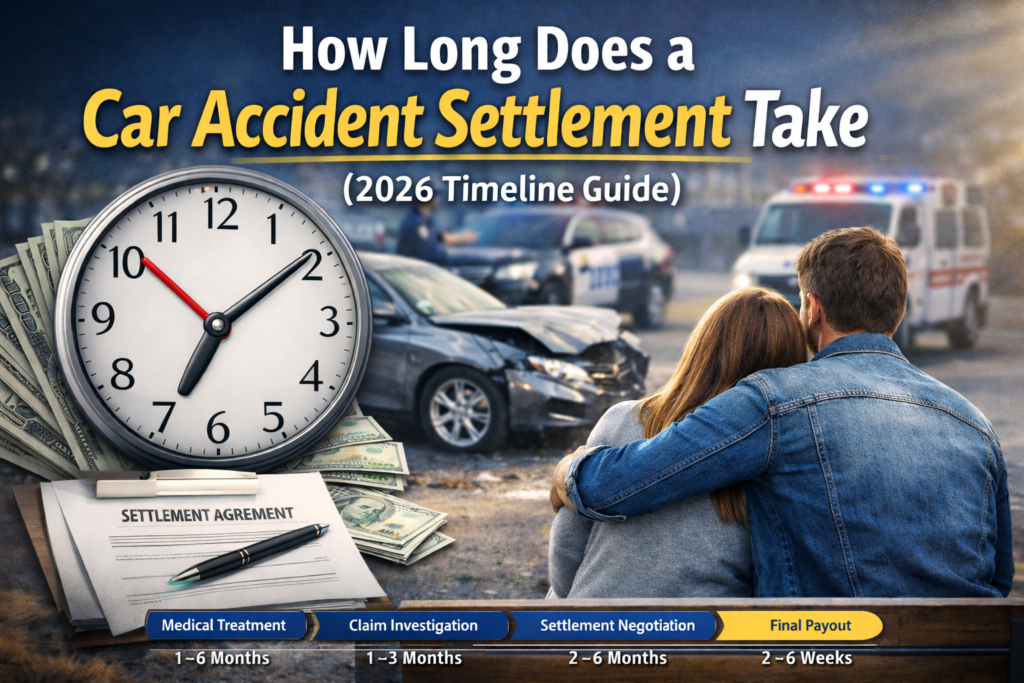
Section 6: Car Accident Settlement Timeline
Personal injury claims usually follow a predictable timeline.
Step 1 – Medical Treatment
Victims receive medical care and begin documenting injuries.
Step 2 – Insurance Claim
The accident is reported to the insurance company.
Step 3 – Investigation
Insurance adjusters review police reports, witness statements, and medical records.
Step 4 – Demand Letter
The injured party submits a demand letter requesting compensation.
Step 5 – Negotiation
Insurance companies respond with an initial offer and negotiations begin.
Step 6 – Settlement or Lawsuit
If negotiations fail, the case may proceed to court.
However, most claims settle before reaching trial.
Section 7: Insurance Company Negotiation Strategies
Insurance companies are businesses whose primary goal is to reduce claim costs.
Adjusters may use several strategies during negotiations.
Common tactics include:
-
Offering quick settlements
-
Questioning medical treatment
-
Blaming partial fault on the victim
-
Disputing long-term injury claims
Understanding these strategies can help accident victims avoid accepting low settlement offers.
Section 8: Common Mistakes That Reduce Settlement Value
Many accident victims unintentionally reduce their settlement value.
Common mistakes include:
-
Not seeking immediate medical treatment
-
Admitting fault at the accident scene
-
Posting accident details on social media
-
Accepting the first settlement offer
-
Failing to keep medical documentation
Avoiding these mistakes can significantly improve compensation outcomes.
Section 9: FAQs
How long does a car accident settlement take?
Most settlements take between 3 and 12 months depending on injury severity and negotiations.
Do I need a lawyer for a car accident claim?
Minor cases may not require legal representation, but attorneys often increase settlement value in serious cases.
Are car accident settlements taxable?
Most personal injury settlements are not taxable under federal law.
What if the other driver has no insurance?
Victims may file claims under uninsured motorist coverage.
Can a settlement exceed insurance coverage?
In some cases, lawsuits may allow compensation beyond insurance limits.
What is a lowball offer?
A lowball offer is an initial settlement significantly lower than the claim’s actual value.
Should I accept the first settlement offer?
Many lawyers recommend negotiating before accepting the first offer.
Does a police report guarantee compensation?
Police reports provide evidence but do not determine final settlement amounts.
Can settlements include future medical costs?
Yes, settlements may include projected future treatment expenses.
What affects settlement value the most?
Injury severity, liability, and insurance coverage are the most influential factors.
Conclusion
Car accident settlements depend on numerous factors, including medical expenses, liability, insurance coverage, and legal strategy.
While minor accidents may result in relatively small settlements, severe injuries often lead to significantly larger payouts.
Understanding how settlement values are calculated can help accident victims make informed decisions during negotiations and avoid accepting unfair offers.
If you have been involved in a car accident, documenting injuries, maintaining medical records, and understanding your legal rights are critical steps toward securing fair compensation.
Disclaimer
This article is intended for educational purposes only and should not be considered legal advice. Settlement outcomes vary based on case circumstances and state laws. Always consult a qualified personal injury attorney regarding your specific legal situation.
average car accident settlement USA, average car accident settlement USA,
-
car accident settlement calculator
-
average injury settlement USA
-
personal injury settlement amount