
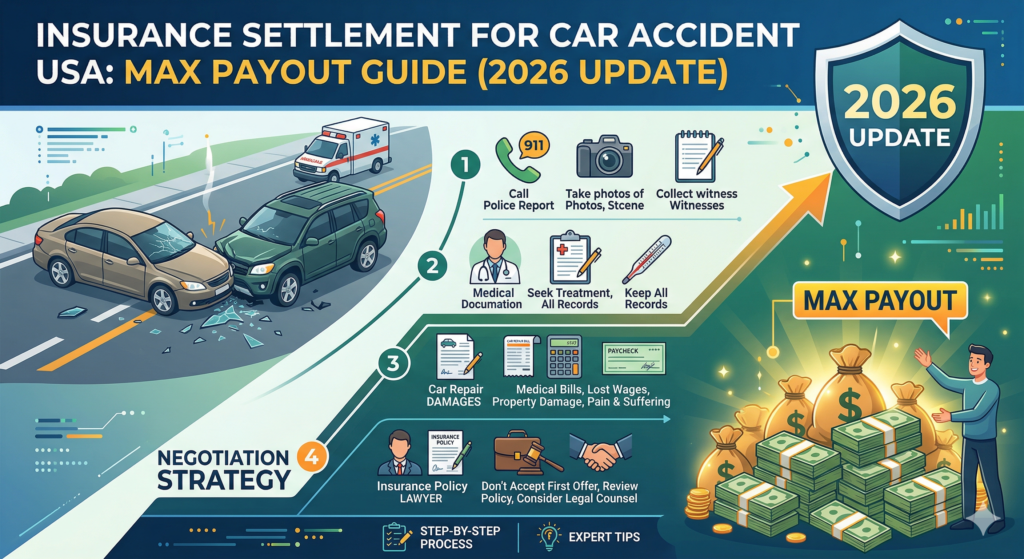
After a car accident, the first question most people ask is: “How much is my settlement worth?” The answer depends on far more than the damage to your car. Insurance companies follow specific playbooks to keep payouts low — and the people who receive the largest settlements are the ones who understand how those playbooks work.
This 2026 guide covers everything you need to know: what your claim is actually worth, how insurers calculate offers, the step-by-step claim process, advanced negotiation strategies, and the state laws that can make or break your case. For a broader overview of how insurance payouts work across all claim types, see our Insurance Settlement Guide USA 2026.
What Is a Car Accident Insurance Settlement?
An insurance settlement is a negotiated agreement in which the at-fault driver’s insurance company pays you compensation for your losses, and you agree to release any further legal claims. Most car accident cases in the United States are resolved this way — roughly 95% never reach a courtroom.
A settlement typically compensates you for:
- Medical expenses — emergency care, hospital bills, surgeries, medication, and rehabilitation
- Lost wages — income lost while recovering, plus reduced future earning capacity
- Property damage — vehicle repair or replacement, and damaged personal property
- Pain and suffering — physical pain, emotional distress, and reduced quality of life
- Future costs — ongoing treatment, therapy, and long-term care
Types of Car Accident Insurance Settlements
1. Bodily Injury Settlement
This is the most important category and usually the largest part of a claim. It covers medical bills, rehabilitation, and emotional distress. Examples include whiplash, fractures, head injuries, spinal damage, and soft-tissue injuries. Severe injuries command the highest payouts because they generate large medical bills and justify a higher pain-and-suffering multiplier.
2. Property Damage Settlement
This covers repair costs for your vehicle, the actual cash value if your car is totaled, and rental vehicle expenses while yours is out of service. Property damage claims are usually straightforward because repair estimates and market values are objective.
3. Pain and Suffering Settlement
This is where claim values can grow significantly. It includes mental trauma, anxiety, PTSD, sleep disruption, and loss of enjoyment of life. Pain and suffering is often calculated using the multiplier method (explained below), and strong documentation of emotional impact can substantially raise this portion.
4. Wrongful Death Settlement
When a loved one dies in an accident, surviving family members can pursue compensation for funeral expenses, loss of household income, loss of companionship, and emotional damages. These cases can reach seven figures, particularly when the deceased was a primary earner.
Average Car Accident Settlement Amounts in 2026
Here is what claimants in the USA typically receive, based on commonly reported settlement ranges:
| Injury Type | Average Settlement Range |
|---|---|
| Minor injuries (whiplash, bruising) | $3,000 – $15,000 |
| Moderate injuries (fractures, herniated discs) | $15,000 – $75,000 |
| Severe injuries (spinal damage, TBI) | $75,000 – $500,000+ |
| Permanent disability | $500,000 – $2,000,000+ |
| Wrongful death | $1,000,000 – $10,000,000+ |
Real-life example: John from California was rear-ended at a traffic signal. His injuries seemed minor at first, but he was later diagnosed with spinal damage. The insurer’s first offer was $15,000. After hiring a lawyer and documenting his long-term medical needs, his final settlement reached $150,000 — ten times the original offer. The difference came down to understanding his rights, the long-term medical impact, and negotiation strategy.
Key Factors That Affect Your Settlement Amount
1. Severity of Your Injuries
More serious injuries mean higher payouts. Soft-tissue injuries settle for less, while brain injuries, spinal cord damage, and permanent disabilities command the largest awards because they change the victim’s life permanently.
2. Total Medical Expenses
Insurers use medical bills as the anchor for the entire claim. For example, $20,000 in medical bills with a multiplier of 2 to 5 produces a settlement range of $40,000 to $100,000. This is why consistent, well-documented treatment matters so much.
3. Fault and Liability
Who caused the accident drives everything. If the other driver is 100% at fault, you can pursue full compensation. If fault is shared, your payout is reduced by your percentage of fault — and in some states, being even slightly at fault can bar recovery entirely (more on this below).
4. Insurance Policy Limits
Even if your case is worth $500,000, the at-fault driver’s policy may cap recovery at $50,000 or $100,000 per person. Your own underinsured-motorist coverage can fill this gap, which is why reviewing your policy limits is essential.
5. Strength of Your Evidence
Strong evidence means a stronger negotiating position: police reports, photos and video, witness statements, and complete medical records. Weak documentation gives the adjuster reasons to discount your claim.
How Insurance Companies Calculate Settlement Offers
There is no single official formula, but insurers commonly use two methods — and many now run claims through computer programs (such as Colossus) that weigh similar factors.
The Multiplier Method
Settlement = Medical Bills × Multiplier (typically 1.5 to 5). The multiplier rises with injury severity, treatment length, and documented pain. Example: $10,000 in bills with a multiplier of 3 produces a $30,000 starting point for pain and suffering, plus economic losses on top.
The Per Diem Method
Under this method, you are assigned a daily rate for pain and suffering — for example, $100 to $300 per day — multiplied by the number of days you were affected. Example: $100/day × 200 days of recovery = $20,000. To estimate your own figures, try our car accident settlement calculator for a rough starting point before you negotiate.
Step-by-Step Car Accident Claim Process
Step 1: At the Scene and Immediately After
Call the police, get medical help, and collect evidence: photos of vehicles and injuries, witness contact information, and the other driver’s insurance details. What you do in the first 24 hours can shape the entire claim. Even if you feel fine, see a doctor — some injuries surface 24 to 72 hours later.
Step 2: File the Insurance Claim
Notify your own insurer and the at-fault driver’s insurer promptly. Stick to basic facts. Do not admit fault, speculate about injuries, or agree to a recorded statement without legal advice.
Step 3: Investigation
The insurance company assigns an adjuster who reviews fault, damages, and medical reports. Cooperate reasonably but remember the adjuster works for the insurer, not for you.
Step 4: The First Settlement Offer
The first offer is almost always low — often far below the claim’s real value. It is an opening bid, not a final number. Never accept it without evaluating your full damages.
Step 5: Negotiation
You (or your lawyer) present a demand backed by documentation, reject inadequate offers, and counter with a justified figure. Most cases settle during this phase.
Step 6: Final Settlement and Payment
Once you agree on a number, you sign a release form and receive payment — usually within 2 to 6 weeks. Understand that signing the release ends your claim permanently.
Biggest Mistakes That Reduce Your Settlement
- Accepting the first offer — the fastest way to leave money on the table
- Delaying or skipping medical treatment — gaps in care let insurers argue you were not seriously hurt
- Admitting fault at the scene — even a casual apology can be used against you
- Giving a recorded statement without advice — adjusters are trained to elicit damaging answers
- Posting on social media — a single gym selfie or vacation photo can be used to dispute your injuries
- Missing your state’s filing deadline — the statute of limitations can permanently bar your claim
- Signing a release too early — once signed, you cannot reopen the case, even if new injuries appear
Advanced Negotiation Strategies to Maximize Your Payout
1. Never Accept the First Offer
The first offer is intentionally low. Respond with a reasoned counteroffer backed by your medical records, bills, lost income documentation, and a clear pain-and-suffering calculation. A useful rule: if they offered it easily, it was too low.
2. Build a High-Value Case File
Treat your claim like a business case: medical reports, doctor’s prognoses, prescription receipts, pay stubs showing lost income, repair estimates, and a daily symptom journal. Create a timeline of events — accident date, ER visit, MRI, therapy milestones — because a clear chronology signals seriousness and increases perceived value.
3. Use the Pain Multiplier Effect
Regular doctor visits increase credibility. Specialist treatment supports a higher multiplier. Physical therapy documents long-term impact. Mental-health treatment adds legitimate emotional-damage value. Example: $15,000 in bills at a multiplier of 2 yields $30,000, but at a multiplier of 4 it yields $60,000 — same bills, double the payout.
4. Limit What You Say to the Adjuster
Adjusters are trained professionals whose goal is to reduce the claim. Do not say “I’m feeling better” or “It was partly my fault.” Instead, keep it factual: “I am still under medical evaluation, and I will provide documentation when my treatment concludes.”
5. Protect Your Claim on Social Media
Until your case closes, avoid posting about travel, workouts, or social activities. Insurers routinely review claimants’ public profiles, and a single misleading photo can be used to argue you are not injured.
6. Consider Hiring a Car Accident Lawyer
Insurers take represented claimants far more seriously. Lawyers know the procedural levers — demand letters, filing deadlines, litigation threats — that move offers upward. Real-world data consistently shows represented claimants recover multiples of what unrepresented claimants receive, even after the typical 33% to 40% contingency fee. The American Bar Association offers guidance on finding and working with a lawyer.
7. Use Strategic Patience
Insurers delay to frustrate you into settling cheaply — but you can reverse the dynamic. Do not rush: wait until treatment is complete or your prognosis is clear before settling, so the full long-term impact is documented and priced into the demand.
Fault vs. No-Fault States: Why Your State Changes Everything
This is one of the most important legal facts in American car accident claims. In fault-based states (the majority), the driver who caused the accident pays: you file against their liability insurance and can sue for full damages including pain and suffering. In no-fault states, your own insurance (personal injury protection, or PIP) pays your medical bills first, and you can only sue the at-fault driver in serious-injury cases.
States with no-fault systems include Florida, New York, Michigan, New Jersey, Pennsylvania (choice system), Hawaii, Massachusetts, Minnesota, Utah, and North Dakota. In no-fault states, claims are typically faster but sometimes smaller; in fault states, payouts can be higher but take longer. If you believe your insurer is handling your claim unfairly, the Consumer Financial Protection Bureau explains your options for disputes and complaints.
How Comparative Negligence Affects Your Claim
These rules decide how shared fault reduces your payout:
Pure Comparative Negligence
Even if you are 99% at fault, you can still recover the remaining 1%. Example: $100,000 in damages with 70% fault assigned to you still yields $30,000. States like California and New York follow this rule.
Modified Comparative Negligence
You recover only if your fault is below a threshold — usually 50% or 51%. At 40% fault you recover 60%; at 55% fault you may recover nothing. Texas, Georgia, and Illinois use versions of this rule.
Contributory Negligence
The strictest rule: even 1% fault bars all recovery. Only a few jurisdictions still use it — Alabama, Maryland, Virginia, North Carolina, and the District of Columbia. Insurers in these states try hard to pin some fault on you, because it eliminates your claim entirely.
Statute of Limitations: Know Your Filing Deadline
Every state sets a deadline for filing a personal injury lawsuit. Miss it, and your case is permanently barred — no negotiation, no settlement, nothing.
| Case Type | Typical Time Limit |
|---|---|
| Personal injury claims | 1 – 3 years (varies by state) |
| Property damage claims | 2 – 6 years (varies by state) |
Common examples: California and Texas allow 2 years for personal injury; New York allows 3 years; Florida allows 2 years. Always confirm your specific state’s deadline, because exceptions and shorter notice periods can apply (for example, claims involving government vehicles).
Settlement vs. Lawsuit: Which Is Better?
| Factor | Settlement | Lawsuit |
|---|---|---|
| Time | Weeks to months | 1 – 3 years |
| Risk | Low – guaranteed payment | High – you could lose |
| Payout potential | Moderate | Potentially much higher |
| Stress and cost | Low | High |
| Control | You negotiate the number | Jury decides |
File a lawsuit when the insurer denies a valid claim, offers an unreasonably low amount, or disputes liability. Note that simply filing — or credibly threatening to file — often forces the insurer to increase its offer quickly, because litigation is expensive for them too.
Insurance Policy Limits and UM/UIM Coverage
Your recovery is capped by available coverage: the at-fault driver’s liability policy, your own collision coverage for the vehicle, and — critically — your uninsured/underinsured motorist (UM/UIM) coverage. If the at-fault driver has no insurance or only a $25,000 minimum policy against your $300,000 in damages, your own UM/UIM policy can cover the difference. Review your UM/UIM limits today; increasing them is one of the cheapest ways to protect your future claim.
The Demand Letter: Your Most Powerful Negotiation Tool
A demand letter is the formal document that opens serious negotiations. A strong one includes: an accident summary with liability facts, a complete list of injuries and treatment, an itemized damages total (medical expenses, lost wages, pain and suffering), and a specific settlement demand — typically 2 to 3 times your expected minimum, because negotiation will bring the number down.
Sample structure: Subject line identifying the claim; “Dear [Insurance Company Name],”; a paragraph describing the accident and the other driver’s fault; a list of injuries and their impact on your daily life; an itemized damages table; the demand amount with a response deadline; and a closing noting that you are prepared to pursue legal action if a fair settlement is not reached. A well-crafted demand letter alone can double or triple an initial offer.
Related Reading
- Insurance Settlement Guide USA 2026: Payouts & Process
- Car Accident Settlement Calculator
- Insurance Settlement Calculator
- Personal Injury Settlement Calculator
Frequently Asked Questions
1. How long does a car accident settlement take in the USA?
Simple claims can settle in 2 to 6 weeks; complex injury claims typically take 3 to 12 months. Cases involving severe injuries or disputed liability can take over a year, especially if a lawsuit is filed.
2. Can I settle a car accident claim without a lawyer?
Yes, and many minor claims settle that way. However, unrepresented claimants typically receive significantly less, because they lack leverage and knowledge of claim valuation. For anything beyond minor property damage, a free consultation with a lawyer is worthwhile.
3. Is my car accident settlement taxable?
Generally, compensation for physical injuries and medical expenses is not taxable under federal law. However, portions attributable to lost wages, punitive damages, or interest may be taxable. Consult a tax professional about your specific settlement.
4. What if the insurance company denies my claim?
You can appeal the denial internally, file a complaint with your state’s department of insurance, or file a lawsuit. A lawyer can evaluate whether the denial was made in bad faith, which can expose the insurer to additional damages.
5. How much do car accident lawyers charge?
Most work on contingency — typically 33% to 40% of the settlement — meaning you pay nothing upfront and nothing unless you win. Most also offer free initial consultations.
6. Can I reopen a settlement after I accept it?
No. Once you sign the release agreement, the case is closed permanently — even if new injuries surface later. This is why you should never settle before your treatment is complete and your prognosis is clear.
7. What is a good settlement amount for a car accident?
It depends entirely on your injuries and losses: minor injuries may settle for $3,000 to $15,000, while severe injuries can reach hundreds of thousands. Use the multiplier method on your medical bills as a rough starting point.
8. Do all car accident cases go to court?
No — roughly 95% settle out of court. Lawsuits are the exception, used when the insurer denies the claim, disputes fault, or refuses to offer a fair amount.
9. Can I negotiate a car accident settlement myself?
Yes. The keys are thorough documentation, a well-supported demand letter, rejecting low first offers, and patience. That said, represented claimants consistently achieve higher net results in serious-injury cases.
10. What should my first counteroffer be?
A common approach is to demand 2 to 3 times the insurer’s first offer — or 2 to 3 times your calculated minimum acceptable amount — leaving room for the back-and-forth that negotiation requires.
Legal Disclaimer
This article is for general informational purposes only and does not constitute legal advice. Car accident and insurance laws vary by state, and every claim depends on its specific facts. Settlement ranges cited are illustrative estimates, not guarantees. Consult a licensed attorney in your state before making decisions about your claim. Use of this website does not create an attorney-client relationship.
