
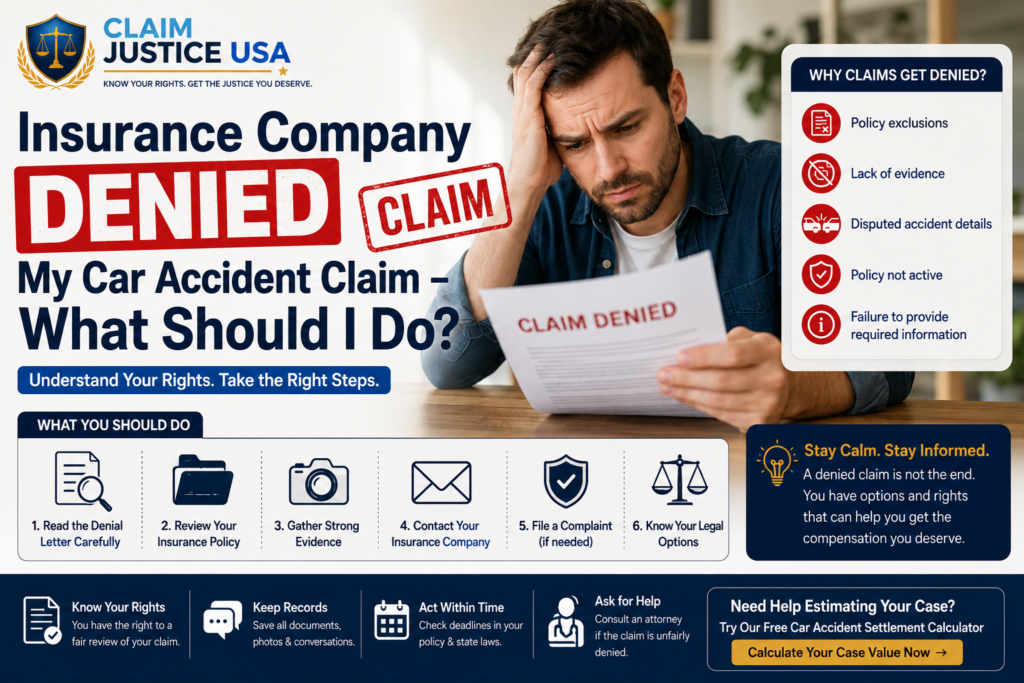
Insurance Company Denied My Car Accident Claim — What Should I Do?
The Letter That Changes Everything
You get an email from your insurance company.
You open it expecting to see information about your car accident claim.
Instead, you see one sentence that makes your stomach drop:
“Your claim has been denied.”
That was the situation for a fictional driver we’ll call Daniel.
Daniel had been involved in a car accident. He reported the accident, submitted photographs, gave the insurance company the requested information, and expected the claim process to move forward.
Then the denial letter arrived.
Daniel’s first reaction was simple:
“Does this mean I’m getting nothing?”
Not necessarily.
An insurance claim denial is a decision by the insurer, but it doesn’t automatically mean the decision is correct or that you have no options.
The reason for the denial matters.
Your policy matters.
The evidence matters.
And the laws and insurance rules in your state matter.
The National Association of Insurance Commissioners (NAIC) advises consumers who are dissatisfied with an insurer’s handling of a claim to first try to resolve the issue with the insurance company and, if the problem remains unresolved, contact their state insurance department.
So what should you actually do?
Let’s go step by step.
Why Would an Insurance Company Deny a Car Accident Claim?
There isn’t one universal reason.
A claim could be denied because the insurer believes:
- The policy does not cover the loss
- An exclusion applies
- The accident circumstances are disputed
- The policy was not active at the relevant time
- The damage does not match the reported accident
- Required information or documentation is missing
- Another party may be responsible
- The amount being claimed is disputed
- The insurer believes the facts don’t support coverage
The important thing is not to guess why your claim was denied.
Look at the actual denial.
1. Read the Denial Letter Carefully
This is the first thing Daniel should have done.
Don’t just look at the word “denied.”
Look for the explanation.
Check for:
- Claim number
- Date of the accident
- Policy information
- Reason for denial
- Policy provision cited
- Exclusion cited
- Documents considered
- Instructions for disputing the decision
- Any deadline mentioned
If the explanation isn’t clear, ask the insurance company for a written explanation.
The NAIC recommends asking questions and requesting a written explanation of claim decisions when there is disagreement.
2. Compare the Denial With Your Insurance Policy
This is where the actual policy becomes important.
Insurance policies contain definitions, coverage provisions, exclusions, conditions, limits, and other terms.
Don’t rely only on what an adjuster said over the phone.
Look at the written policy.
For example, imagine your insurer says:
“This damage isn’t covered under your policy.”
The next question is:
Why?
Is there an exclusion?
Is the wrong coverage being applied?
Was another type of coverage potentially relevant?
Understanding the exact language can help you determine what question to ask next.
3. Gather Your Evidence
If you’re challenging a denial, organization matters.
Create one folder containing:
Accident Evidence
- Police report
- Accident photographs
- Dashcam footage
- Video footage
- Witness information
- Vehicle photographs
Insurance Documents
- Policy
- Declarations page
- Claim number
- Denial letter
- Adjuster correspondence
- Emails
- Repair estimates
- Receipts
- Towing bills
- Rental-car expenses
- Medical bills, if applicable
- Lost-income documentation, if applicable
Communication Records
Keep track of:
- Who you spoke with
- Date and time
- Phone number
- What was discussed
- Promises or follow-up requests
- Documents you submitted
The NAIC specifically recommends keeping records of communications and gathering documentation when dealing with insurance complaints.
4. Ask the Insurance Company to Reconsider
Before escalating the matter, contact the insurer.
Ask:
“Can you explain exactly why my claim was denied?”
Then ask:
“What part of my policy supports that decision?”
And:
“What documents or evidence would you need to reconsider the claim?”
Keep the conversation professional.
Don’t exaggerate.
Don’t threaten the adjuster.
Don’t change your story to make the claim sound stronger.
Stick to the facts.
5. Put Your Dispute in Writing
A written dispute can make your position much clearer.
You might write something like:
Subject: Request for Review of Claim Denial — Claim #12345
I am requesting a review of the denial of my auto insurance claim related to the accident on [date].
Please provide the specific policy provision supporting the denial and review the attached documentation.
Attached are photographs, the accident report, repair estimate, and relevant correspondence.
Please provide your written response after reviewing these materials.
Keep a copy of everything you send.
6. Don’t Ignore the Deadline
This is extremely important.
Insurance policies and applicable state laws can contain deadlines and procedures.
A denial letter may tell you what steps to take next.
Don’t assume you can wait indefinitely.
If you’re considering an appeal, complaint, arbitration, or lawsuit, determine the applicable deadline as soon as possible.
Because these rules can vary by state and by policy, consider getting advice specific to your situation.
7. Contact Your State Department of Insurance
What if you contacted the insurance company and still believe the claim was unfairly denied?
Your state Department of Insurance (DOI) may be able to help.
The NAIC explains that state insurance departments can investigate certain consumer complaints involving issues such as unfair claim delays or denials, failure to honor a policy, and violations of state insurance laws.
You can use the NAIC’s directory to find your state’s insurance department:
Find Your State Insurance Department
Keep in mind that an insurance department isn’t your personal lawyer and generally doesn’t act as your legal representative in court.
8. What If the Insurance Company Still Says No?
At this point, your options depend heavily on why the claim was denied, what your policy says, your state’s law, and the evidence available.
Depending on the situation, a person may consider:
- Further negotiations with the insurer
- An internal review process
- An appraisal process for certain valuation disputes
- Mediation
- Arbitration, if applicable
- A complaint to the state insurance department
- Consulting an attorney
- Litigation
These aren’t automatically appropriate for every claim.
For example, a disagreement about the value of vehicle damage can be different from a dispute about whether the policy provides coverage at all.
A Denied Claim Is Not the Same as a Lowball Offer
This distinction is worth understanding.
Lowball Offer
The insurance company says:
“We will pay you $15,000.”
You believe the claim is worth substantially more.
That’s an offer dispute.
Claim Denial
The insurance company says:
“We will not pay this claim.”
That’s a coverage or liability/claim-handling dispute, depending on the circumstances.
The strategy for dealing with each situation can be different.
That’s why your first step should be understanding exactly what the insurance company is saying.
What If the Other Driver’s Insurance Denied Your Claim?
This can make things more complicated.
Suppose another driver caused an accident.
You file a claim with that driver’s insurance company.
The insurer investigates and denies the claim because it disputes liability.
Now you may have to look at:
- Police report
- Witness statements
- Photos
- Video
- Vehicle damage
- Accident reconstruction evidence, if relevant
- Statements from the drivers
- Available insurance coverage
- Your own policy
Depending on your policy and state law, your own insurance coverage may also become relevant.
Don’t assume that the other driver’s denial automatically ends your ability to pursue compensation.
What If You Were Injured?
A vehicle-damage claim and an injury claim aren’t necessarily the same thing.
If you were injured, keep records of:
- Medical treatment
- Bills
- Prescriptions
- Follow-up appointments
- Work missed
- Doctor’s restrictions
- Out-of-pocket expenses
- Symptoms and recovery
If the dispute involves significant injuries or a potentially substantial claim, speaking with a qualified personal injury attorney can be useful.
Should You Sue the Insurance Company?
This is where you need to slow down.
Don’t file a lawsuit simply because you received a denial letter.
First understand:
- Why was the claim denied?
- What does the policy say?
- What evidence supports your position?
- What review or dispute procedures are available?
- What deadlines apply?
- What does your state law provide?
In some circumstances, litigation may become appropriate.
In others, the dispute may be resolved through additional documentation or negotiations.
The right answer depends on the facts.
Daniel’s Story: What Happened Next?
Remember Daniel?
After receiving his denial letter, his first instinct was to call the insurance company and argue.
Instead, he slowed down.
He downloaded his policy.
He read the denial letter.
He collected the accident report and photographs.
He organized his repair estimates.
Then he asked the insurer for a written explanation of the denial.
The explanation helped him understand the actual dispute.
Rather than simply saying “my insurance company won’t pay,” Daniel now knew exactly what issue he needed to challenge.
That’s a much better place to start.
A Simple Checklist for a Denied Car Insurance Claim
If your claim has been denied, work through this checklist:
☐ Read the denial letter
☐ Identify the exact reason for denial
☐ Review the relevant policy language
☐ Request a written explanation if necessary
☐ Gather photographs and reports
☐ Collect repair estimates and receipts
☐ Organize emails and phone records
☐ Ask the insurer to reconsider
☐ Check your state’s insurance department resources
☐ Check applicable deadlines
☐ Consider legal advice if the dispute is significant
Final Thoughts
Getting a claim denial can be frustrating, especially when you’re already dealing with the consequences of an accident.
But don’t assume the denial letter is the end of the road.
Start by understanding why the insurer denied the claim.
Then compare that explanation with your policy, gather your evidence, communicate with the insurer in writing, and learn what options are available in your state.
The NAIC says consumers with unresolved problems involving claim delays or denials can contact their state insurance department, which may investigate complaints within its authority.
Most importantly, don’t make decisions based only on emotion.
Read the documents. Keep the evidence. Know the deadlines. Understand your options.
Helpful External Resources
National Association of Insurance Commissioners — How to File a Complaint
A useful resource for understanding how consumers can raise unresolved insurance problems with their state insurance department.
NAIC — How to File a Complaint
NAIC — What You Should Know About Filing an Auto Claim
Useful information about communicating with adjusters, documenting an auto claim, and disagreements over settlements.
NAIC — State Insurance Departments
Use this directory to find your state’s insurance department and consumer complaint resources.
NAIC — State Insurance Departments
Disclaimer: This article is for general informational and educational purposes only and does not constitute legal advice. Laws regarding car accidents, insurance claims, lawsuits, settlements, and personal injury vary by state and individual circumstances. Reading this article does not create an attorney-client relationship. If you have a specific legal issue, consider consulting a qualified attorney licensed in your state
