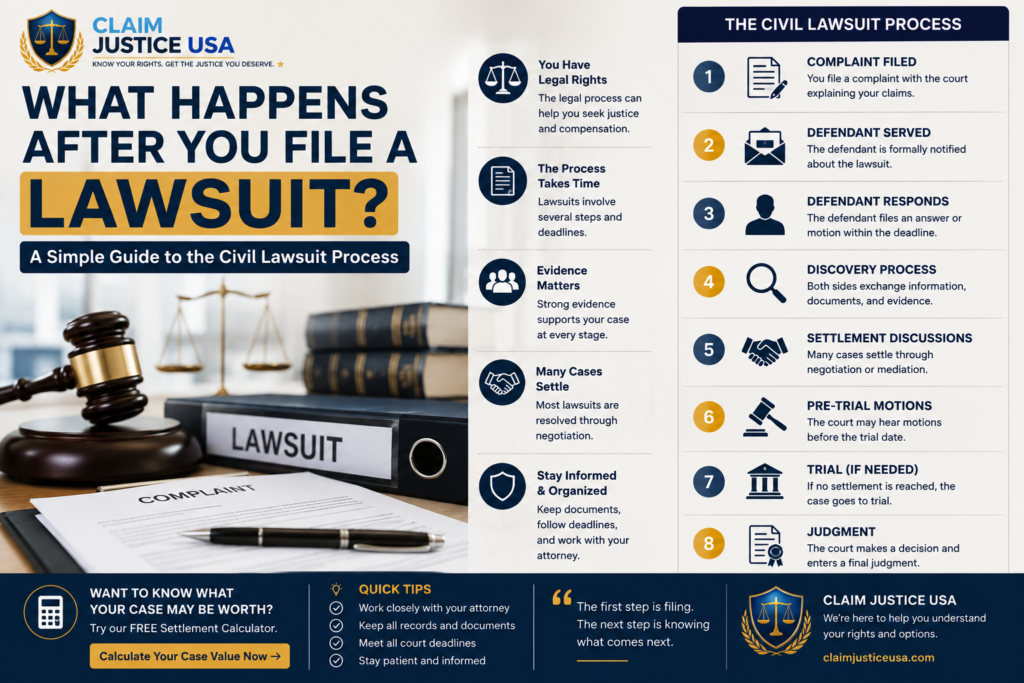
What Happens After You File a Lawsuit? A Simple Guide to the Civil Lawsuit Process
You Filed a Lawsuit. Now What?
Filing a lawsuit can feel like the biggest step in the process.
But for many people, filing the complaint is actually where the next phase begins.
You may suddenly have questions:
What happens after the lawsuit is filed?
When does the other side respond?
Will I have to go to court?
When can the case settle?
How long will everything take?
These are normal questions.
Imagine someone named Mike who was injured in an accident. After trying to resolve the matter without going to court, Mike eventually decided to file a civil lawsuit.
He expected something dramatic to happen immediately.
Instead, the next few weeks involved paperwork, deadlines, communication between attorneys, and waiting.
That is often what the beginning of litigation looks like.
A civil lawsuit generally moves through several stages, although the exact procedure can vary depending on the state, court, type of case, and circumstances. In federal court, a civil action generally begins with a complaint, followed by service on the defendant.
So, what happens next?
Let’s break it down.
1. The Complaint Is Filed
The first major step is filing the complaint with the appropriate court.
The complaint explains the plaintiff’s claims, the basic facts supporting those claims, and the relief being requested.
Depending on the case, the plaintiff may be seeking financial compensation, an injunction, a declaration of rights, or another legal remedy.
In simple terms, the complaint tells the court:
“This is what happened, this is why I believe the defendant is legally responsible, and this is what I am asking the court to do.”
Once filed, the lawsuit officially begins.
Important: Filing a lawsuit does not automatically mean the plaintiff will win. The plaintiff generally has the burden of proving the claims.
2. The Defendant Is Served
After the complaint is filed, the defendant generally needs to receive formal notice of the lawsuit.
This is known as service of process.
The purpose is straightforward: the defendant needs to know that a lawsuit has been filed and have an opportunity to respond.
The exact service requirements depend on the applicable court rules.
This is one reason simply filing paperwork with a court is not the end of the process.
3. The Defendant Responds
Once properly served, the defendant generally has a deadline to respond.
In federal civil cases, a defendant generally has 21 days to answer after being served, although exceptions and different deadlines can apply.
The defendant may:
- File an answer
- Deny some or all allegations
- Raise legal defenses
- File a motion to dismiss
- Take another action permitted by the applicable rules
For example, the defendant might argue that the complaint does not establish a legally sufficient claim.
If the defendant does not respond when required, the plaintiff may potentially seek a default under the applicable rules.
4. The Court Establishes Deadlines
Once the initial pleadings are underway, the court may establish a schedule for the case.
This can include deadlines for:
- Discovery
- Motions
- Disclosures
- Expert witnesses
- Settlement discussions
- Pretrial filings
- Trial
For someone unfamiliar with lawsuits, this stage can feel slow.
But there may be a lot happening behind the scenes.
Attorneys may be collecting records, reviewing evidence, communicating with witnesses, preparing discovery, and negotiating with the other side.
5. Discovery Begins
This is one of the most important stages of a civil lawsuit.
Discovery is the process through which parties obtain relevant information and evidence from one another.
Depending on the case, discovery can include:
Interrogatories
Written questions that the opposing party must answer according to the applicable rules.
Requests for Production
Requests for relevant documents or other information.
Requests for Admissions
Statements that the other party may be asked to admit or deny.
Depositions
A witness or party may be questioned under oath outside the courtroom, with the testimony generally recorded by a court reporter.
Federal court guidance explains that discovery can involve documents, witnesses, interrogatories, and depositions.
This stage can take months in some cases.
6. Both Sides Build Their Case
This is where a lawsuit can become much more detailed.
The parties may collect and analyze:
- Medical records
- Police reports
- Accident reports
- Photographs
- Videos
- Contracts
- Emails
- Text messages
- Financial records
- Employment records
- Expert opinions
- Witness statements
For example, if someone is claiming compensation after an accident, evidence may be used to establish what happened, who was responsible, and the financial and personal impact of the injury.
The goal isn’t simply to collect as many documents as possible.
The evidence needs to be relevant to the issues in dispute.
7. Settlement Discussions Can Happen
Here’s something many people don’t realize:
A lawsuit does not necessarily have to go all the way to trial.
The parties can discuss settlement during the case.
Settlement discussions may happen early in litigation, during discovery, during mediation, during pretrial proceedings, or even later.
Federal courts encourage alternative dispute resolution methods such as mediation because they can help parties resolve disputes without going through a full trial.
For example:
Imagine Mike originally believed his case was worth $100,000.
The defendant disagrees.
After discovery, both sides learn more about the evidence and risks involved.
Instead of spending additional time preparing for trial, they may decide to negotiate.
Eventually, they might agree on a settlement amount.
That agreement can bring the lawsuit to an end.
8. A Settlement Is Not the Same as Winning at Trial
This distinction is important.
A settlement is an agreement between the parties resolving the dispute.
A trial is different.
At trial, the judge or jury evaluates the evidence and reaches a decision according to the applicable law and procedures.
The U.S. Courts notes that many civil disputes are resolved through settlement rather than reaching trial.
Settlement can be attractive because it may provide:
- More control over the outcome
- Less uncertainty
- Potentially faster resolution
- Avoidance of some trial expenses
- Privacy in some circumstances
But whether settlement is appropriate depends entirely on the individual case.
9. What If the Case Does Not Settle?
If the parties cannot reach an agreement, the lawsuit may continue toward trial.
Before trial, the court may consider various motions.
One important example is a motion for summary judgment.
This type of motion asks the court to decide some or all of the case without a trial when the legal requirements for doing so are met.
If the motion is denied, the disputed issues may continue toward trial.
10. The Case May Go to Trial
If the lawsuit survives the pretrial stages and isn’t settled, the case may proceed to trial.
A trial can involve:
- Jury selection, if applicable
- Opening statements
- Presentation of evidence
- Witness testimony
- Cross-examination
- Closing arguments
- Judge or jury deliberation
- Verdict or judgment
In a civil case, the outcome depends on the evidence presented and the legal standards applicable to that case.
Federal courts explain that, in many civil cases, a plaintiff must establish the claim by a preponderance of the evidence, meaning the claim is more likely than not to be true.
11. The Court Enters a Judgment
After the case is decided, the court enters a judgment reflecting the outcome.
Depending on the circumstances, the judgment may involve monetary damages or another form of relief.
However, receiving a judgment and actually collecting money are not always the same thing.
The practical steps after judgment can depend on the circumstances and applicable state or federal law.
How Long Does a Lawsuit Take?
This is one of the hardest questions to answer with a single number.
There is no universal lawsuit timeline.
A relatively straightforward case may resolve much faster than a complicated case involving multiple parties, extensive discovery, experts, disputed evidence, or appeals.
Some lawsuits settle relatively early.
Others continue for years.
Factors that can affect the timeline include:
- Type of lawsuit
- Court backlog
- Number of parties
- Complexity of evidence
- Discovery disputes
- Expert witnesses
- Motions
- Settlement negotiations
- Trial availability
- Appeals
For this reason, anyone promising that a lawsuit will definitely settle within a specific number of weeks or months should be treated cautiously.
Should You Accept a Lawsuit Settlement?
This is where things can become complicated.
A settlement offer may look attractive because it gives you a definite number.
But the amount alone doesn’t tell you whether the settlement is appropriate.
You may need to consider:
- Current damages
- Future damages
- Medical expenses
- Lost income
- Property damage
- Legal fees
- Insurance coverage
- Liens or reimbursement claims
- Strength of the evidence
- Potential trial risks
- How long the dispute may continue
A settlement decision is ultimately a legal and financial decision that should be evaluated based on the specific circumstances.
Keep Your Lawsuit Documents Organized
If you’re involved in a lawsuit, organization can make a big difference.
Create a folder for important documents such as:
Court Documents
- Complaint
- Answer
- Motions
- Court orders
- Notices
Evidence
- Photos
- Videos
- Reports
- Emails
- Messages
- Witness information
Financial Records
- Medical bills
- Receipts
- Wage-loss documentation
- Repair estimates
- Other relevant expenses
Communication
- Emails
- Letters
- Attorney communications
- Settlement offers
Keeping your records organized can make it easier to understand what has happened and what still needs attention.
A Simple Example
Let’s go back to Mike.
Mike files a lawsuit after an accident.
At first, he expects the defendant to immediately agree to pay.
That doesn’t happen.
The defendant files a response and disputes some of Mike’s allegations.
Then discovery begins.
Mike’s attorney requests documents.
The defendant provides records.
Witnesses are identified.
Both sides learn more about the evidence.
Eventually, the parties enter settlement negotiations.
At this point, Mike has a choice.
He can consider the settlement based on the evidence and risks involved, or continue pursuing the case toward trial.
That’s how many civil lawsuits actually develop.
It isn’t always dramatic.
Often, it is a long process of evidence, deadlines, negotiation, and legal decisions.
What Should You Do After Filing a Lawsuit?
If you’ve already filed a lawsuit, some practical steps include:
1. Don’t Ignore Court Deadlines
Missing a deadline can create serious problems.
2. Keep Your Attorney Updated
Tell your attorney about significant developments and provide requested documents promptly.
3. Preserve Evidence
Don’t intentionally delete or destroy potentially relevant records.
4. Keep Your Contact Information Updated
Make sure your attorney and the court can reach you when required.
5. Don’t Discuss the Case Carelessly Online
Public posts can potentially create complications depending on the circumstances.
6. Carefully Review Settlement Documents
Don’t assume that a settlement offer is automatically in your best interest simply because it provides immediate money.
Final Thoughts
Filing a lawsuit is only the beginning of the civil litigation process.
After filing, the case may move through service, a defendant’s response, scheduling, discovery, motions, settlement negotiations, and potentially trial.
And importantly, not every lawsuit reaches trial. Many civil disputes are resolved before that stage.
If you’re trying to understand what your case might be worth, a calculator can provide a starting point for organizing potential damages—but it cannot predict what a court or opposing party will ultimately decide.
For legal advice about a specific lawsuit, speak with a qualified attorney familiar with the law and court rules that apply to your case.
Important Disclaimer
This article is for general informational and educational purposes only and is not legal advice. Insurance laws, deadlines, coverage rules and personal injury laws vary by state. The examples in this article are hypothetical and do not predict the value or outcome of any individual claim. Claim Justice USA does not guarantee any settlement amount. For advice about your specific circumstances, consult a qualified attorney licensed in the applicable state.
Helpful External Resources
For readers who want reliable information about the civil litigation process:
- U.S. Courts — Civil Cases: explains the general federal civil-case process, including complaints, discovery, settlement, and trial.
- U.S. Courts — Civil Case Guide: provides additional information about pleadings, discovery, settlement, and trial.
- Cornell Legal Information Institute — Litigation: provides a general explanation of litigation and major stages of a civil case.
- Cornell LII — Complaint: explains what a complaint is and how it starts a civil action.