
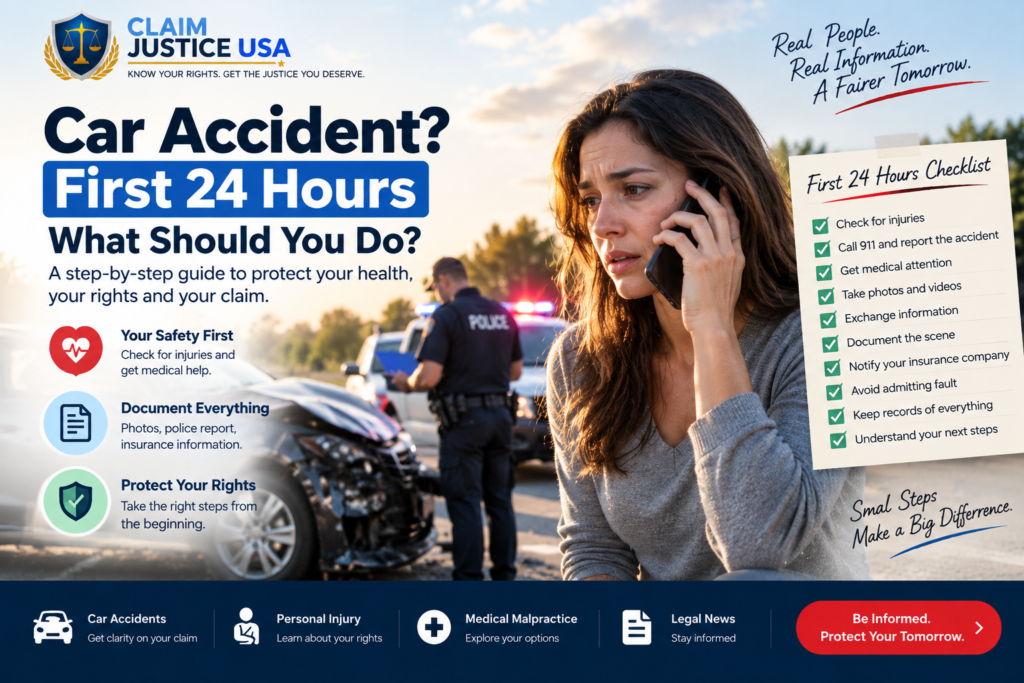
Car Accident? What TO Do in the First 24 Hours?
By Claim Justice USA
A car accident can leave you confused even when nobody is seriously injured.
One minute you’re driving normally.
The next minute, there’s a loud crash, your airbags may go off, someone is asking if you’re okay, and you suddenly have no idea what you’re supposed to do next.
Should you call the police?
Should you move the car?
Should you call your insurance company?
Should you go to the doctor if you don’t feel hurt?
And perhaps the biggest question:
“What should I do right now so I don’t make things worse later?”
The first 24 hours can be important.
You don’t need to panic. You don’t need to become a legal expert.
You just need to take the right basic steps.
1. First, Check If Anyone Is Hurt
Forget about the car for a moment.
Look at yourself, your passengers and the people in the other vehicle.
If someone appears seriously injured, call 911 immediately.
Don’t worry about taking photographs or exchanging insurance information before getting medical help.
Your health comes first.
Even if you think your injury is minor, pay attention to how you feel over the next several hours. Some symptoms may not be obvious immediately after a crash.
If you have pain, dizziness, headaches, confusion, numbness or other concerning symptoms, seek medical attention.
2. Move to a Safe Location If You Can
If the vehicles can be moved safely and local law allows it, getting out of the traffic lane can help prevent another collision.
Turn on your hazard lights.
If you cannot safely move the vehicle, stay somewhere safe and wait for emergency assistance.
A second accident can make an already bad situation much worse.
3. Call the Police
Even when an accident doesn’t look serious, having an official accident report can be useful.
The police may document:
- Where the accident happened
- The vehicles involved
- Statements from drivers
- Statements from witnesses
- Visible damage
- Traffic conditions
- Other relevant circumstances
Don’t argue with the other driver about who caused the accident.
Let the appropriate authorities document what happened.
4. Take Photos Before You Leave
This is one of the easiest things to forget.
Your phone is probably already in your pocket.
Use it.
Take photographs of:
- Your vehicle
- The other vehicle
- Damage to both vehicles
- The road
- Traffic signs
- Traffic lights
- Lane markings
- Skid marks
- Debris
- Weather or road conditions
- Visible injuries
Take pictures from different distances.
A close-up photograph can show damage.
A wider photograph can show where the vehicles were and what the surrounding area looked like.
That context can become important later.
5. Exchange Information
Get the other driver’s basic information.
Depending on your state and circumstances, this may include:
Name
Phone number
Driver’s license information
Insurance company
Policy information
Vehicle information
License plate number
If there are witnesses, ask for their contact information too.
You don’t need to interrogate anyone.
Just collect the basic information you may need later.
6. Don’t Start an Argument About Who Was at Fault
You’re angry.
The other driver is angry.
Everyone is standing beside damaged cars.
This is usually not the best time to decide who is legally responsible.
Avoid statements like:
“It was completely my fault.”
or
“I’m definitely not injured.”
You may not know the full situation yet.
Simply provide accurate information to the police and your insurance company.
Let the evidence speak for itself.
7. Don’t Assume You’re Fine Just Because You Feel Fine
This is something accident victims often overlook.
Right after a crash, you may be focused on what just happened.
Adrenaline and shock can make it difficult to notice everything you’re feeling.
Maybe you feel fine at the accident scene.
Later that evening, your neck starts hurting.
The next morning, your back is stiff.
A few days later, you realize the pain hasn’t gone away.
That’s why it’s important to pay attention to your body after an accident.
If you have symptoms or concerns, talk to a medical professional.
And keep records of your appointments and treatment.
8. Tell Your Insurance Company
You should generally notify your insurer about the accident according to the requirements of your policy and applicable law.
But remember something important:
Reporting an accident and settling an injury claim are two different things.
You can notify your insurer that an accident occurred without immediately agreeing to a settlement.
Keep copies of emails, letters and other communications.
Write down when you spoke with an adjuster and what was discussed.
9. Keep Every Document
This may feel boring on Day One.
It won’t feel boring three months later when you’re trying to remember what happened.
Create a folder on your phone or computer.
Save:
- Police reports
- Medical records
- Medical bills
- Insurance correspondence
- Repair estimates
- Towing receipts
- Prescription receipts
- Pay stubs
- Employer documentation
- Photos
- Videos
- Witness information
Basically:
If it is connected to the accident, keep it.
10. Write Down What Happened While You Still Remember It
Here’s a simple trick that can help.
Open your phone and write down everything you remember.
What time was it?
Where were you going?
What lane were you in?
What happened immediately before the crash?
What happened immediately afterward?
What did the other driver say?
Were there witnesses?
Was it raining?
Was the traffic light green, yellow or red?
You don’t need to write a novel.
Just record the details while they’re fresh.
Memory changes.
Your notes give you something you can look back at later.
What About Medical Bills?
This is where the situation can start becoming stressful.
Maybe your emergency room bill is $3,000.
Then there’s a doctor’s appointment.
Then physical therapy.
Then medication.
Then another appointment.
Suddenly, you have thousands of dollars in expenses.
Keep track of everything.
A simple spreadsheet can help:
| Expense | Amount |
|---|---|
| Emergency treatment | $3,000 |
| Doctor visits | $1,200 |
| Physical therapy | $2,500 |
| Medication | $150 |
| Lost wages | $2,000 |
| Other expenses | $350 |
| Total | $9,200 |
This doesn’t mean your settlement will automatically be $9,200—or $18,400, or any other specific amount.
It simply gives you a clear picture of your documented losses.
What About Lost Wages?
An injury can cost you money even when you aren’t receiving a medical bill.
Suppose you normally earn $1,000 per week.
You miss two weeks because of your injuries.
That’s potentially $2,000 in lost income.
Maybe you used paid vacation instead.
You may still want to keep documentation showing that you were unable to work because of the accident.
Save your pay stubs and any relevant employer records.
What If the Other Driver Says, “Let’s Just Handle It Ourselves”?
This happens.
Someone may say:
“Don’t call the police. I’ll pay for everything.”
It may sound friendly.
But you don’t know what will happen tomorrow.
The other driver may change their story.
The damage may turn out to be more expensive than it initially appeared.
You may develop symptoms later.
That’s why it’s generally safer to properly document an accident and follow the applicable reporting and insurance requirements rather than relying solely on a verbal promise.
What If the Insurance Company Calls You the Same Day?
Don’t be surprised if an insurance adjuster contacts you quickly.
They may ask what happened.
Answer questions honestly.
But don’t guess.
If you don’t know something, it’s okay to say you don’t know.
And don’t exaggerate your injuries.
If you’re still being evaluated medically, you may not yet know the full extent of your condition.
Most importantly, don’t feel pressured to accept a settlement simply because someone offers you money quickly.
Should You Accept a Settlement Immediately?
This is where you should slow down.
Imagine the insurance company offers you:
$8,000
You have $5,000 in medical bills so far.
You missed work.
You’re still experiencing pain.
And you haven’t finished treatment.
Before accepting anything, understand exactly what the settlement covers and what rights you may be giving up.
A settlement can have significant consequences.
If you’re dealing with serious injuries or a complicated claim, speaking with a qualified attorney in your state before signing a settlement agreement may be worthwhile.
What If the Accident Wasn’t Your Fault?
Evidence can become very important.
That’s why photographs, police reports, witness information and medical records can matter.
For example, imagine a driver claims that you suddenly changed lanes.
But your photographs show the positions of the vehicles.
A witness saw what happened.
The police report contains additional information.
Your evidence may tell a very different story from the other driver’s version.
You don’t have to win an argument at the accident scene.
Document what happened.
Your First 24 Hours Checklist
If you want to keep it simple, remember this:
At the Scene
☐ Check for injuries
☐ Call 911 when necessary
☐ Move to a safe location if possible
☐ Exchange information
☐ Get witness information
☐ Take photographs
☐ Don’t argue about fault
After Leaving the Scene
☐ Seek medical attention if needed
☐ Report the accident to your insurer as required
☐ Save all documents
☐ Keep medical bills
☐ Document missed work
☐ Write down what you remember
☐ Keep track of symptoms
☐ Don’t rush into a settlement
How Much Could Your Accident Claim Be Worth?
Once the immediate emergency is over, another question usually appears:
“How much is my claim worth?”
There’s no honest way to give everyone the same answer.
The potential value of a claim can depend on things such as:
- Severity of the injury
- Medical expenses
- Lost income
- Future treatment
- Permanent impairment
- Pain and suffering
- Property damage
- Liability
- Insurance coverage
- State law
- Strength of the evidence
That’s why an online settlement calculator should be treated as an estimate, not a guaranteed result.
Try the Free Claim Justice USA Settlement Calculator
If you’ve already started collecting your accident information, you can use the Claim Justice USA Free Legal Settlement Calculator to get an initial estimate.
You can consider your:
Medical expenses
Lost wages
Property damage
Injury severity
and other relevant information.
Calculate Your Potential Settlement — Free
No signup required.
The result is only an educational estimate. Your actual claim value may be different depending on the facts of your case and the law that applies.
One Last Piece of Advice
The first 24 hours after a car accident can feel chaotic.
You don’t need to solve your entire case that day.
You need to protect your health, document what happened, keep your records and avoid making rushed decisions.
Your car can be repaired.
Insurance paperwork can be handled.
Legal questions can be answered.
But good documentation is much easier to create while the details are still fresh.
So if you ever find yourself standing beside a damaged car wondering, “What do I do now?”
Start with the basics.
Check for injuries.
Get help.
Document everything.
Keep your records.
And don’t let anyone pressure you into making a decision you don’t understand.
Important Disclaimer
This article is for general informational and educational purposes only and is not legal advice. Car accident laws, insurance requirements, deadlines and procedures vary by state. The information above does not create an attorney-client relationship and does not guarantee any particular claim or settlement outcome. If you have suffered significant injuries or have questions about your legal rights, consider consulting a qualified attorney licensed in the applicable state.
