Debt Settlement vs. Bankruptcy: Which Option Is Right for You?
When debt starts getting out of control, it usually doesn’t happen all at once.
It may begin with a credit card balance.
Then another credit card.
A medical bill arrives.
A personal loan gets added to the list.
For a while, the minimum payments may seem manageable. But eventually, the numbers stop making sense.
$8,000 becomes $15,000.
Then $15,000 becomes $30,000.
And suddenly, you’re asking:
“Should I try to settle my debts, or should I consider bankruptcy?”
Both options can provide a possible path forward, but they work in very different ways.
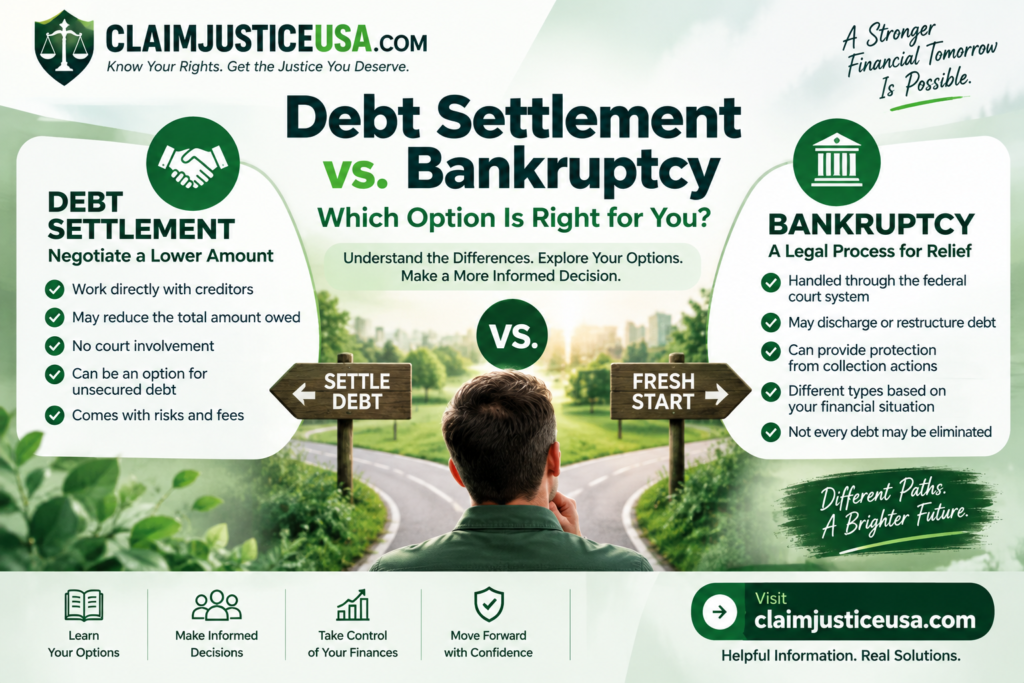
Debt settlement is primarily a negotiation with creditors. Bankruptcy is a formal federal legal process.
There isn’t one solution that works for everyone. Your income, debt, assets, state laws, collection activity, and financial goals can all affect which option deserves consideration.
Debt & Credit Settlement Calculator –
A Real-World Example
Let’s imagine Michael, a 42-year-old employee with a steady income.
Michael has:
- $18,000 in credit-card debt
- $9,000 personal loan
- $6,000 in medical bills
- $4,000 in other unsecured debt
That’s approximately $37,000 in debt.
Michael earns enough to pay for rent, food, utilities, and basic living expenses. But after making debt payments every month, there’s very little left.
He starts researching his options.
One website says:
“Settle your debt for less!”
Another says:
“Bankruptcy can give you a fresh start.”
Michael doesn’t know which direction to take.
And that’s exactly why understanding the difference matters.
What Is Debt Settlement?
Debt settlement generally involves negotiating with creditors to accept less than the full amount owed.
For example, imagine you owe:
$20,000
After negotiations, a creditor agrees to accept:
$12,000
If the agreement is completed according to its terms, the remaining balance may be forgiven.
That sounds simple.
But there’s an important issue:
A creditor generally does not have to agree to settle your debt.
Debt settlement can also involve risks such as:
- Additional interest
- Fees
- Collection calls
- Collection lawsuits
- Damage to your credit
- Potential tax consequences
- Delays in resolving your debt
So debt settlement isn’t simply:
“Pay 50% and you’re done.”
The real process can be considerably more complicated.
Before entering a settlement program, understand the fees, timeline, risks, and what happens if one or more creditors refuse to participate.
What Is Bankruptcy?
Bankruptcy is a formal legal process handled through the federal court system.
For individuals, bankruptcy can generally involve different types of relief depending on the person’s financial situation.
Two commonly discussed approaches are:
Liquidation Bankruptcy
This type of bankruptcy is generally associated with the discharge of qualifying debts after applicable requirements are met.
However, eligibility rules apply, and not every debt can necessarily be eliminated.
Certain property may also be protected by exemptions, while other property or assets may be treated differently depending on the circumstances.
Repayment Bankruptcy
A repayment-based bankruptcy process is generally designed for individuals with regular income who need a structured plan for repaying creditors.
The repayment plan generally lasts three to five years.
Depending on the circumstances, this process may allow an eligible person to keep certain property while making payments under a court-approved plan.
Bankruptcy may also provide protection from many collection actions while the case is pending.
But bankruptcy isn’t a magic button that eliminates every financial problem.
The details matter.
Debt Settlement vs. Bankruptcy: The Basic Difference
The easiest way to understand the distinction is:
Debt settlement = negotiation.
Bankruptcy = formal court process.
| Feature | Debt Settlement | Bankruptcy |
|---|---|---|
| Who handles the process? | You or a settlement company | Federal court process |
| Must creditors agree? | Generally yes | Formal legal process applies |
| Court involved? | Usually no | Yes |
| Debt reduction | Negotiated with creditors | Depends on the applicable legal process |
| Credit impact | Can be significant | Can be significant |
| Collection lawsuits | May continue | Automatic stay generally stops many collection actions |
| Timeline | May take months or years | Depends on the individual case |
| Guaranteed result? | No | No |
| Legal advice | May be useful | Often very important |
Neither option should be selected simply because an advertisement promises an easy solution.
When Might Debt Settlement Make Sense?
Debt settlement may be worth researching when someone:
- Primarily has unsecured debt
- Has some ability to save money toward negotiated settlements
- Doesn’t need bankruptcy protections
- Understands the potential credit consequences
- Has reviewed the fees and terms carefully
- Understands that creditors may refuse to settle
However, consumers should be cautious about promises that their debt can simply disappear.
Some settlement programs may take a long time. During that period, interest, fees, collection activity, or lawsuits may continue.
Before signing an agreement, understand exactly what you’re paying for and what happens if the program doesn’t work as expected.
When Might Bankruptcy Be Worth Considering?
Bankruptcy may deserve serious consideration when:
- Your debt is far beyond what you can realistically repay
- Creditors are suing or threatening legal action
- Wage garnishment is a concern
- Collection calls have become overwhelming
- You need legal protection from certain collection activity
- You have little realistic chance of repaying unsecured debts in full
Bankruptcy can provide a legal mechanism for discharging certain debts or restructuring repayment, depending on your circumstances.
That doesn’t mean bankruptcy is automatically the better choice.
It means it should be properly evaluated rather than dismissed because of its reputation.
What About Your House or Car?
This is where things can become more complicated.
A mortgage or auto loan may be secured by property that serves as collateral.
Debt settlement and bankruptcy don’t treat secured debts in exactly the same way.
A repayment-based bankruptcy process may, in certain circumstances, allow an eligible person to retain property while making payments under a court-approved plan.
It may also provide mechanisms for addressing certain overdue secured debts over time.
But bankruptcy does not mean:
“You automatically get to keep everything.”
Exemptions, secured claims, eligibility, income, assets, and state law can all affect the outcome.
If your home or vehicle is important to you, understand how your specific situation could be affected before making a decision.
What Happens to Your Credit?
Credit impact is one of the biggest concerns when comparing debt settlement and bankruptcy.
Neither option should be viewed as completely painless for your credit history.
With debt settlement, accounts may become delinquent during the process. Collection activity may continue, and your credit history may be negatively affected.
Bankruptcy is also a major credit event.
But here’s something important:
Your credit score shouldn’t be the only factor in the decision.
If you’re already missing payments every month and facing collection activity, maintaining a perfect-looking credit profile may no longer be realistic.
The bigger question may be:
“Which option gives me the most realistic path toward financial stability?”
Don’t Choose Based Only on the Percentage
You may see advertisements saying:
“Settle your debt for pennies on the dollar!”
That sounds attractive.
But don’t make a decision based only on the advertised percentage.
Consider:
- Program fees
- Interest
- Late charges
- Whether every creditor participates
- How long the program may take
- Collection activity
- Lawsuit risk
- Potential tax consequences
- Whether you can actually afford the required payments
A settlement that looks attractive on paper may have a very different real-world cost after fees, interest, delays, and other consequences are considered.
Another Example: $50,000 in Unsecured Debt
Suppose Sarah has $50,000 of unsecured debt.
She can realistically afford only $700 per month toward her debts.
Option A: Debt Settlement
Sarah enters a settlement program.
Some creditors agree to negotiate.
Others don’t.
Meanwhile, some accounts become delinquent and collection activity continues.
Eventually, certain balances may be negotiated downward.
But the process can take considerable time, and there is no guarantee that every creditor will agree to a settlement.
Option B: Bankruptcy
Sarah speaks with a qualified bankruptcy attorney and learns that she may qualify for a particular type of bankruptcy relief based on her financial circumstances.
Instead of negotiating separately with every creditor, she enters a formal federal court process.
Her outcome depends on factors such as:
- Income
- Assets
- Types of debt
- Eligibility
- Applicable law
- Exemptions
- Repayment obligations
So which option is better?
There is no responsible way to answer that question based only on Sarah’s $50,000 debt balance.
That’s the important lesson.
Your individual financial circumstances matter.
Don’t Forget About Taxes
Debt forgiveness can sometimes have tax consequences.
For example, when a creditor cancels part of a debt, the canceled amount may potentially be treated as taxable income, subject to applicable exceptions.
That’s why you shouldn’t simply calculate:
Original debt − settlement amount = total savings
The actual financial result can be more complicated.
Depending on your circumstances, a qualified tax professional can help you understand how canceled debt may affect your tax situation.
Liquidation vs. Repayment Bankruptcy
If bankruptcy is being considered, understanding the broad difference between liquidation-based and repayment-based relief can be useful.
Liquidation-Based Relief
This approach may allow qualifying debts to be discharged after applicable requirements are satisfied.
However:
- Eligibility requirements apply
- Some debts may not be dischargeable
- Exemptions matter
- Assets can affect the case
- Individual circumstances determine the outcome
Repayment-Based Relief
This approach generally involves a court-approved repayment plan lasting three to five years.
For individuals with regular income who meet the applicable requirements, it may provide a structured way to repay creditors while potentially retaining certain property.
So if someone says:
“Bankruptcy means losing everything.”
That’s an oversimplification.
And if someone says:
“Bankruptcy wipes out every debt.”
That’s also incorrect.
The details of the individual case matter.
Questions to Ask Before Choosing Debt Settlement
Before signing up with a debt settlement company, consider asking:
- What exactly are the fees?
- How long could the program take?
- What happens if a creditor refuses to settle?
- Could creditors sue me during the program?
- What happens if I leave the program early?
- Could forgiven debt create tax consequences?
- What could happen to my credit?
- Are there alternatives I should consider?
Don’t focus only on the promised savings.
Understand the risks and terms before committing.
Questions to Ask Before Considering Bankruptcy
If you’re considering bankruptcy, you may want to discuss:
- What type of bankruptcy relief might apply?
- Do I qualify?
- Which debts could potentially be discharged?
- What could happen to my house?
- What could happen to my vehicle?
- What property could be affected?
- What would my repayment obligation be?
- What happens to existing lawsuits or collection actions?
- Are there debts that bankruptcy may not eliminate?
A qualified bankruptcy attorney can review your circumstances and explain the options that may apply to you.
So, Debt Settlement or Bankruptcy?
Here’s the simplest way to think about it.
Debt Settlement May Be Worth Exploring When:
You have some ability to pay, but your current balances are difficult to manage and creditors may be willing to negotiate.
Bankruptcy May Be Worth Exploring When:
Your debt situation is so severe that ordinary repayment or negotiation isn’t realistically solving the problem, and you may need the legal protections or debt relief available through bankruptcy.
Neither option should be chosen simply because an advertisement promises an easy solution.
A Better Way to Compare Your Options
Before making a decision, write down your actual financial situation.
Total unsecured debt: $________
Monthly take-home income: $________
Essential monthly expenses: $________
Minimum debt payments: $________
Savings available: $________
Assets: $________
Past-due accounts: $________
Collection lawsuits: Yes / No
Then ask yourself:
“If nothing changes, can I realistically become debt-free?”
If the answer is no, it may be time to investigate your options instead of simply making another minimum payment.
What Should You Do Next?
Don’t choose debt settlement or bankruptcy based on a social-media advertisement, a sales pitch, or a promise of guaranteed results.
Start by understanding your numbers.
Look at your total debt, income, expenses, assets, past-due accounts, and collection activity.
Then learn how each option could affect your financial future.
If your situation involves lawsuits, wage garnishment, significant assets, complicated debts, or uncertainty about your legal rights, consider speaking with a qualified professional who can evaluate your specific circumstances.
Final Thoughts
Debt settlement and bankruptcy aren’t competing products where one option is always the winner.
They’re different tools for different financial situations.
Debt settlement is fundamentally a negotiation.
Bankruptcy is a formal federal legal process.
The right decision can depend on your income, debt type, assets, state law, collection activity, eligibility, and long-term financial goals.
If you’re already struggling financially, you don’t necessarily have to wait until the situation becomes a crisis before learning about your options.
Understanding your choices early can be far more valuable than reacting after the problem becomes overwhelming.
Explore more debt and financial information on Claim Justice USA to better understand your options and prepare for your next step.
Legal & Financial Disclaimer
This article is for general informational and educational purposes only. It is not legal, financial, tax, or bankruptcy advice.
Debt settlement and bankruptcy laws can vary depending on your circumstances and location. Eligibility, exemptions, dischargeable debts, settlement terms, tax consequences, creditor rights, and legal procedures may depend on specific facts.
Before making a significant financial or legal decision, consider speaking with a qualified bankruptcy attorney, financial professional, or tax professional who can review your individual situation.
Claim Justice USA does not guarantee debt reduction, settlement results, bankruptcy outcomes, or any specific financial result.