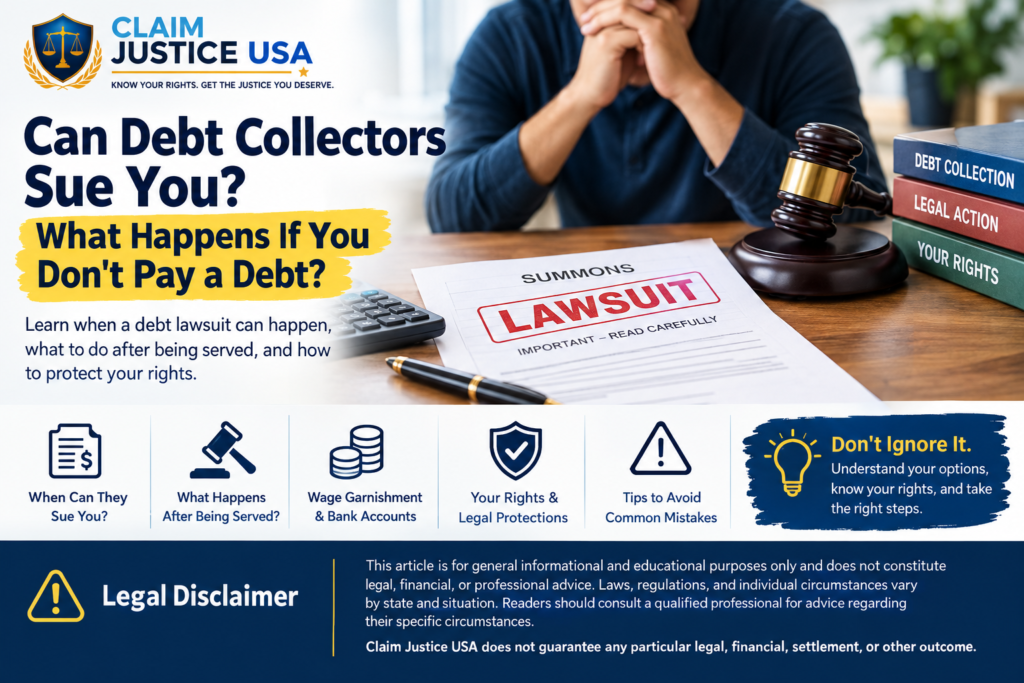
Can Debt Collectors Sue You?
Yes, a debt collector may be able to sue you for an unpaid debt, but that doesn’t mean every unpaid debt automatically turns into a lawsuit.
What happens depends on factors such as:
- What type of debt you owe
- How old the debt is
- Your state
- Whether the collector can legally collect the debt
- Whether the statute of limitations has expired
- Whether the collector can prove you owe the amount claimed
And there’s one thing you should never do if actual court papers arrive:
Ignore them.
The FTC and CFPB both advise consumers to respond to a debt-collection lawsuit by the deadline listed in the court documents.
What Happens If You Stop Paying a Debt?
Let’s say you have a credit card with a $10,000 balance.
You lose income and stop making payments.
At first, you might receive:
Payment reminders → collection calls → letters → collection agency contact
Eventually, the account may be sent or sold for collection.
But here’s where many people make a mistake.
They think:
“They’re calling me, but nobody has sued me yet, so I’ll deal with it later.”
That can be risky.
Ignoring collection activity doesn’t necessarily make the debt disappear. A collector may eventually pursue a lawsuit where permitted.
Can a Debt Collector Sue You for Credit Card Debt?
Potentially, yes.
Credit-card debt is one example of consumer debt that may be pursued through a collection lawsuit.
But before you assume the collector’s claim is correct, look at the details.
Ask:
- Is this actually my account?
- Who owns the debt now?
- How much was originally owed?
- What payments have I made?
- Are the interest and fees accurate?
- Is the collector legally entitled to collect it?
- Is the debt too old for a lawsuit under applicable law?
The FTC says that when a collector sues, it generally must prove that you owe the debt, that the amount is correct, and that it has the legal right to sue to collect it.
What If the Debt Is Several Years Old?
This is one of the most important parts of debt-collection law.
Every state has its own rules concerning statutes of limitations, and the applicable period can depend on the type of debt and other circumstances.
For some debts, the clock may be affected by the date a payment was missed or the most recent payment, depending on state law.
And there’s another important issue:
Making a payment or acknowledging an old debt can sometimes affect the statute-of-limitations period.
The CFPB specifically warns that the rules vary and recommends getting legal advice when dealing with an old debt.
So don’t blindly make a small payment on an extremely old debt simply because a collector says:
“Just pay $20 today and we’ll close the account.”
First understand the legal consequences in your state.
I Received a Debt Collection Lawsuit. What Should I Do?
This is where things become serious.
If you’re served with a lawsuit, don’t throw the papers away.
Step 1: Find the deadline
Your lawsuit should tell you when and how you need to respond.
Step 2: Identify the plaintiff
Is it:
- The original credit-card company?
- A debt buyer?
- A collection agency?
- Another company?
Step 3: Check the amount
Compare the lawsuit with your old statements.
Step 4: Check whether the debt is yours
If you don’t recognize it, don’t simply assume you owe it.
Step 5: Respond appropriately
The CFPB says responding doesn’t mean you’re admitting that the debt is valid. It gives you an opportunity to require the plaintiff to prove its claim.
What Happens If You Ignore a Debt Lawsuit?
This is where ignoring the problem can become much more expensive.
Suppose a collector sues you for:
$14,000
You don’t respond.
You don’t appear.
The court may enter a default judgment.
Now the collector may have stronger legal collection tools available, depending on state law.
These can potentially include:
- Wage garnishment
- Bank-account garnishment or restraint
- Property liens
- Additional court-awarded costs or interest
The CFPB explains that a judgment can give a collector stronger collection tools than it had before the lawsuit.
That’s why “I’ll just ignore it” can be one of the most expensive choices.
Can a Debt Collector Garnish Your Wages?
A debt collector generally doesn’t just get to take money from your paycheck because you owe a bill.
Typically, additional legal steps are involved.
A judgment may give a creditor or collector the ability to seek garnishment under applicable law.
But the rules vary by state and situation.
So if someone tells you:
“They can take your entire paycheck tomorrow.”
Don’t automatically believe them.
Likewise, don’t assume:
“Nobody can ever garnish my wages.”
Get the actual rules for your situation.
Can They Take Money From Your Bank Account?
Again, possibly after obtaining the appropriate legal authority, depending on state law and the circumstances.
This is another reason a judgment matters.
Before a judgment, you’re generally dealing with a claim.
After a judgment, the creditor may have significantly stronger enforcement options.
The CFPB describes judgments as court orders that can enable collection methods such as garnishment or liens, depending on applicable law.
Can a Debt Collector Arrest You?
Not simply because you haven’t paid a consumer debt.
A collector cannot legally threaten to have you arrested just to scare you into paying an ordinary debt. The CFPB says such threats can violate federal debt-collection law.
However, don’t confuse that with ignoring a court order.
If a court orders you to appear or provide information and you deliberately fail to comply, different legal consequences can apply.
So if someone calls saying:
“Pay $2,000 today or police will arrest you.”
That’s a major warning sign.
What If You Don’t Recognize the Debt?
This happens.
Imagine opening your mailbox and finding a collection notice for:
$7,842
You have no idea what they’re talking about.
Don’t panic.
Don’t immediately pay.
First ask for information that helps you determine:
- Who the original creditor was
- How much is allegedly owed
- What account the debt relates to
- How to dispute the debt
- Who currently owns the debt
The CFPB says consumers who don’t recognize a debt can dispute it and request verification.
What If the Collector Has the Wrong Amount?
Let’s say your old records show you owed:
$4,800
But the collector’s lawsuit says:
$8,900
Don’t assume the $8,900 is automatically correct.
Check:
The exact calculation depends on the account and applicable law.
If the number doesn’t make sense, that’s something you should address.
Can You Negotiate After Being Sued?
Sometimes, yes.
Being sued doesn’t necessarily mean the case must end in a trial.
The FTC notes that responding to the lawsuit can sometimes put you in a better position to negotiate a settlement.
For example:
You allegedly owe:
$18,000
You can’t afford $18,000.
But perhaps you have access to a smaller amount that could potentially be used in a negotiated settlement.
That doesn’t mean the collector must accept your offer.
But negotiation may be an option worth exploring.
If you reach an agreement, get the terms in writing before sending money.
Debt Settlement vs Fighting the Lawsuit
These aren’t always mutually exclusive.
You may have a situation where:
Option A: Defend the lawsuit
Option B: Negotiate a settlement
Option C: Explore another debt-relief option
Option D: Combination of the above, depending on circumstances
The important thing is to understand the lawsuit before choosing a strategy.
Don’t agree to a payment arrangement simply because you’re frightened by the paperwork.
And don’t assume you should fight everything simply because you don’t like the collector.
Look at the actual facts.
What If You Have Multiple Debts?
This is where the problem can become much bigger than one collection account.
Imagine:
| Debt | Balance |
|---|---|
| Credit Card A | $7,500 |
| Credit Card B | $11,200 |
| Personal Loan | $8,400 |
| Medical Debt | $5,900 |
| Collection Account | $4,300 |
| Total | $37,300 |
If you’re facing several accounts, dealing with each collector separately may not solve the underlying financial problem.
At this point, you may want to compare:
- Debt management
- Debt settlement
- Direct negotiation
- Bankruptcy
- Legal defenses
- Other available financial options
How to Deal With a Debt Collector Without Making Things Worse
If a collector contacts you, keep records.
Save:
- Letters
- Emails
- Text messages
- Account statements
- Payment receipts
- Settlement offers
- Phone-call dates
- Names of representatives
The CFPB recommends keeping records of communications and documents related to debt collection.
Also be careful about giving sensitive financial information to a caller before you’ve verified who they are and what debt they’re collecting.
Debt Collector Red Flags
Be careful if someone:
❌ Threatens immediate arrest
❌ Claims to be law enforcement
❌ Refuses to identify the debt
❌ Demands unusual payment methods
❌ Pressures you to pay immediately
❌ Gives misleading information about the amount owed
❌ Threatens actions they have no legal right or intention to take
Federal law restricts abusive, deceptive, and unfair debt-collection practices.
A Simple Debt Lawsuit Checklist
If you receive court papers, save this checklist:
DON’T:
- Ignore the lawsuit
- Miss the response deadline
- Assume the collector is automatically correct
- Admit facts you haven’t verified
- Pay a suspicious caller immediately
DO:
- Read every page
- Confirm the court and case number
- Check the deadline
- Review the debt
- Gather account records
- Check whether the amount is accurate
- Consider legal assistance
- Keep copies of everything
The Biggest Mistake People Make
The biggest mistake isn’t necessarily having debt.
It’s waiting until the problem becomes a court judgment before taking it seriously.
A collection call can be uncomfortable.
A lawsuit is more serious.
A judgment can give a creditor stronger collection rights.
And once a judgment exists, it can be much harder to undo.
Final Thoughts
So, can debt collectors sue you?
Yes, potentially.
But you have rights, and receiving a lawsuit doesn’t mean you should automatically pay whatever amount appears on the paperwork.
Verify the debt.
Check the amount.
Look at the age of the account.
Understand the deadline.
And most importantly:
Don’t ignore court papers.
If you’re dealing with several debts and can’t realistically repay them, don’t focus only on the individual collector. Look at your entire financial situation and compare the available options.
⚠️ Legal Disclaimer
This article is for general informational and educational purposes only and does not constitute legal, financial, medical, tax, or professional advice. Laws, regulations, and individual circumstances vary by state and situation. Readers should consult a qualified professional for advice regarding their specific circumstances.
Claim Justice USA does not guarantee any particular legal, financial, settlement, or other outcome.
🔗 Helpful Official Resources