Most people think:
👉 “I’ll just pay the minimum due… it’s fine.”
But here’s the reality: interest keeps compounding, your debt barely reduces, and you end up paying far more in interest than you ever borrowed.
And the worst part? Most people don’t even realize how much they’re losing — until they see the numbers. That’s where a credit card interest calculator changes everything.
What a Credit Card Interest Calculator Shows You
A credit card interest calculator estimates the true cost of carrying a balance:
- How much total interest you’ll pay over time
- How long repayment will take at your current pace
- Why the minimum payment keeps you trapped
- How much faster you’d be debt-free with larger payments
It reveals the real cost of your debt — not the comfortable illusion printed on your monthly statement.
How Credit Card Interest Is Calculated
Unlike simple loans, credit cards use daily compounding. Here’s how the math works:
Step 1: Start With Your APR
Your Annual Percentage Rate (APR) is the yearly interest rate — for example, 24%.
Step 2: Convert to a Daily Rate
Divide the APR by 365. At 24% APR, that’s 24% ÷ 365 = 0.0658% per day.
Step 3: Interest Compounds Daily
Each day, interest is calculated on your current balance — including interest added on previous days — and tacked onto what you owe. That compounding is what makes credit card debt grow so aggressively.
The Basic Formula
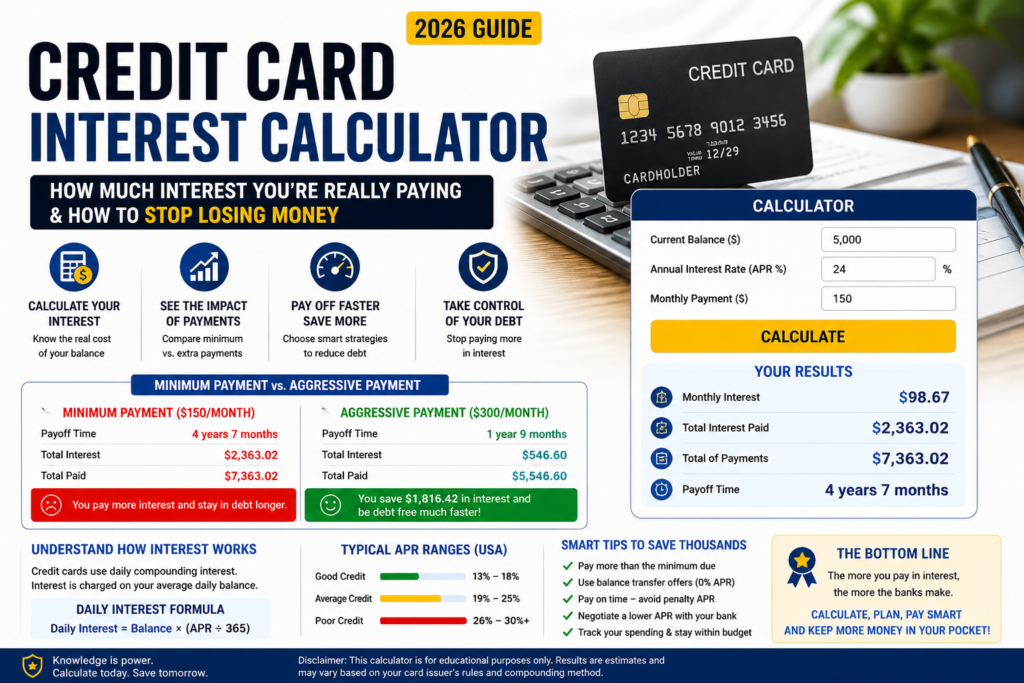
Daily interest = Balance × (APR ÷ 365)
Example: $5,000 × (0.24 ÷ 365) = $3.29 per day — roughly $100 per month in interest alone, before you pay down a single dollar of principal.
The Minimum Payment Trap
Most Americans fall into this trap: paying only the minimum each month. Banks love minimum payments, because:
- You pay far more interest over the life of the debt
- Repayment stretches out for many years
- The bank earns maximum profit from your balance
Example: $5,000 Balance at 24% APR, $150 Minimum Payment
- Time to pay off: 4+ years
- Total interest paid: $2,000+
- Total paid: $7,000+ on a $5,000 debt
That’s over 40% extra — for the privilege of paying slowly.
Real Interest Cost Breakdown
| Balance | APR | Monthly Interest |
|---|---|---|
| $1,000 | 20% | ~$16 |
| $5,000 | 24% | ~$100 |
| $10,000 | 26% | ~$217 |
Higher balance plus higher APR equals devastating monthly interest charges — money that buys you nothing.
Types of Credit Card Interest
1. Purchase APR
The standard rate on everyday spending — typically 20%–30% in 2026.
2. Cash Advance APR
Higher than purchase APR (often 25%–35%), with no grace period — interest starts accruing immediately, plus an upfront fee.
3. Penalty APR
Triggered by missed or late payments. It can spike to nearly 30% and may apply to your entire existing balance, not just new charges.
Credit Card Interest vs. Other Debt
| Debt Type | Typical Rate | Risk Level |
|---|---|---|
| Credit card | 18%–30% | Very high |
| Personal loan | 10%–18% | Medium |
| Mortgage | 5%–8% | Low |
Credit cards carry the most expensive interest of any common consumer debt — which is why they should be your first payoff priority.
5 Strategies to Reduce Credit Card Interest
Strategy 1: Pay More Than the Minimum
Even an extra $50 per month can save thousands in interest and cut years off your repayment timeline.
Strategy 2: Balance Transfer (0% APR)
Move debt to a card offering a 0% introductory APR and pay down principal interest-free during the promo period. Watch for balance transfer fees (usually 3%–5%).
Strategy 3: Debt Avalanche Method
Attack the highest-APR balance first while making minimums on the rest. This saves the maximum interest mathematically.
Strategy 4: Debt Snowball Method
Pay off the smallest balance first for quick wins and motivation, then roll that payment into the next debt.
Strategy 5: Negotiate a Lower APR
Call your card issuer and ask for a rate reduction. It works surprisingly often — especially with a solid payment history.
If your balances have grown beyond what these strategies can fix, read our honest guide to debt settlement and compare the best debt settlement companies.
Payoff Comparison: Why Payment Size Matters
| Strategy | Payoff Time | Interest Paid |
|---|---|---|
| Minimum payment only | 5–10 years | Very high |
| Double the minimum | 2–4 years | Medium |
| Aggressive payoff | Under 2 years | Low |
Real-Life Scenario: $8,000 at 22% APR
Minimum Payment Route
- Payoff time: roughly 5 years
- Interest paid: $3,500+
Aggressive Payoff ($400/Month)
- Payoff time: roughly 2 years
- Interest paid: roughly $1,800
You save $1,700+ in interest — and get three years of your financial life back.
Common Mistakes That Increase Interest
- Paying only the minimum every month
- Missing payments (triggers late fees and penalty APR)
- Taking cash advances
- Ignoring your APR entirely
- Opening new cards while carrying balances
If debt has become unmanageable, understand how your options compare: debt settlement vs. bankruptcy.
Frequently Asked Questions
1. How is credit card interest calculated?
Credit card interest compounds daily. Each day, your issuer multiplies your balance by your daily periodic rate (APR ÷ 365) and adds the result to your balance. That’s why balances grow even when you stop spending.
2. What is APR?
APR stands for Annual Percentage Rate — the yearly cost of borrowing, expressed as a percentage. A 24% APR doesn’t mean you pay 24% once; it’s applied a little bit every day through compounding.
3. Why is credit card interest so high?
Credit cards are unsecured — there’s no collateral for the lender to seize. To offset that risk (plus rewards programs and defaults), issuers charge 18%–30%, far above secured loans like mortgages.
4. What is the minimum payment trap?
Paying only the minimum covers mostly interest and barely reduces principal. A $5,000 balance at 24% APR with $150 minimum payments takes 4+ years and costs $2,000+ in interest.
5. How can I reduce my credit card interest?
Pay more than the minimum, use a 0% balance transfer card, try the avalanche or snowball payoff method, and call your issuer to negotiate a lower APR.
6. Can I avoid paying interest altogether?
Yes — if you pay your statement balance in full every month during the grace period (usually 21–25 days), most cards charge zero interest on purchases.
7. What is a grace period?
The grace period is the window between your statement date and payment due date when new purchases accrue no interest — but only if you paid the previous balance in full. Cash advances never get a grace period.
8. What happens if I miss a payment?
You’ll face a late fee (up to $30–$41), a possible penalty APR near 30%, and a negative mark on your credit report if the payment is 30+ days late.
9. Can I negotiate a lower APR with my card issuer?
Yes. Call customer service, mention competing offers or your loyalty, and ask directly. Issuers reduce rates more often than people expect — particularly for customers with good payment histories.
10. What is a balance transfer and is it worth it?
A balance transfer moves debt to a card with a 0% introductory APR, letting payments attack principal directly. It’s worth it if you can pay off the balance before the promo ends; otherwise the regular APR kicks in. Factor in the 3%–5% transfer fee.
The Bottom Line
Credit card interest is not just a fee — it’s a system designed to keep you paying longer. But once you understand the numbers, you can break free: pay more than the minimum, target high-APR balances first, and use balance transfers or negotiation to cut your rate.
Banks make money when you stay in debt. You win when you understand the math. Calculate smart, pay smart, and get free faster.
Helpful Resources
- Consumer Financial Protection Bureau (CFPB) — credit card rules, billing rights, and consumer guides
- Federal Trade Commission (FTC) — debt, credit, and scam prevention information
Financial disclaimer: This article is for general informational and educational purposes only and does not constitute financial advice. Interest calculations are estimates; your actual charges depend on your card’s specific terms. Consult a qualified financial professional for advice about your situation.