How to File a Homeowners Insurance Claim After Storm Damage (2026 Guide)
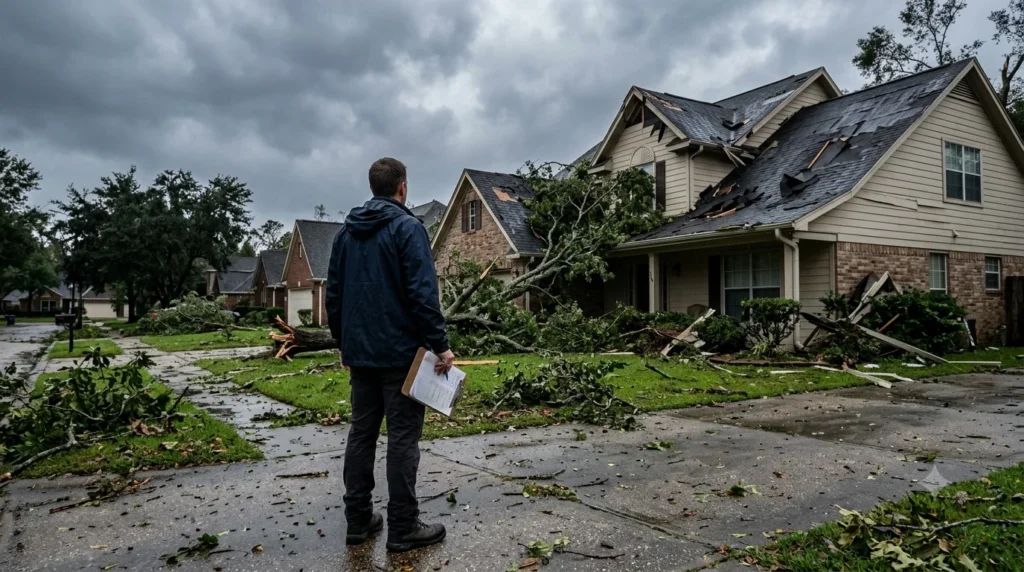
The storm has passed, but the damage is still staring back at you. Maybe it is a roof with shingles scattered across the yard, a ceiling stained and sagging from rain that poured in overnight, or a fence flattened against the neighbor’s property. Whatever you are looking at right now, it is normal to feel overwhelmed — and normal to wonder where you even begin.
You do not have to figure this out all at once. Filing a homeowners insurance claim after storm damage is a process, and like any process, it works best when you take it one step at a time. The most important thing to understand is that what you do in the next few days — how you document the damage, how you talk to your insurer, and what you do not sign — will shape how smoothly your claim goes and how much of your repair costs get covered.
This guide walks you through the entire journey: the critical first 48 hours, how to document damage so nothing gets missed, what your policy typically covers (and the exclusions that surprise people), how deductibles and payout calculations really work, how to handle the adjuster’s visit, and what to do if your claim is denied or comes back far lower than you expected. Take a breath. You have already started by reading this.
The First 48 Hours: What to Do Right Now
The hours right after a storm are chaotic. Your priority order matters: safety first, then protecting your home from further damage, then starting the claims process. Here is how to handle each.
Get everyone safe, then stop the bleeding
Before you touch anything, make sure it is safe to be in or around your home. Do not enter rooms with sagging ceilings, stay clear of downed power lines, and do not walk on a damaged roof yourself. If the structure looks unstable, stay out and call your local fire department or emergency services for guidance.
Once it is safe, your job is to prevent further damage — insurers expect this of you, and it is one of the most important things you can do for your claim. If the roof is breached, stretch a tarp over the opening. Cover broken windows with plywood or heavy plastic. Shut off the water if a pipe burst, and move undamaged belongings out of rooms where water is still coming in. These are temporary, protective measures, not permanent repairs.
Call your insurer before you do anything major
Contact your insurance company or agent as soon as you can — the same day if possible. The Insurance Information Institute advises policyholders to contact their agent or company immediately after a disaster, and to find out how long you have to file a claim, whether the damage exceeds your deductible, and how long processing will take. Most insurers have 24-hour claims lines and mobile apps that let you start a claim by uploading photos directly.
When you call, have your policy number ready and be prepared to describe the damage. The insurer will give you a claim number — write it down and keep it handy, because you will use it in every conversation from this point forward. Ask who your assigned claims adjuster will be, how you will hear from them, and whether you should get contractor estimates on your own or wait for the adjuster first. Write down the answers.
Make temporary repairs and keep every receipt
Temporary repairs are generally reimbursable under your policy, and saving the receipts is how you prove them. Buy tarps, plywood, plastic sheeting, and basic supplies as needed, and keep every receipt in your claim file. The Triple-I’s guide to settling insurance claims after a disaster notes that payments for temporary repairs are part of your total settlement — so if you spend a large sum on a temporary fix, it can reduce what is left for permanent repairs. Keep temporary work modest and focused on preventing further harm.
If you hire someone for emergency work, like a roofer to tarp a hole or a tree service to remove a limb from your house, get the agreement in writing and never pay the full amount up front. Be cautious of door-knocking contractors who show up right after a storm asking for a large deposit — that is a classic red flag.
What not to do in the first two days
Do not throw damaged items away before documenting them, even if they are ruined. Do not make extensive permanent repairs before the adjuster has seen the damage — the insurer needs to assess the loss as it happened. Do not sign any contract that assigns your insurance benefits to a contractor (sometimes called an assignment of benefits) without fully understanding what it means, because it hands control of your claim to someone else. And do not post about the damage on social media in a way that contradicts your claim; insurers do look.
Documenting Storm Damage Like a Professional
Documentation is the backbone of your claim. The more thoroughly you record the damage, the harder it is for anything to be overlooked or disputed later. Think of yourself as building a case file, one piece of evidence at a time.
Photograph and video everything before you clean up
Before you move, clean, or repair anything, photograph every area of damage from multiple angles: wide shots that show the whole room or roof section, medium shots of specific damage, and close-ups of details like cracked shingles, water lines on walls, or broken fixtures. Take video walkthroughs too, narrating what you are seeing and when the damage occurred. The Insurance Information Institute’s claims guidance emphasizes that thorough documentation — photos of the loss plus a written summary of exactly what happened — helps the adjuster assess the damage accurately.
Make sure your phone’s date and time stamp is turned on, and back up your photos somewhere safe, like cloud storage, in case your phone is lost or damaged. If you already cleaned up before photographing, do not panic — photograph what remains and write down what was removed and why.
Build a room-by-room inventory of damaged property
Walk through your home room by room and list every damaged or destroyed item: furniture, electronics, appliances, clothing, and anything else affected. For each item, note a description, the approximate age or purchase date, what you paid (if you remember), and what it would cost to repair or replace. This inventory becomes the basis for your personal property claim.
If the storm also damaged your car — a tree fell on it, or flooding reached it — that is a separate claim under your auto policy’s comprehensive coverage, not your homeowners policy. For a sense of how that process works, this explanation of how insurers value a totaled car walks through the valuation methods carriers use.
Save every receipt, estimate, and contract
Create a physical folder or a digital folder on your phone for everything related to the claim: temporary repair receipts, contractor estimates, hotel and meal receipts if you had to relocate, and any correspondence with your insurer. If your home is uninhabitable and you need to stay elsewhere, standard homeowners policies typically cover additional living expenses — but only the expenses you can prove, so keep every receipt.
Keep a written claim diary
Start a simple log with dates, names, and summaries of every conversation about your claim: the adjuster’s visit, phone calls with the insurer, contractor appointments. Note what was promised and by whom. If a dispute arises later, this diary becomes your record of what actually happened and when.
What Your Homeowners Policy Covers After a Storm (and What It Excludes)
Not all storm damage is treated the same by your policy. Understanding the basic coverage lines before the adjuster arrives will help you read the estimate with clear eyes.
Wind and hail damage: usually covered
Standard homeowners policies cover wind-related damage to your house, its roof, its contents, and other insured structures on the property. That includes damage from tornadoes, hurricanes, severe thunderstorms, and hail. According to the Insurance Information Institute, wind-driven rain that gets into the home because the wind damaged the structure is also covered — so if a storm tore off part of your roof and rain poured in through the opening, both the roof and the resulting interior water damage are typically part of the claim.
Water damage: the “from above” rule
Here is a distinction that trips up many homeowners: water damage from rain that enters through a storm-created opening (a hole in the roof, a broken window) is generally covered, but water that rises from the ground — flooding — is not. Sewer backups are usually excluded too, unless you purchased a specific endorsement. When you describe the damage to your insurer, be precise about how the water got in, because the source of the water determines whether it is covered.
Flood and storm surge: excluded without separate flood insurance
This is the exclusion that causes the most heartbreak after major storms. Standard homeowners and renters insurance policies do not cover flood damage, including damage from a storm surge, according to the Insurance Information Institute. Flood coverage requires a separate policy — either from the federal government’s National Flood Insurance Program (NFIP) or from a private flood insurer. If you live anywhere near a coast, a river, or a floodplain and you do not have flood insurance, this is worth addressing before the next storm season, not after.
Additional living expenses: help while your home is uninhabitable
If storm damage makes your home unsafe to live in, your policy’s loss-of-use coverage (also called additional living expenses, or ALE) pays the extra costs of living elsewhere while repairs are underway — hotel bills, restaurant meals, and similar expenses above what you would normally spend. Keep receipts for everything. ALE coverage does have limits, so check your policy for the cap and track your spending against it.
The Deductible That Catches Homeowners Off Guard
You probably know your standard deductible — the flat dollar amount, like $1,000, that you pay out of pocket before coverage kicks in. But after a hurricane or named storm, a very different deductible may apply, and it is much larger than most homeowners expect.
How percentage-based hurricane deductibles work
In many coastal states, homeowners policies include a separate hurricane or named-storm deductible that is calculated as a percentage of your home’s insured value rather than a flat dollar amount. These percentage deductibles typically range from 1% to 10% of the insured value, according to the National Association of Insurance Commissioners. So if your home is insured for $300,000 and your policy has a 5% hurricane deductible, you would owe $15,000 out of pocket before your insurer pays anything on a hurricane-related claim — compared to a $1,000 standard deductible for other losses.
Hurricane deductibles vs. named-storm deductibles
The two terms are not identical, and the difference matters. A hurricane deductible typically applies only when the National Weather Service or National Hurricane Center officially classifies the storm as a hurricane — meaning sustained winds of 74 mph or more. A named-storm deductible is broader: it applies to any storm the weather service has officially named, including tropical storms with winds of 39 mph or more. If a named tropical storm damages your roof but never reaches hurricane strength, a named-storm deductible would apply while a hurricane-only deductible would not — and your lower standard deductible would be used instead.
The states where these deductibles apply
According to the Insurance Information Institute, 19 states plus the District of Columbia allow hurricane or named-storm deductibles: Alabama, Connecticut, Delaware, Florida, Georgia, Hawaii, Louisiana, Maine, Maryland, Massachusetts, Mississippi, New Jersey, New York, North Carolina, Pennsylvania, Rhode Island, South Carolina, Texas, and Virginia, plus D.C. If you live in one of these states, check your policy’s declarations page now so you know which deductible would apply and what percentage it is.
Do the deductible math before you decide to file
Because hurricane deductibles are so large, some storm damage may cost less to repair than your deductible — in which case filing a claim gains you nothing but a claim on your record. Get a rough repair estimate first, compare it to your applicable deductible, and only file when the damage clearly exceeds what you would pay out of pocket.
Actual Cash Value vs. Replacement Cost: Why Your First Check Looks Small
One of the most confusing moments in the claims process is receiving the first settlement check and discovering it is far smaller than the contractor’s estimate. In most cases, this is not a mistake — it is how the payout math works.
The two numbers that shape your payout
Insurers value damaged property in one of two ways. Actual cash value (ACV) pays what the item was worth at the time of the loss — the replacement cost minus depreciation for age, wear, and condition. A 15-year-old roof is worth less than a brand-new one, so its ACV reflects that lost value. Replacement cost value (RCV) pays the full cost to repair or replace the property with new materials of like kind and quality, with no deduction for age or wear.
Which one applies to you depends on your policy. Many policies pay replacement cost for the dwelling but ACV for personal belongings unless you purchased a replacement-cost endorsement for contents.
Why the first check is smaller: recoverable depreciation
If your policy pays replacement cost, the insurer usually does not hand you the full amount up front. Instead, the first check covers the actual cash value, and the depreciation — the difference between ACV and replacement cost — is withheld as what the industry calls recoverable depreciation or a holdback. You get that withheld amount back after you complete the repairs and submit proof, such as invoices and receipts. This two-check system is designed to make sure the money is actually used for repairs.
How to claim your recoverable depreciation
Once repairs are finished, send your insurer the paid invoices and any required completion forms, and request release of the withheld depreciation. Pay attention to deadlines: many policies require you to complete repairs and claim the recoverable depreciation within a set window after the loss, which can be as short as six months to a year. Mark that deadline on your calendar the day you receive your first payment. If you miss it, you may forfeit the withheld amount entirely.
Contents coverage: check how your belongings are valued
Personal property is where ACV vs. replacement cost hits hardest. If your contents are covered at actual cash value, a five-year-old television will be valued far below what a new one costs. If you purchased replacement-cost coverage for your belongings, you can recover the difference — but again, usually only after you actually replace the items and submit receipts. Review your policy’s loss-settlement language so you know which standard applies before you negotiate.
Meeting the Insurance Adjuster: How to Get a Fair Assessment
The adjuster’s inspection is the single most important event in your claim. Their report becomes the foundation of your settlement, so preparation pays off.
What the adjuster actually does
An adjuster is a professional trained to assess damage, and their job is to determine what was damaged, what caused it, whether your policy covers it, and what it will cost to repair. They will photograph the damage, take measurements, and may use estimating software to price the repairs. Remember that the adjuster works for the insurance company — most are honest professionals, but their estimate is the insurer’s starting position, not the final word.
Preparing for the visit
Before the adjuster arrives, have your documentation organized: your photos and videos, your room-by-room inventory, any contractor estimates you have obtained, and receipts for temporary repairs. Get at least one detailed written estimate from a licensed contractor that lists proposed repairs, repair costs, and replacement prices — the Insurance Information Institute specifically recommends this. A contractor’s line-item estimate gives you something concrete to compare against the adjuster’s numbers.
Walking the damage with the adjuster
Be present for the inspection and walk through the damage together. Point out everything, including damage the adjuster might miss — water stains inside closets, cracked siding on the far side of the house, damage to detached structures like sheds and fences. Be polite, factual, and thorough. Answer questions honestly, but do not speculate about causes you are unsure of. Take your own notes during the visit, and if you can, have your contractor present as well. For more on the human side of this conversation, these tips on how to negotiate with an insurance adjuster cover principles that apply to property claims just as well as auto claims.
After the inspection: review the estimate carefully
Once the adjuster submits their report, your insurer will send you a settlement offer with an itemized estimate. Compare it line by line against your contractor’s estimate and your own documentation. Look for missing items, underpriced labor, or damage the adjuster never addressed. You have the right to question anything that looks wrong — and to learn how long your insurance company has to settle your claim in your state, so you know when a delay becomes unreasonable.
What to Do If Your Claim Is Denied or Underpaid
A denial letter or a lowball offer is not the end of the road. Many denied or underpaid claims get reversed once the homeowner pushes back with better documentation. Here is how to fight back, step by step.
Read the denial letter word by word
Your insurer is required to explain why it denied your claim or paid less than you expected. Read the letter carefully and match each reason against your actual policy language. Common denial reasons include: the damage is excluded (often flood or wear and tear), the damage is below your deductible, the insurer believes the damage predates the storm, or you missed a filing deadline. Understanding the stated reason tells you exactly what you need to challenge.
Ask for a reconsideration with better documentation
If the denial rests on facts you can dispute — for example, the insurer says your roof was already worn out, but you have photos from before the storm showing it intact — gather that evidence and submit a written request for reconsideration. Be specific: reference the denial letter’s reasons, attach your photos, contractor estimates, and any expert opinions, and ask the insurer to re-inspect if appropriate. Keep copies of everything and send important correspondence in a way you can track.
Get an independent estimate or hire a public adjuster
If your contractor’s estimate is far higher than the insurer’s, a second independent estimate strengthens your position. For larger disputes, you can hire a public adjuster — a licensed professional who works for you, not the insurer, and re-evaluates the damage. Public adjusters typically charge a percentage of the final settlement, so weigh the cost against the size of the dispute. Understanding why insurance companies deny claims and how to fight back can also help you recognize the tactics carriers use to minimize payouts.
File a complaint or talk to an attorney
If the insurer will not budge, you have outside options. Every state has a department of insurance that accepts consumer complaints, and regulators do investigate patterns of unfair claim handling. If your insurer is acting in bad faith — unreasonably delaying, misrepresenting your policy, or refusing to investigate — learn how to fight back when your insurer acts unfairly, because bad faith conduct can give rise to legal claims beyond the policy itself. For significant disputes, a consultation with an attorney who handles property insurance claims is worth the time; many offer free initial reviews.
And if the storm was part of a presidentially declared disaster and your insurance falls short, you may qualify for federal help. Learn how to apply for FEMA disaster assistance on USAGov — you must file your insurance claim first, then submit your settlement or denial letter to FEMA. Low-interest SBA disaster loans for home repairs are also available to homeowners in declared disaster areas.
Coverage Comparisons at a Glance
Insurance language is full of pairs that sound similar but work very differently. Use this table as a quick reference while you read your own policy.
| Topic | Option A | Option B |
|---|---|---|
| Policy form | HO-3 (Special Form): the most common homeowners policy. Covers the dwelling on an open-perils basis (everything except listed exclusions), but personal belongings only on a named-perils basis. | HO-5 (Comprehensive Form): broader coverage. Covers both the dwelling and personal belongings on an open-perils basis, and typically pays contents at replacement cost. Costs more than HO-3. |
| Payout method | Actual cash value: pays what the item was worth at the time of loss — replacement cost minus depreciation for age and wear. First checks are often ACV. | Replacement cost: pays the full cost to repair or replace with new materials of like kind and quality, with no depreciation deduction. Withheld depreciation is recoverable after repairs are completed. |
| Water peril | Wind/hail: covered under standard homeowners policies, including wind-driven rain that enters through storm-created openings. | Flood/storm surge: excluded from standard policies. Requires a separate NFIP or private flood insurance policy. |
| Deductible type | Standard deductible: a flat dollar amount (often $500–$2,500) that applies to most covered losses like fire or theft. | Hurricane/named-storm deductible: a percentage of the insured home value (typically 1–10%), applying in 19 states plus D.C. when the triggering storm type causes the damage. |
Key Takeaway
Filing a homeowners insurance claim after storm damage comes down to a few fundamentals: act quickly but carefully in the first 48 hours, document everything before you clean up, understand the difference between what your policy covers and what it excludes, and read every number on the adjuster’s estimate before you accept it. The process rewards the organized and the patient. Keep your receipts, keep your diary, meet every deadline, and do not be afraid to push back when an offer does not match the damage in front of you. You paid for this coverage — now make it work for you.
Frequently Asked Questions
How soon after storm damage should I file my homeowners insurance claim?
Contact your insurer as soon as possible — ideally the same day you discover the damage. Most policies place a time limit on filing claims, and waiting too long can give the insurer grounds to deny your claim. Even if you are still assessing the full extent of the damage, you can open the claim now and add documentation as you gather it.
Will my homeowners insurance cover roof damage from a storm?
In most cases, yes. Standard homeowners policies cover wind and hail damage to your roof, which are the most common causes of storm-related roof losses. The payout will depend on whether your policy pays actual cash value or replacement cost, and on your deductible. Damage from long-term wear, neglect, or poor maintenance, however, is not covered.
Does homeowners insurance cover flooding from a storm?
No — standard homeowners policies exclude flood damage, including storm surge and rising water from heavy rain. Flood coverage requires a separate policy from the National Flood Insurance Program or a private flood insurer. This is one of the most common and painful coverage gaps homeowners discover after a major storm.
What is the difference between a hurricane deductible and my regular deductible?
Your regular deductible is a flat dollar amount that applies to most claims. A hurricane or named-storm deductible is a separate, percentage-based deductible — typically 1% to 10% of your home’s insured value — that applies only to damage from qualifying storms in the 19 states plus D.C. where insurers use them. On a $300,000 home with a 5% hurricane deductible, you would owe $15,000 before coverage begins.
Why was my first settlement check so much smaller than the repair estimate?
This is usually recoverable depreciation at work. If your policy pays replacement cost, the insurer first pays the actual cash value (replacement cost minus depreciation) and withholds the rest. You can recover the withheld amount after completing repairs and submitting proof such as paid invoices. Check your policy for the deadline to claim it.
Should I get my own contractor estimate before the adjuster visits?
Yes. A detailed, line-item estimate from a licensed contractor gives you a baseline to compare against the adjuster’s numbers and helps you spot anything the adjuster missed or underpriced. The Insurance Information Institute specifically recommends securing a detailed estimate for permanent repairs and sharing it with the adjuster.
Can I make repairs before the insurance adjuster inspects the damage?
You should make temporary repairs to prevent further damage — tarping a roof, boarding windows — and keep all receipts. But do not make extensive permanent repairs before the adjuster has assessed the damage, because the insurer needs to see the loss as it happened. If emergency permanent work is truly unavoidable, photograph everything first and keep detailed records.
What should I do if my storm damage claim is denied?
Read the denial letter carefully and match each stated reason against your policy language. Then submit a written request for reconsideration with supporting evidence — photos, contractor estimates, and anything that contradicts the denial reason. If that fails, consider a public adjuster, file a complaint with your state’s department of insurance, or consult a property insurance attorney.
Does homeowners insurance pay for a hotel while my home is being repaired?
Usually, yes, through your policy’s additional living expenses (loss of use) coverage, as long as the damage was caused by a covered peril and the home is uninhabitable. It covers the extra costs of living elsewhere — hotel bills, meals, and similar expenses above your normal spending. Keep every receipt, and check your policy for the coverage limit.
What if my insurance payout is not enough to cover all the repairs?
First, challenge the estimate with your own contractor’s numbers and documentation — underpaid claims are often revised upward on appeal. If the storm was part of a presidentially declared disaster, you may also qualify for FEMA assistance for uninsured losses or a low-interest SBA disaster loan for home repairs. You must file your insurance claim first and provide FEMA with your settlement or denial letter.
Disclaimer: This article provides general information for educational purposes only and is not legal advice. Policy terms, deductibles, filing deadlines, and coverage rules differ from state to state and from insurer to insurer, so always read your own policy and confirm the details that apply to you. For guidance about your specific situation, consult a licensed attorney in your state.